
By-election update: Seat polls, splitters and Scotland
Burnham looks to be ahead going into the final days, but an upset can't be discounted

There are just three days to go until the polls open in Makerfield, and we know now a bit more about the lay of the land. The highest profile by-election in living memory has attracted plenty of attention from pollsters: five polls from four different firms have been published so far, with time yet for more to arrive.
Seat polling: Advantage Andy?
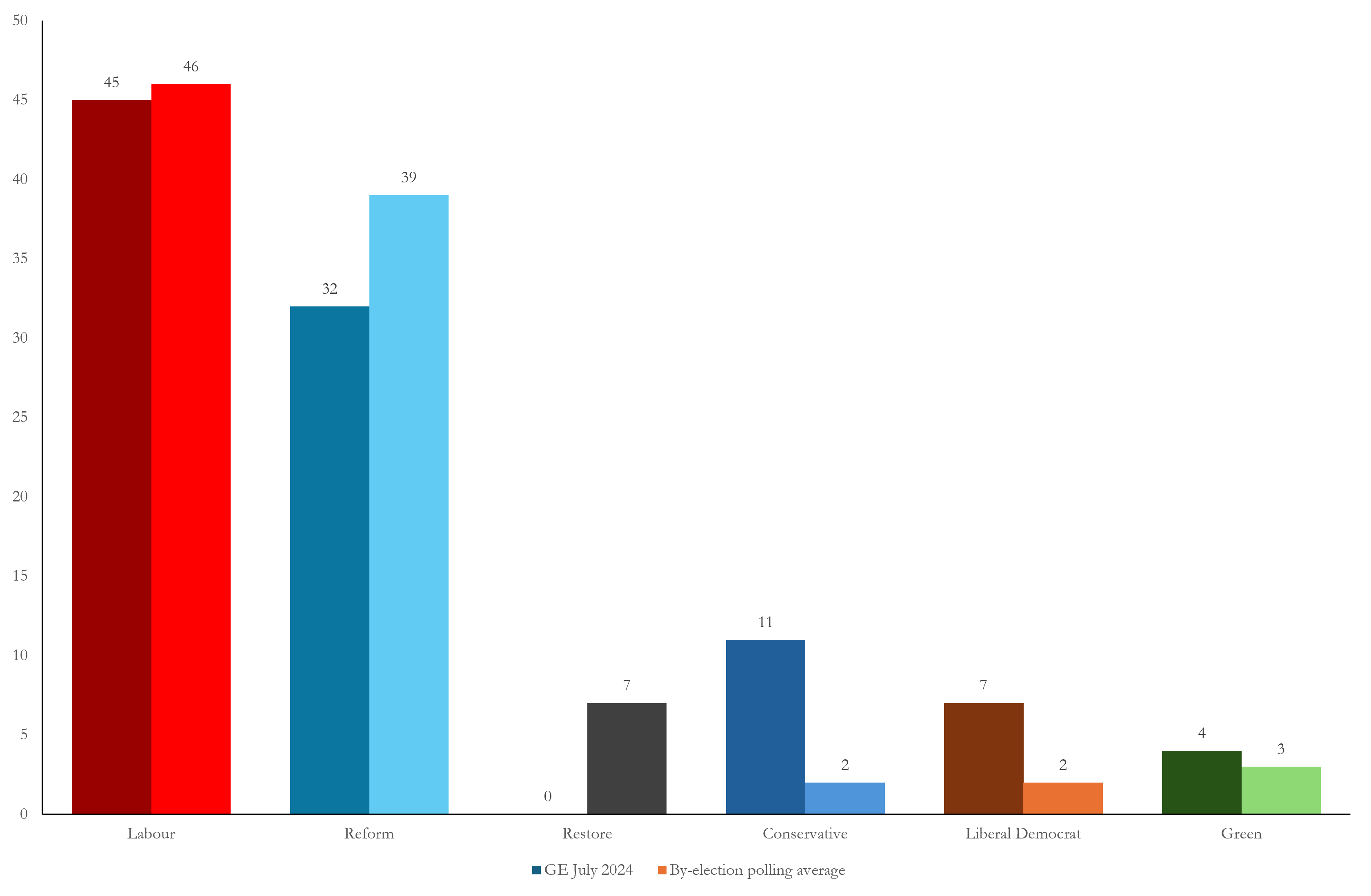
The polls to date have all painted a pretty similar picture of the race: Burnham ahead, but not by much; Reform up on the general election, but not by enough; Tory, Lib Dems and Greens squeezed hard; and a substantial vote share for the far right newcomer Restore Britain. The seat poll average shares put Labour on 46%, marginally better than their share in July 2024, while Reform are on 39, up 7 on the general election. Labour’s average lead of seven points matches the average share currently going to Restore Britain, generating Reform anxities that a “split right” will hand the seat to Burnham. The Conservatives (down from 11 to 2), Liberal Democrats (down from 7 to 2) and Greens (down from 4 to 3) all look set to lose their deposits on Thursday.
Makerfield general election vote shares (darker bars) and average by-election shares across five polls (light bars)
The first two polls, published a week apart at the start of the race, were conducted using phone interviewing by Survation. The first Survation poll, fielded 18-22 May, had Labour up by just 3 points on Reform (43-40). In the second poll, with fieldwork from 26 May to 1st June, this lead grew to 10 points (49-39).
Three more polls appeared last weekend, all with fieldwork conducted mainly over the first ten days of June. More in Common (fieldwork 28 May - 12 June) had Labour five points ahead (45-40), Opinium (fieldwork 3-11 June) also had Labour five ahead (46-41) while Convergent Opinion have a larger Labour lead of 12 points (49-37), while also reporting a lower share for Restore and a higher share for the Greens than other pollsters.1
When we consider both the national polling picture and the recent local election results, it is pretty remarkable for Labour to be consistently ahead in the seat polling, and on an increased vote share from 2024.2 Current national polling shows a 14 point swing from Labour to Reform, while there was an average 31 point Labour to Reform swing from May 2024 to May 2026 in the eight wards making up the bulk of the Makerfield electorate. By contrast, the average Labour to Reform swing in the five Makerfield by-election polls to date is just three points.
Labour to Reform swing 2024-26 in current national Westminster polling, local elections in the Makerfield wards, and in Makerfield constituency polling
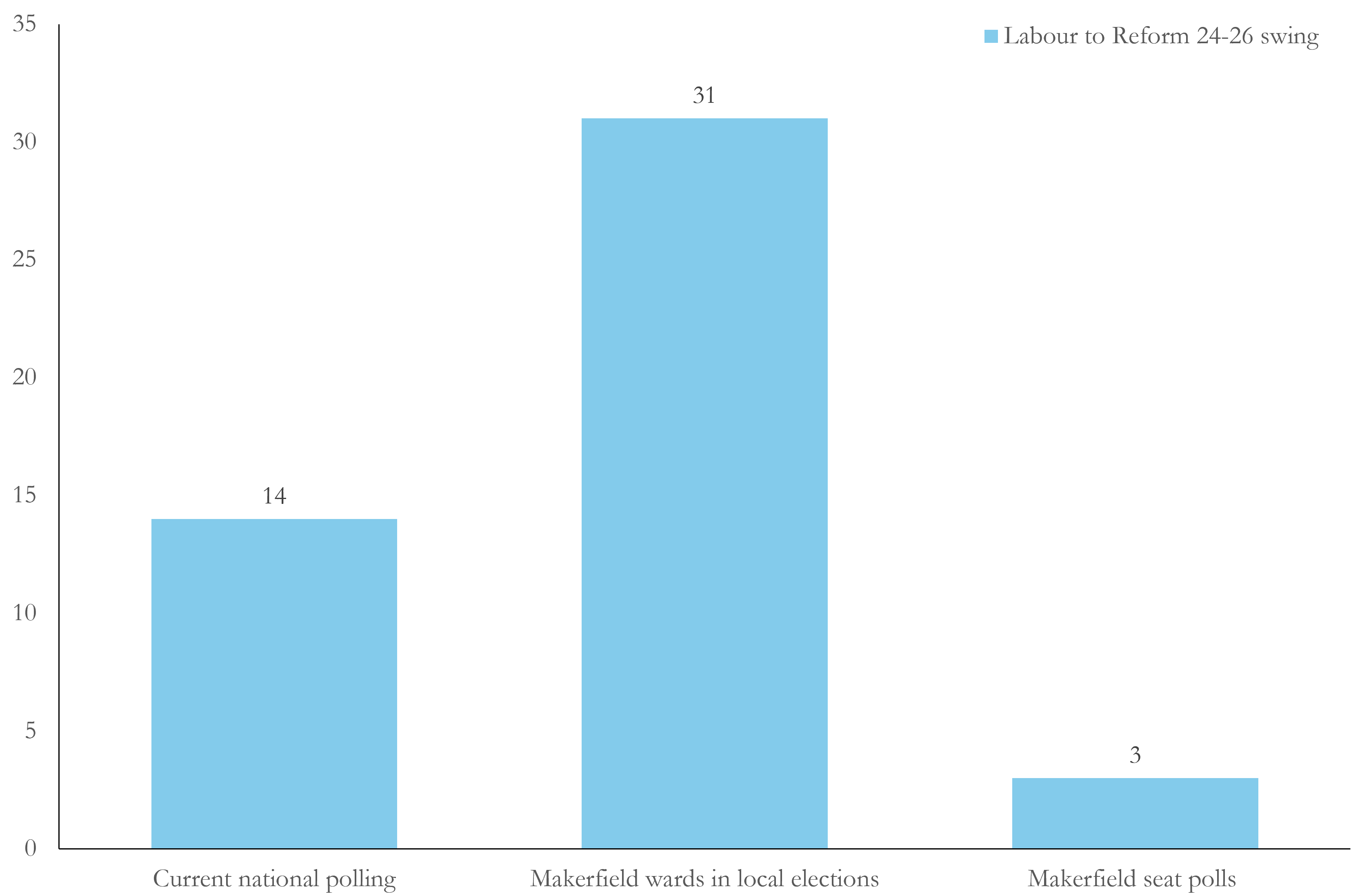
Makerfield wards swing is the average swing from the 2024 local elections to the 2026 local elections across the eight wards which are wholly or nearly wholly in Makerfield constituency: Abram, Ashton-in-Makerfield, Bryn with Ashton North, Hindley, Hindley Green (91% in Makerfield), Orrell, Winstanley and Worsley Mesnes
A Burnham effect?
The obvious explanation for Labour’s remarkable resilience is the identity of the Labour candidate, and the resulting nature of the race. Andy Burnham is a very popular local Labour politician running for Westminster in order, everyone expects, to challenge the very unpopular Labour Prime Minister who has presided over his party’s polling collapse. It seems a reasonable theory that Burnham will run ahead of his party, either because voters like him personally, or because they see him as the best option to “get Starmer out.”
Evidence from the seat polls points to a substantial Burnham effect. The first Survation poll and the Opinium poll both have general election vote intention questions. Reform were ahead in Makerfield on this question in both polls - leading 45-34 with Survation and 42-34 with Opinium. Both these polls suggest the presence of Burnham on the ballot generates about a 6-7 point net swing from Reform to Labour, enough to switch the seat from a Reform gain to a Labour hold. A look at the polling cross-tabs suggests, while Burnham wins over a small slice of Reform voters, this swing is mainly coming from a squeeze on Lib Dem and Green voters, though with substantial numbers of Tories backing Burnham too.
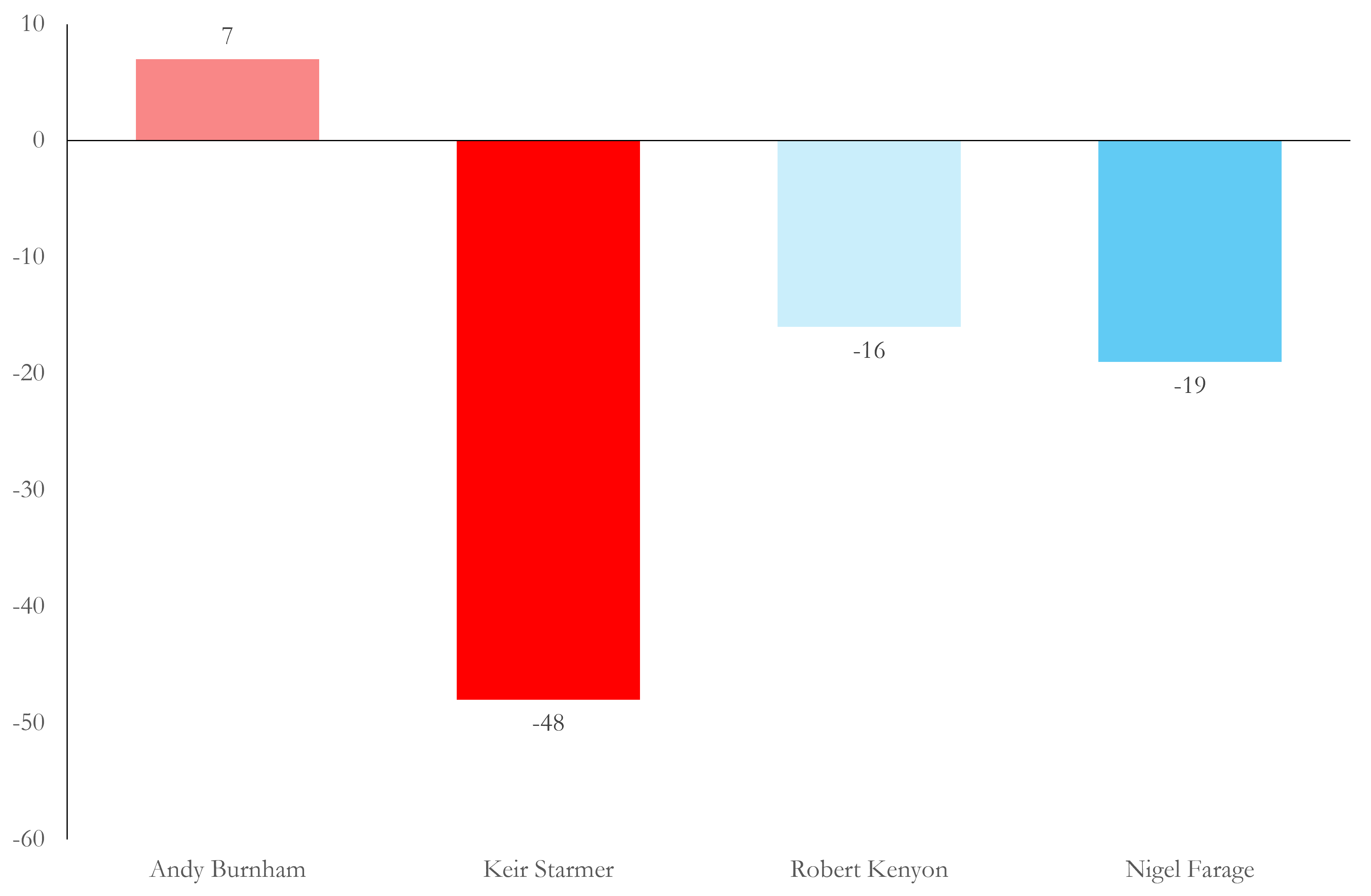
More In Common also asked voters what they thought of the candidates and their party leaders. Here, too, we can see evidence of a big Burnham effect: Burnham has a net approval among Makerfield voters of +7, ahead of both the Reform candidate and leader, and miles ahead of Labour leader Keir Starmer, who Makerfield voters give a dismal -48. Voters in Makerfield clearly draw a sharp positive contrast between the local Labour candidate and the party leader, something they don’t do with Reform - local candidate Robert Kenyon has a more or less identical rating as party leader Nigel Farage (-16 vs -19).
Makerfield approval ratings of the main candidates and their party leaders
Will the polls be accurate? Evidence from other recent by-elections
All five polls point to a narrow Burnham win, but seat polling is a difficult business, so we may wonder how secure such a lead really is. There is some evidence from three other recent by-elections which feature constituency polling. The accuracy of the seat polls in those cases is set out below. In Runcorn and Helsby the two seat polls correctly projected a Reform win and got the vote share almost right, but both pollsters substantially underestimated Labour’s strength in a contest which ended up in a photo finish. In the Caerphilly Senedd by-election, the only seat poll got the winner wrong, projecting a four point Reform win in a contest which Plaid Cymru ended up winning by 11. In Gorton and Denton both polls published towards the end of the race got the outcome (sort of) right - one projected a narrow Green win, the other a tie between the Greens and Labour. But both polls greatly underestimated the Green share and margin of victory, while overestimating both Labour and the also-ran parties.
Seat poll averages and election results in three recent by-elections
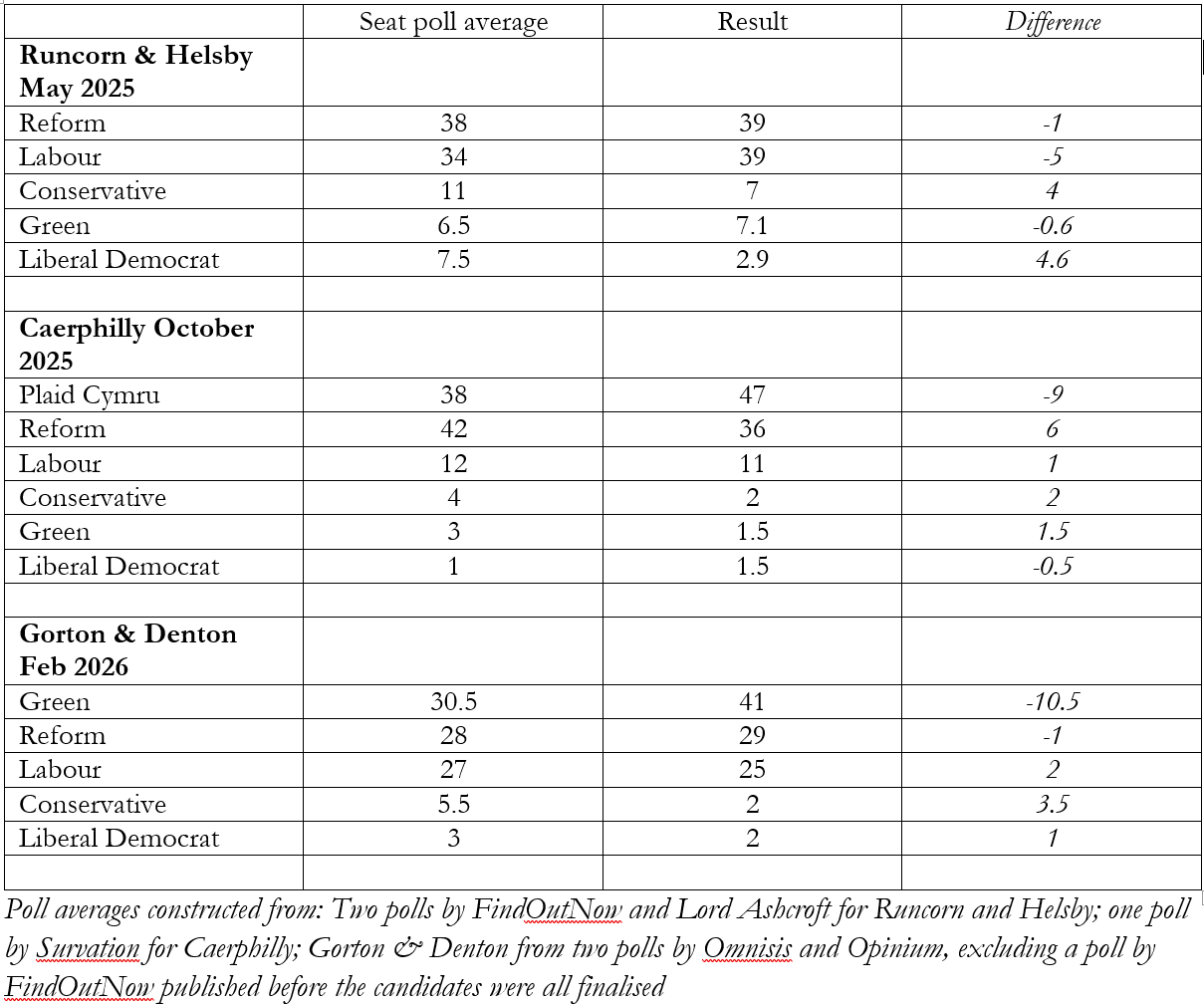
These results can be read several ways. They suggest a miss large enough to change the outcome is plausible - at least one party’s vote share estimate was out by five points or more in each of these contests. Errors of around that size on Labour and Reform shares could be enough to wipe out Burnham’s narrow lead. What will give Labour campaigners initial heart is that in none of the three previous by-elections this Parliament was Reform substantially underestimated by pollster. In two cases the Reform figure was bang on while in the third (Caerphilly) Reform strength was overstated, and ended up second in a seat they were projected to win. Reform campaigners might respond that the two most recent contests have both seen the main challenger to a Labour candidate substantially outperform their polling, and in Makerfield Reform are the main challenger to Labour.
Labour campaigners can retort in turn that Plaid in Caerphilly and the Greens in Gorton both benefitted from tactical votes because they were seen as the best placed anti-Reform candidate on the ballot - and in Makerfield that mantle clearly belongs to Andy Burnham. But in the two earlier contests, the squeezable third party vote came mainly from left bloc parties, while Makerfield polling suggests the biggest third party vote now available belongs to Restore Britain - a party attacking Reform from the right. Much may thus depend on the behaviour of Restore voters - pollsters underestimated tactical voting in earlier contests, but are Restore voters perhaps more resistant to squeeze arguments? A dig into the electoral history of Makerfield suggests there might be a substantial electorate more receptive to Restore than Reform in at least some of Makerfield’s wards.
Revolt on the (far) right: Makerfield, Restore and the BNP
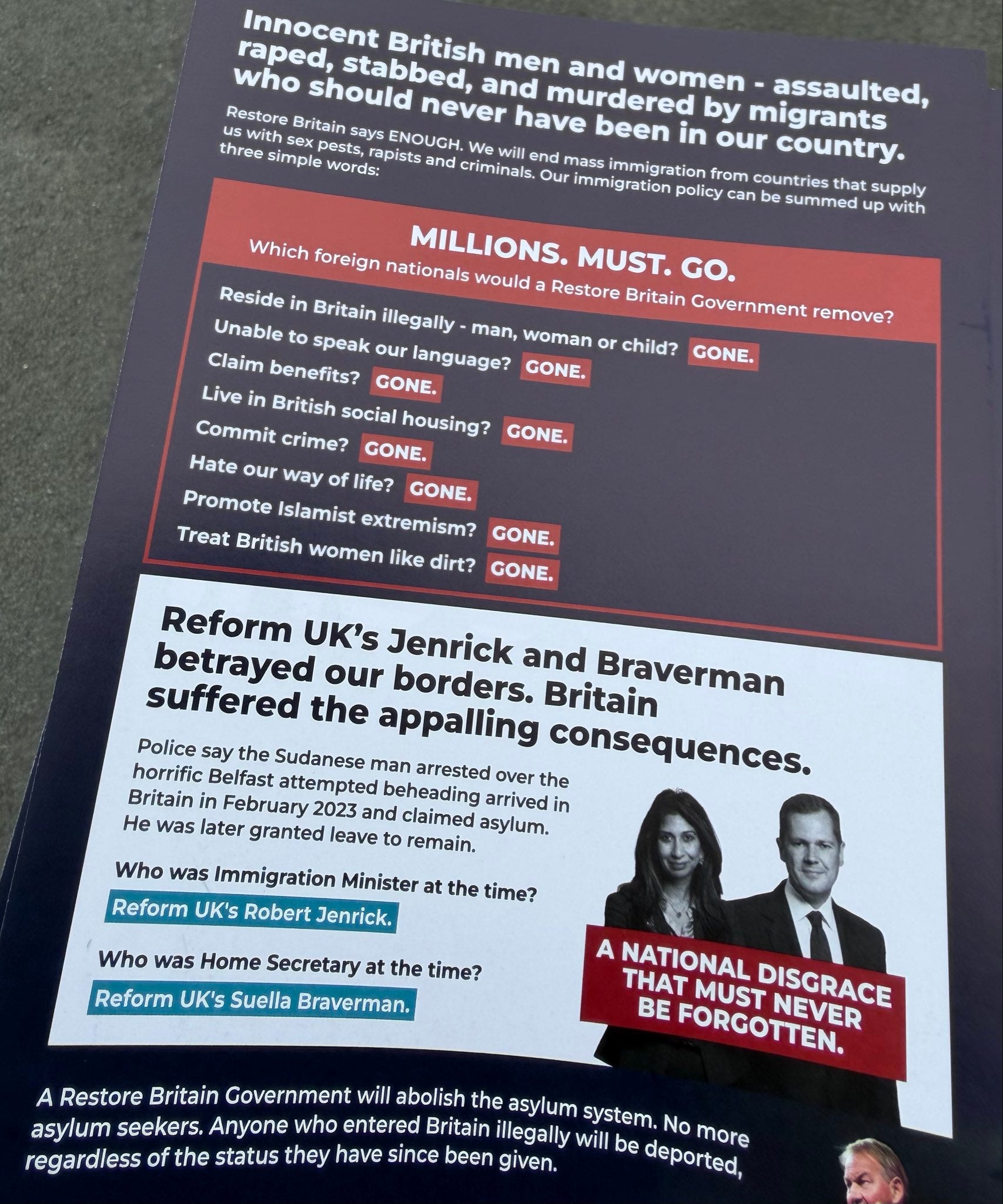
Restore were founded by former Reform UK MP Rupert Lowe just a few months ago. They have never contested a by-election before. Lowe makes no secret of his personal hostilty to Farage, having fallen out with the Reform leader within months of being elected under Reform colours, and attacks on Reform UK feature heavily in Restore’s Makerfield campaign material (see leaflet above).
Restore Britain’s flagship policy is mass deportation of settled migrants - though its official policy documents focus on criminals and others posing a threat to public safety, party leader Lowe’s Twitter posts - heavily promoted by Twitter owner Elon Musk - frame the issue much more expansively (see below), as do party campaign leaflets. The Makerfield leaflet above is headlined “Millions. Must. Go.”
Recent Tweets by Restore Britain leader Rupert Lowe
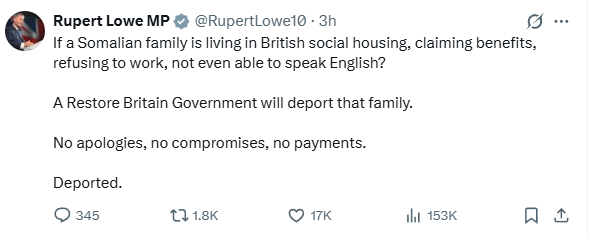
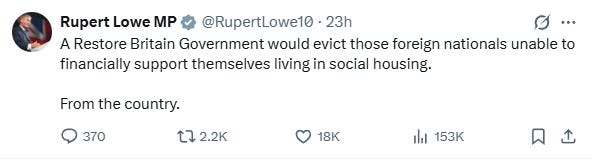
Both the ethnic nationalist language and extreme mass deportation proposals of Restore Britain most closely resemble parties of the far right, in particular the British National Party, who rose to some prominence under Nick Griffin in the 2000s, winning over half a million votes in the 2010 general election before disintegrating soon afterwards. One of the places where the BNP’s message found a substantial audience was Makerfield. The BNP first stood a candidate in the area in the 2002 local elections, winning 23% in Abram ward, where BNP candidates would appear every year but one for the next decade. The BNP also featured regularly in Orrell ward (every year from 2003-10) and Bryn ward (2006-10), and the party fielded candidates in all wards but one in the 2010 local elections.
The BNP consistently won an average of about 10% of the vote in the wards where it stood local election canddiates, and did even better in the European Parliament election of 2009, when nearly 12% of Wigan voters backed BNP leader Nick Griffin’s successful bid to become an MEP from the North West of England. The BNP won 7.4% of the vote in Makerfield in the 2010 general election, finishing fifth.
BNP electoral performance in Makerfield/Wigan 2005-10
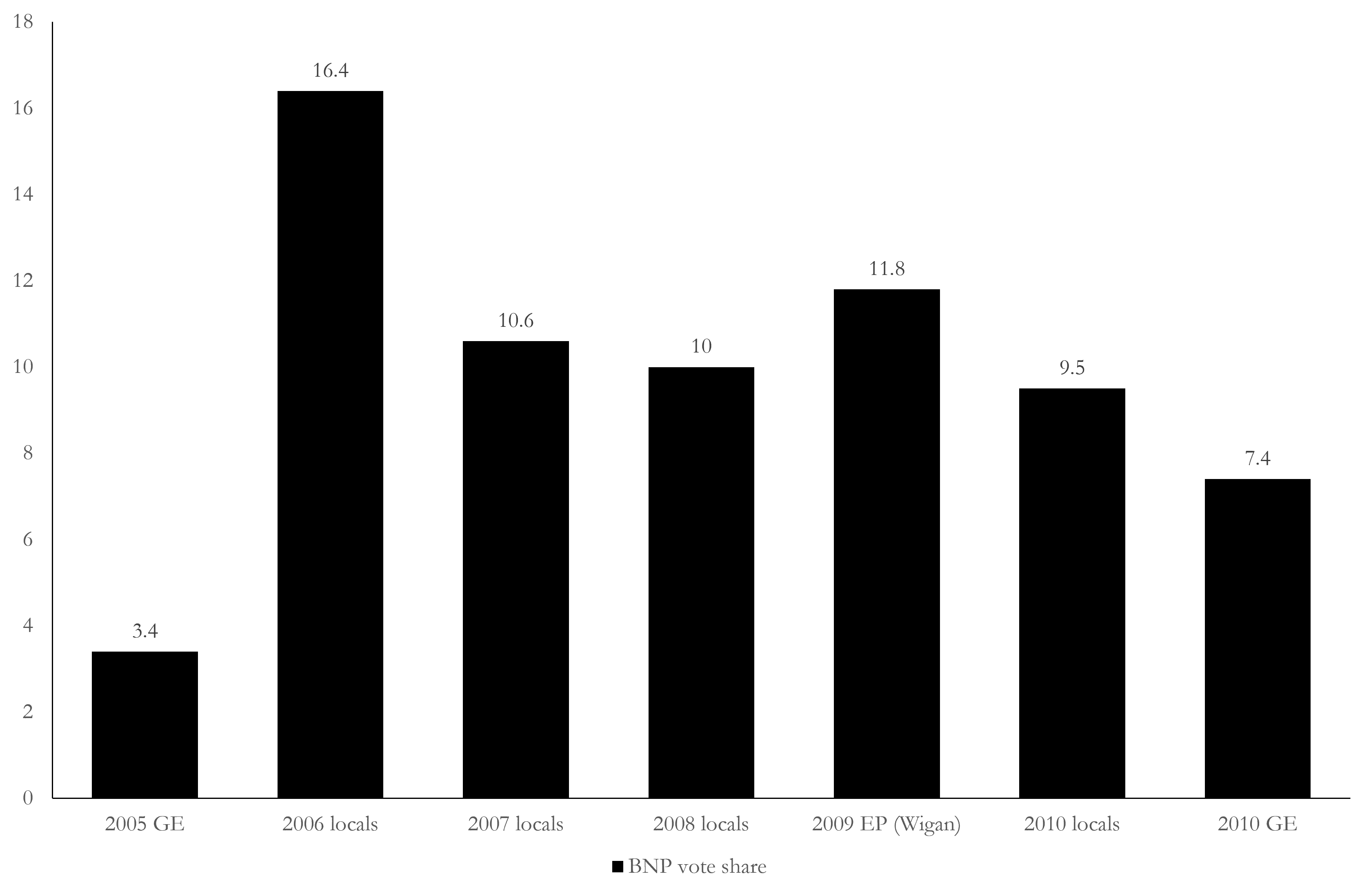
Local election figures are average vote shares in the wards where the BNP stood candidates: three wards in 2006, four in 2007, three in 2008 and seven in 2010.
Makerfield thus has recent experience with far right political campaigning, and some Makerfield voters, particularly in the wards of Abram, Bryn and Orrell, have cast ballots for the far right before. While the cross-break sample sizes are very small, both the Survation and Opinium polls suggest Restore Britain is doing best in these very same wards, which are also stronger for Reform. The potential for a substantial far right vote on Thursday is clear in both electoral history and current polling.
However, while Reform look like the obvious alternative for voters attracted by Lowe’s message, we cannot be sure how many Restore voters would back Reform is Restore were not available. Though they had clear overlaps, the demographics and attitudes of UKIP voters and BNP voters in the 2000s were quite different, and some BNP voters were (and likely still are) deeply alienated people with extreme views unwilling to back UKIP, perceived as insufficiently hardline. I suspect something similar may be true for Reform and Restore. This will be cold comfort though for disappointed Reform supporters if it looks like Restore votes have stood between them and a historic by-election giant killing. We can expect further furious rows on the right if that scenario comes to pass on Friday morning.
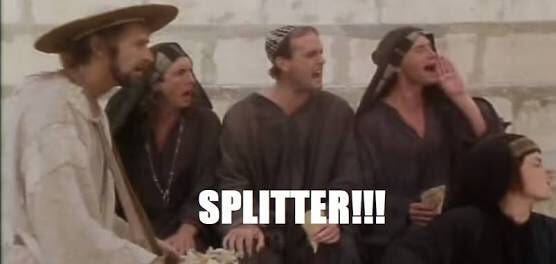
Reform UK activists offer their views on Rupert Lowe
Looking (further) North: Two by-elections in Scotland
Though it has won the lion’s share of political and media attention given the extraordinary circumstances, Makerfield is not the only constituency holding a by-election this week. There are also two contests in Scotland, occasioned by the departure of SNP politicians Stephen Gethins and Stephen Flynn, who both won seats in the new Scottish Parliament and are resigning their Westminster seats to take up their mandates in Holyrood.
Gethins’ former seat, Arbroath & Broughty Ferry is on paper the more marginal contest, but in practice is likely to be the easier hold for the SNP. The SNP narrowly held off a surging Scottish Labour in this new seat in 2024, but this seat is located in the suburbs of Dundee, an area of longstanding SNP strength. Both of the constituency’s predecessors (Dundee East and Angus) returned SNP MPs for decades prior to their abolition, and with Scottish Labour’s brief bubble now well and truly burst anything other than a comfortable hold on a much increased majority will be a disappointment for the SNP.
The second seat of Aberdeen South is more intriguing. This seat takes in some of the most affluent suburbs in Scotland, plus the city centre of Aberdeen, the heart of the Scottish oil and gas industry. Aberdeen South was once a Conservative stronghold, returning Tory MPs with just one interruption from 1918 to 1987, and then returned a Labour MP (Ann Begg) for 28 years from 1997. The SNP only won the seat for the first time in 2015, when Begg was one of many Scottish Labour politicians swept away in the post independence referendum tsunami, and they lost it again two years later when the Conservatives took the seat back for the first time since 1992. Stephen Flynn recovered the seat in 2019, but it was a close run thing, and the defeated Conservative candidate from that year, Douglas Lumsden, is running again this year.
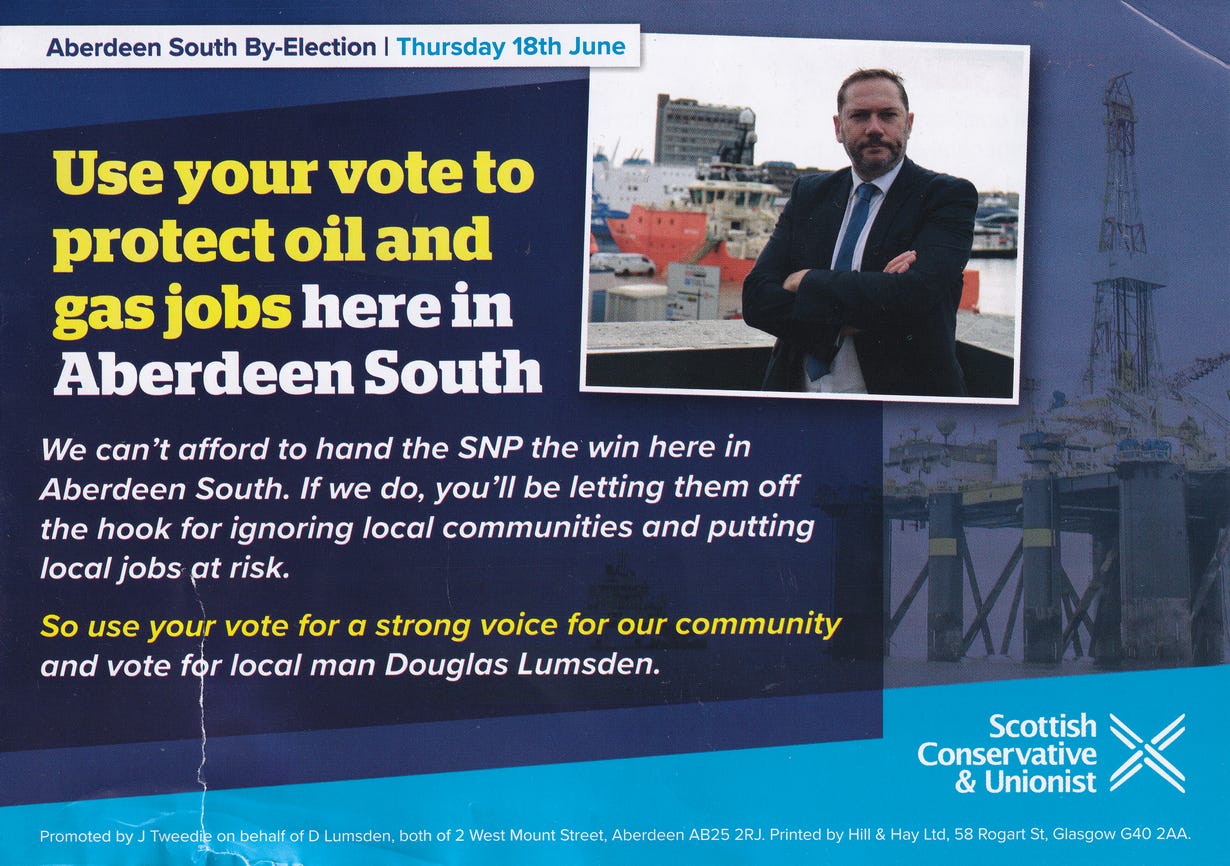
A local man protecting local jobs for local people
The Conservative leadership have been bullish about their prospects in the seat, believing they can channel local disgruntlement about the perceived indifference of both Westminster and Holyrood to the plight of the declining oil and gas sector, a source of a great deal of local anxiety. Such an outcome cannot be ruled out - though they start in third place, the Conservatives have picked a well known local candidate (Lumsden has been an MSP for the area since 2021) and the SNP’s star has been fading. The SNP’s overall vote was down sharply in last month’s Scottish Parliament elections, but a divided unionist opposition helped it retain many seats despite large vote losses.
If the Scottish Conservatives can convince sufficient local voters to treat the by-election as a protest vote against the SNP, they might be able to score a coup here despite their continuing national struggles. In Aberdeen, as elsewhere, the main obstacle the Tories must overcome is Reform, who have been surging in Scotland as elsewhere.
A Tory gain in Aberdeen paired with a Labour hold in Makerfield would be a remarkable result indeed after nearly two years of unremitting misery for both traditional governing parties in both polls and elections, leading to growing speculation that the traditional parties might be on the way out. By this weekend, a path to renewal may open up for the long struggling Labour government while a long marginalised Conservative opposition may have an unfamiliar spring in its step. Perhaps there is life in both the old dogs yet?
Convergent are a new polling firm founded by Dylan Spielman and Fintan Smith, both former members of the polling and data analysis team who informed Labour’s 2024 campaign. We should not assume, however, that the founders’ past links to Labour are the reason for a more Labour friendly polling number - as a new pollster seeking to establish its reputation, Convergent have more at stake than more established firms.
It is very rare for governing parties to increase their vote share in by-elections. The last time this happened was in Hartlepool in 2021, when the Conservatives under Boris Johnson benefitted from the collapse of the Brexit party vote, and took the seat from Labour, a result which nearly triggered the resignation of Keir Starmer one year into his time as Labour leader. The Labour vote only went up four times in by-elections held during the previous Labour governments of 1997-2010 - two of those were withing six months of the 1997 election (at the peak of Tony Blair’s long polling and electoral honeymoon) and one was an increase of just 0.1%. The most recent instance of Labour increasing its vote share in a by-election while in office was Glenrothes in November 2008 (though Labour’s vote share increased, there was a swing to the SNP local opposition in that contest, as the SNP’s vote rose more).
Thanks for this! The cross-tabs on the GE question are interesting: Reform leading 42–34, suggesting Labour’s underlying brand weakness persists even while Burnham outperforms it locally. That gap underlines how candidate-specific this contest has become. Labour is effectively winning off a personal vote, temporarily masking broader fragmentation.
I wonder whether this kind of effect is specific to high-salience by-elections, or if it reflects a deeper shift in UK voting behaviour where party cues are weakening relative to personalities and perceived competence. Reform’s 2024 rise was also heavily anchored in Farage’s personal appeal rather than party brand strength, so Burnham may not be exceptional so much as another version of the same phenomenon. The real question is whether this is becoming structurally dominant, or still largely confined to periods and contests where party cues are already weakened.
I find your analyses excellent; they are clear and they are objective. Many thanks. PS are you on Bluesky?