
Five lessons from the Caerphilly by-election
Politics is changing at a dizzying pace

(1) Plaid in Pole Position
Persistance pays off. Plaid Cymru’s candidate for Caerphilly, Lindsay Whittle, has stood as the Plaid candidate for the seat in every Senedd election since its establishment in 1999, and in every Westminster election since 1983. Thirteen times he fell short. Fourteenth time’s the charm. Whittle’s emphatic win for Plaid Cymru, with a 19 point increase in vote share, was one of the strongest performances ever for the Welsh nationalist party in either Senedd or Westminster constituency by-elections, as the graph below illustrates. Plaid Cymru’s 47.4% share of the vote is their second best performance in any Senedd or Westminster by-election since 1945, and their best ever outside the party’s hearlands in the north and west of Wales, where Welsh speakers congregate. Only current party leader Rhun ap Iorwerth has done better, winning 58.2% of the vote in a 2013 by-election in Ynys Mon, where more than half the population speak Welsh. The 19 point increase in Plaid’s vote is also the party’s biggest gain in a Welsh by-election for nearly half a century, and comes from a higher base than many of the party’s earlier breakthroughs.
By coincidence, the last time Plaid combined a 40% plus vote share with a 20 point plus increase in the vote also came in Caerphilly in 1968, when the party was riding a wave following its first ever Westminster success, winning Carmarthen in 1966. Four of the five biggest increases in Plaid Cymru support came between 1966 and 1972. The Welsh nationalists will be hoping last week’s gain signals another wave coming their way in Senedd elections next May, one which may sweep them into power in the devolved Welsh government.
Best ever performances by Plaid Cymru in Senedd and Westminster by-elections since 1945
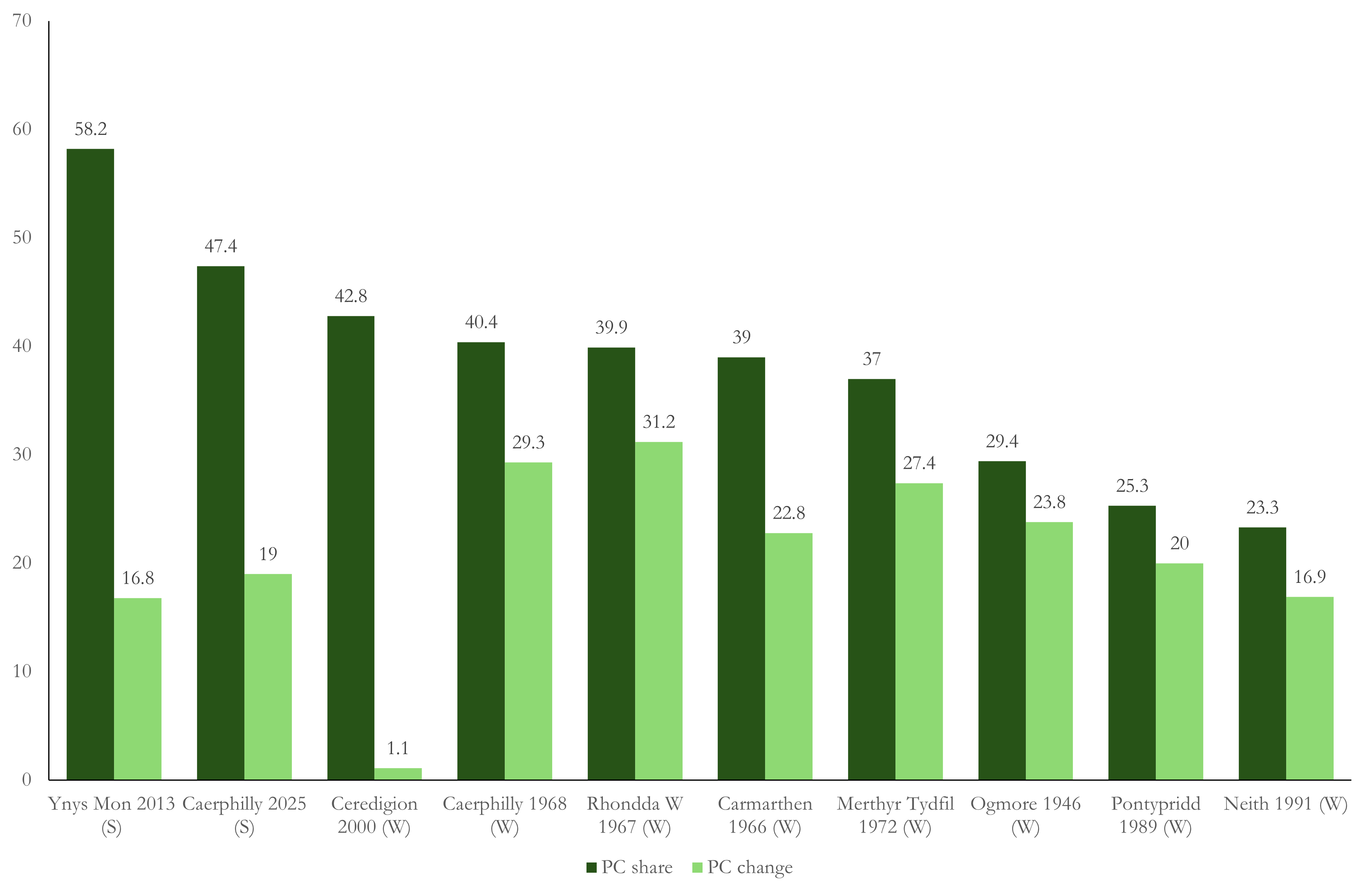
Several factors helped fuel Plaid’s rise - they provided an outlet for progressives and former Labour supporters disappointed with the performance of Labour governments at Westminster and in Cardiff. With Welsh polling showing both Reform and Plaid on the rise as Labour slumps, Plaid could also pitch themselves as best placed to beat Reform locally, and thus squeeze tactical votes from voters who might not share Plaid Cymru’s views on everything but were nonetheless eager to prevent a victory for Farage in their constituency.
Success in Caerphilly puts Plaid in pole position for next year’s elections for the whole Senedd, where some of the same forces will be in play again. Voters across Wales will have an opportunity to express disappointment in Labour’s Cardiff and Westminster administrations, and unless the polling changes drastically Plaid will be able to frame themselves as both the strongest vehicle for progressive discontent and the strongest alternative to a rising Reform.
And while the change in the Senedd electoral system to regional list proportional representation will weaken the tactical voting incentive, left wing and liberal voters will still have an incentive to rally behind one party’s banner to ensure Reform don’t finish in first place. Victory in Caerphilly, far from their natural heartlands, has strengthened Plaid Cymru’s case that they are best placed to lead a more left wing and anti-Reform Welsh government next May. The Welsh nationalists have now consistently the strongest progressive party in Senedd polling, they have a longstanding base of support among Welsh speakers, and after this week they have shown they can achieve major breakthroughs even in Labour’s traditional South Wales heartlands.
(2) Reform Still on the Rise
The Caerphilly result is a self-inflicted setback for Reform UK - Farage’s party encouraged expectations to the point where they went into the contest seen as strong favourites, and hence Reform’s failure to win the seat is being treated as a major failure. The less than graceful behaviour of the defeated candidate at the count, and Farage’s rapid disappearance from Wales as it became clear his party would not prevail has only encouraged the perception that an unexpected setback has bruised Reform.
Yet though the snap verdict is one of Welsh voters rejecting Reform, the underlying figures suggests this is another strong result for the rising force of the right. Farage’s various parties of the radical right - UKIP, the Brexit Party and Reform - have stood nine times in Welsh by-elections since UKIP first appeared on the ballot in the contest to replace Neil Kinnock in Islwyn in 1995. The best previous vote share is UKIP’s 15.4% in Ogmore in 2016, while the biggest rise was UKIP’s 14.3 point rise from a standing start in Ynys Mon in 2013. Reforms’s 36% vote share and 34 point rise in Caerphilly smash both these records. Reform also registered a major advance on the 20% the party won in the equivalent Westminster seat last July, and their 16 point gain last week is roughly in line with their rise in GB-wide opinion polls.
UKIP, Brexit Party and Reform performances in Welsh by-elections for the Senedd and Westminster 1995-2025
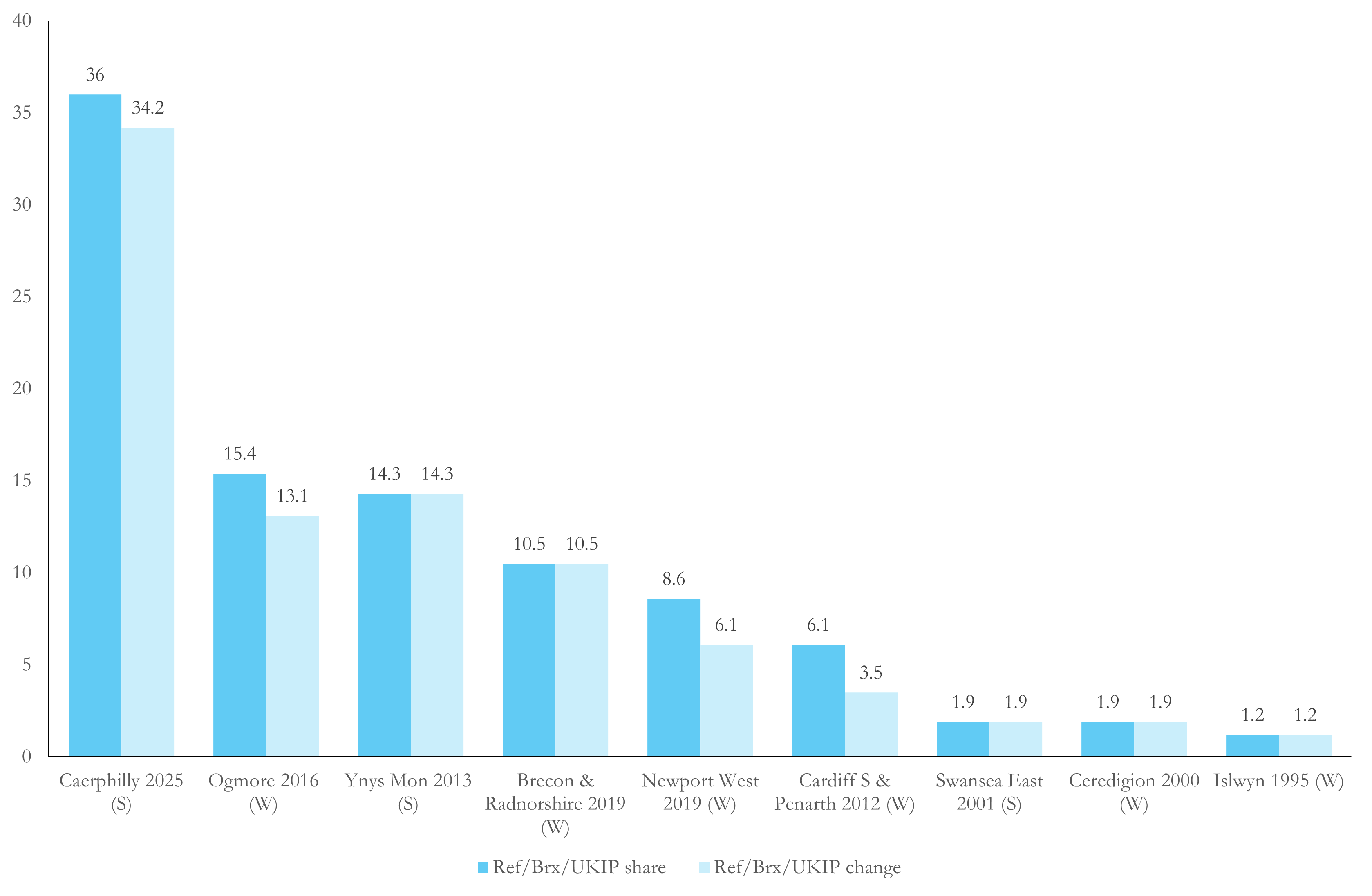
The result can be read two ways. Reform has risen to new heights in Wales and vote shares in the mid-30s will most likely be enough to win Westminster seats if opposition voting is more fragmented, as it often is in Wales as elsewhere in Britain - the winning vote share was below 40% in 14 of Wales’ 34 seats last July. Yet the Caerphilly result also underlines that Reform cannot take it for granted that a fragmented field will lower the bar for victory. The strong consolidation of the vote behind two contenders last week suggests Welsh voters opposed to Reform were both motivated to unite behind one anti-Reform candidate and capable of figuring out which party was best placed, even though the party in question had never won in the area. Tactical voting to stop Reform could drastically shift the local landscape in many contests to come as voters notice and respond to Reform’s growing strength in national polls and local elections. Paradoxically, the more Reform look like a clear and present danger, the harder it may become for them to win locally in many seats, if sufficient voters decide opposing Farage is a more urgent priority than supporting their favoured party.
Such logic will not, however, apply in the next May’s Senedd election, which will be fought under a new regional list propotional representation system. While Reform will be disappointed not to win this week, they have confirmed their status as the coming force of the right, and could yet emerge from next year’s contest as the largest party in the Senedd, though they are less likely to form a government as their only plausible coalition partner, the Welsh Conservatives, are in seemingly terminal decline.
(3) Labour on Life Support
While the Caerphilly result was disappointing for Reform it was catastrophic for Labour, who slumped to just 11% of the vote in a seat it had held in every Senedd and Westminster since 1918. Never has a Labour candidate in Caerphilly polled so low since the very first candidate standing for the fledgling party in December 1910 won 25% of the vote. Labour’s 35 point drop was their second steepest fall since 1945, exceeded only by the Blaenau Gwent Senedd by-election in 2006, when the widow of Peter Law, who had stood against his former party for the equivalent Westminster seat the year before after being de-selected, defeated Labour again on the same day as Law’s former election agent defended the Westminster seat. The next biggest Labour slump after that was also in Caerphilly in 1968, but back then Labour had Himalayan majorities in the South Wales valleys, so a 29 point drop in support still left the party on 46% and comfortably ahead. Labour started below 46% this time, and fell to 11%, the party’s second lowest vote share anywhere in Wales, and by far its weakest by-election showing the land of Nye Bevan and Neil Kinnock. While I have not checked it systematically yet, I would be surprised if Labour have ever fallen so low in any Westminster contest for a South Wales seat since becoming one of the two main parties of government a century ago.
Largest drops in Labour vote share in Senedd and Westminster by-elections since 1945
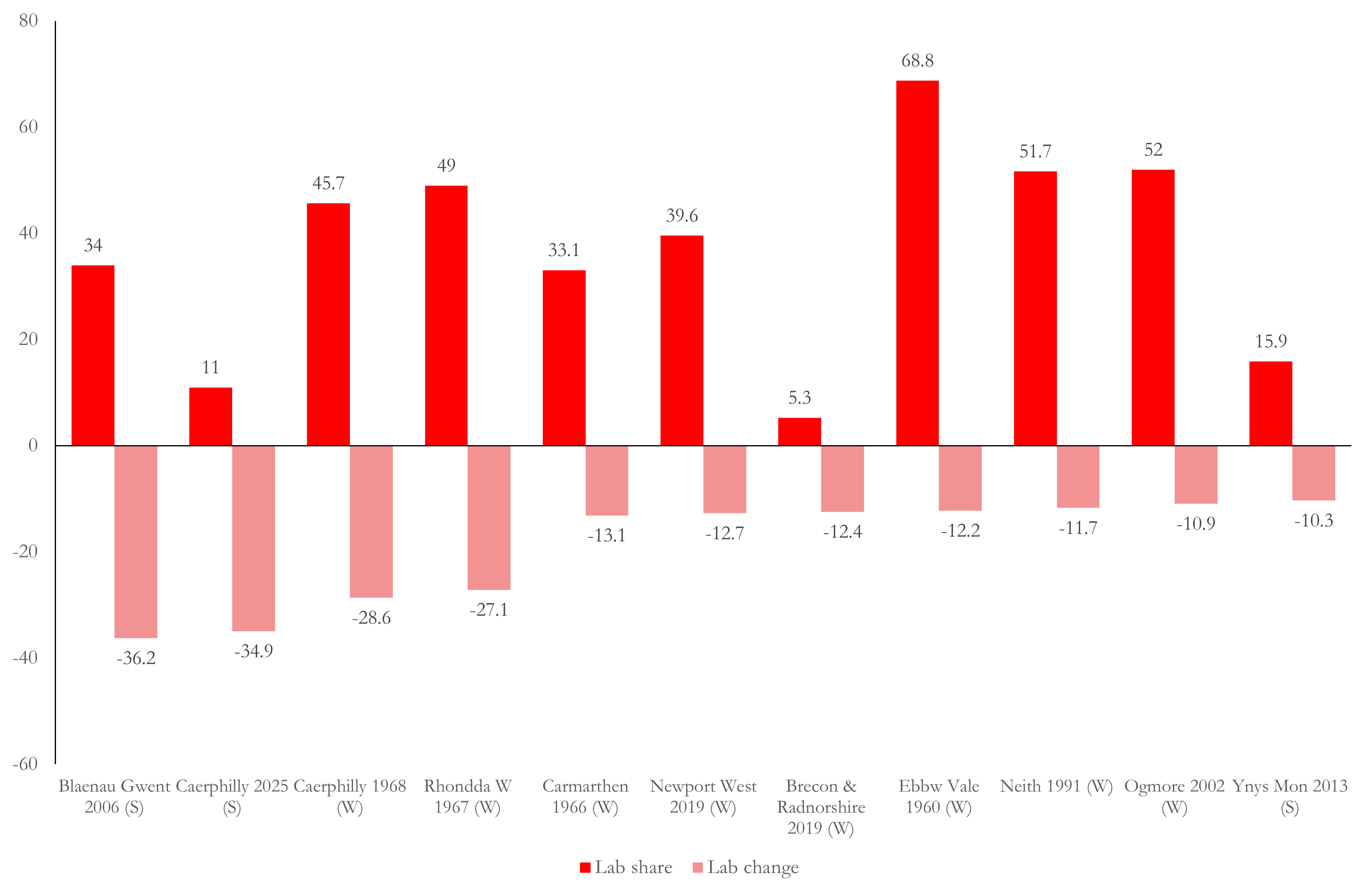
The crash in Caerphilly underlines the catastrophe looming for Welsh Labour in next year’s Senedd election. Labour has been comfortably the largest party in every single Senedd election since the start of devolution in 1999, and led every Welsh government, but current polling has the party already in a distant third place and falling fast. Nor is this polling a blip - Welsh voters give the Cardiff government dismal approval ratings, a factor which may have contributed to the substantial drop in Labour’s vote in Wales in last year’s general election. The Caerphilly result, which is well below what even the worst Welsh would project in a region of deep historic strength for Labour, suggests the party could yet have further to fall before we get to May.
Polling for the 2026 Senedd election
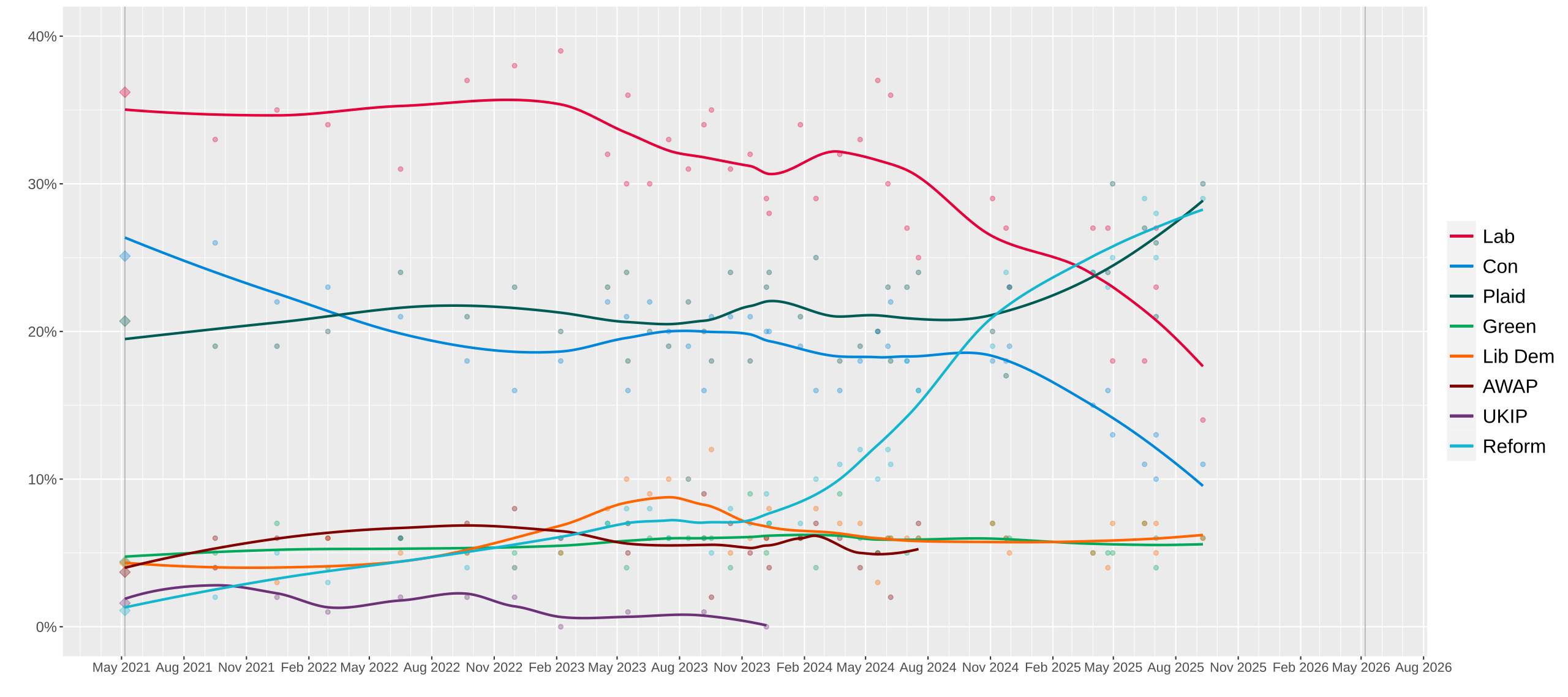
And while the tactical voting which boosted Plaid Cymu in Caerphilly should not be a factor under the new list PR system, that change is a mixed blessing for Labour, who did consistently better on the constituency vote than the list vote under the old mixed member system, suggesting they were often accepted by more left wing voters as a second choice party in constituency contests. Labour’s local strength and the relatively weak proportional element of the old Welsh system also meant the party won a disproportional share of the seats in every Welsh election since devolution began. With no first past the post constituencies to vote tactically in, Welsh voters can back alternatives to Labour’s left confident that these votes will not be wasted. Labour could therefore be reduced to its tribal core of true believers, a group which would once have been formidable in Wales but which, if current partisanship and approval figures are to be believed, could be small indeed. And even Labour true believers may see a protest vote for Plaid or the Greens as a worthwhile enterprise to signal their discontent. The Caerphilly result suggest Labour could fall far indeed as multiple motives to defect away from the party come together. A replication of the Caerphilly collapse could even see Welsh Labour at risk of failing to clear the threshold for winning any seats at all in many of the new six seat constituencies.
Last weak’s dire defeat could have wider implications, by demonstrating to Labour’s progressive opponents the opportunity to throw the logic of tactical voting into reverse. Labour tried to campaign in Caerphilly as the only party capable of beating Reform, a reasonable argument given Labour’s history, but one which Caerphilly voters laughed off. Labour may soon face similar credibility problems soon in a host of other seats if both local election results and MRP models show them consistently behind one of the other parties of the ‘progressive bloc’ - the Greens, the Liberal Democrats, Plaid or the SNP. At that point progressive voters who were often already only reluctant Labour supporters lat July, and have only become more discontent since may find they can have their cake and eat it too, as a party running to Labour’s left will be both the more ideologically congenial and the more locally credible choice.
The confluence of tactical voting, protest voting and ideological voting could, for example, turn Labour’s retreat into a rout in big city areas full of graduates, students and young people, areas the party deliberately ignored last year in its quest to optimise the geography of its support and where neither the Conservatives nor Reform have much change of winning. A Labour collapse in local elections in such areas over the next couple of years could yet prove the prelude to a Westminster rout for the party in it its Miliband and Corbyn-era heartlands.
(4) Death of the Welsh Conservatives, and of traditional two party competition?
Labour were not the only party who slumped to record breaking lows in Caerphilly. The Conservatives secured just 2% of the vote, losing their deposit with a vote share which was by some margin the lowest the party has ever recorded in a Welsh by-election, down fifteen points on their showing in the 2021 Senedd contest, down 9.5 points on their fourth placed Westminster performance last July. Four years on from their best ever Senedd performance, and six years on from the best ever Westminster performance in Wales, the Tories have been reduced to a vote share more typically associated novelty candidates and the lunatic fringe.1 Twin Tory and Labour collapse last week meant the two parties who have dominated Welsh and Westminster politics for generations fell over 50 points to a combined share just 13%. This was by a large margin the biggest drop in the combined vote share for the ‘legacy parties’ who dominate politics to the lowest ever level of combined support.
Lowest combined vote share for Labour and the Conservatives in Welsh Senedd and Westminster by-elections since 1945
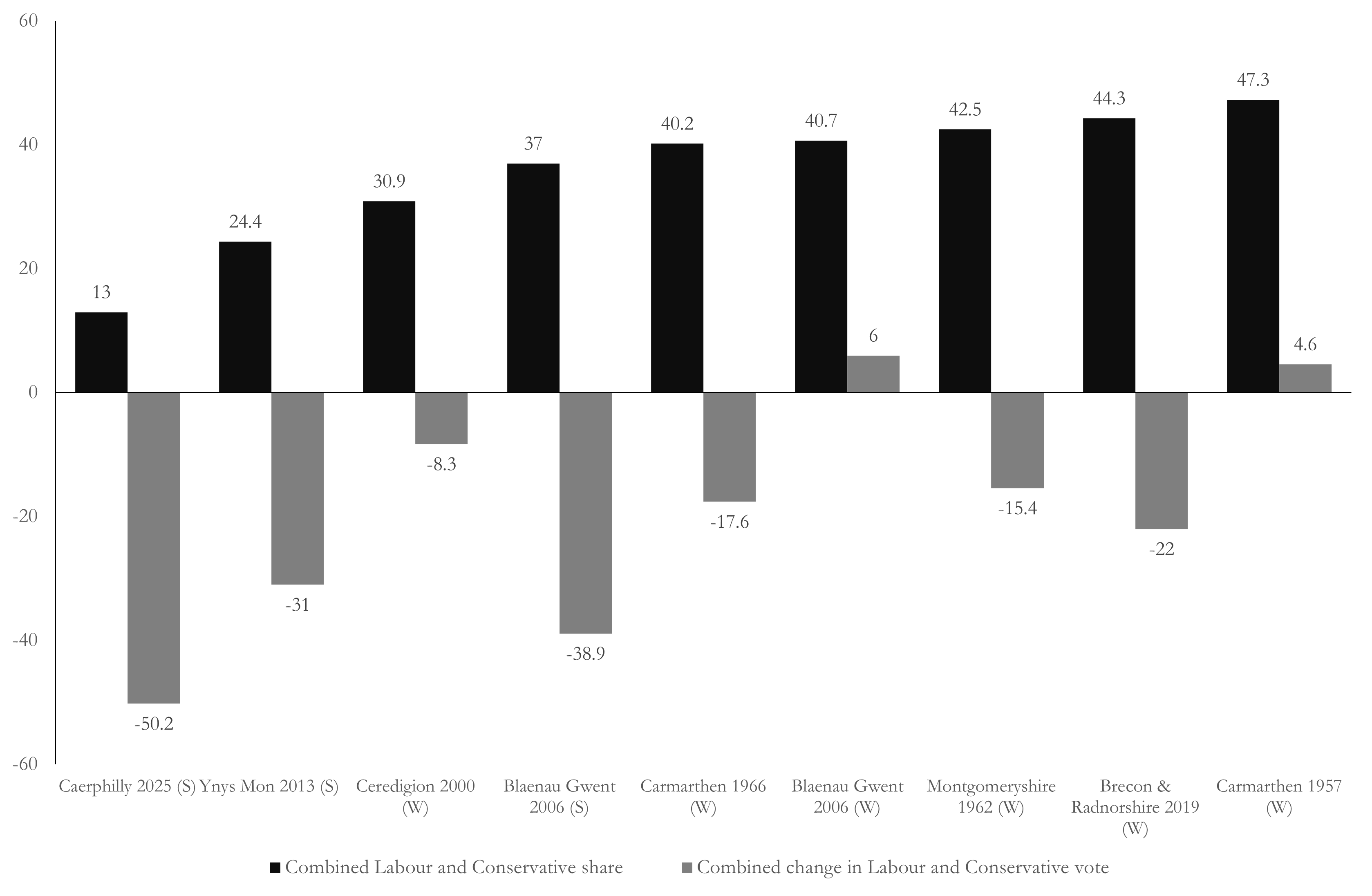
Things look dire indeed for the Welsh Conservatives in particular. They have already fallen to barely over 10% in Senedd polling, a distant fourth and barely ahead of the Liberal Democrats and the Greens. The national Conservative turn to the far right in pursuit of Reform may yet prove fatal for the party in Wales, where Tories have under-performed for nearly two centuries yet have always maintained a viable minority presence. While there are many socially conservative voters who might find polarising rhetoric and policy on race and immigration pappealing, such voters are likely to prefer Reform as both more credible on such policies and more likely to win seats. More moderate Tories - economically right wing but more socially liberal - will be alienated by such politics and may see little point backing a Tory party lacking a distinctive brand of its own and too weak to be relevant to Welsh politics.
The new, more proportional electoral system should in theory help struggling parties like the Tories to remain relevant, but the Welsh Conservatives are now in such dire straights that they could be wiped out in practice under the new system, with a vote too small and too evenly spread to win seats anywhere, and shut out of the Senedd altogether. Dismal poll numbers may indeed encourage this outcome, if even core Conservative voters decide they don’t want to waste their vote on a party unlikely to clear the threshold and therefore cast tactical votes fora second preference. With Labour facing a similar predicament, particularly outside its traditional heartlands, both of the parties who have all but monopolised political power for generations may soon be marginal players in a Senedd dominated by Plaid and Reform. The traditional two party system may be on the brink of wholesale replacement in Wales, perhaps a prelude to similar upheavals elsewhere in Britain, first locally and then in Westminster.
(5) Turnout: reinvigorated politics?
Along with big swings in support for four different parties, there was also another remarkable change in the Caerphilly ballot boxes last week: they were fuller. Turnout in the by-election was more than six points above the level in the previous Senedd election. Indeed, the 50.4% turnout recorded last Thursday was both the highest turnout in any Senedd by-election and the highest turnout ever recorded for a Senedd contest in the area. It is unusual for turnout to rise in by-elections - this was the second rise in a Senedd by-election, and the previous instance is instructive. Turnout rose by over 12 points in Blaenau Gwent in 2006, when local voters angry about high handed behaviour by the national Labour party rose up against it.
Turnout and turnout change in Senedd by-elections
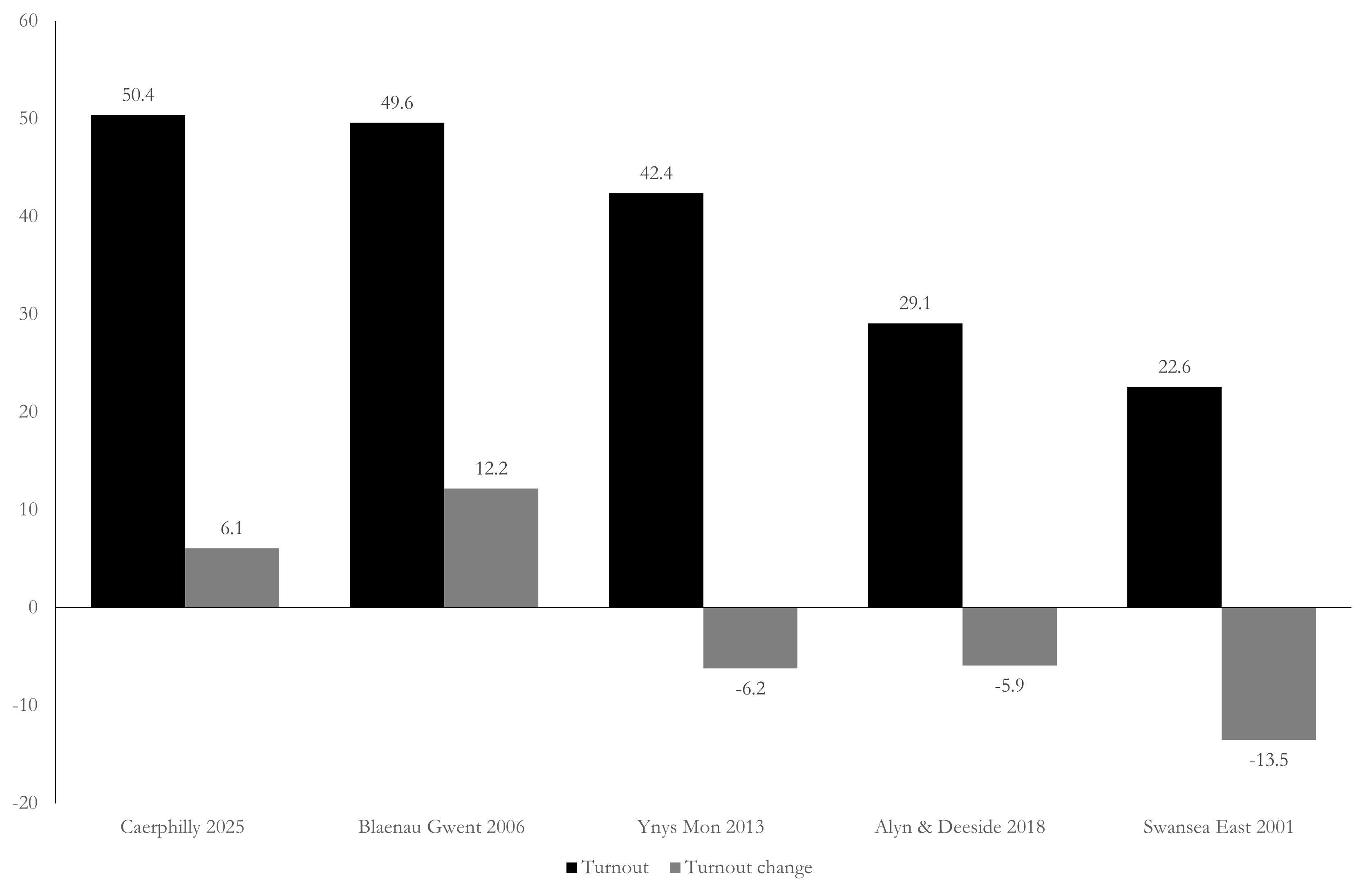
Caerphilly’s turnout bounce last week is also party of a broader recent trend. May’s vote Runcorn and Helsby also featured an exceptionally high turnout for a Westminster by-election, with turnout among less engaged voters credited by both parties as playing a big role in Reform’s upset win. Many recent local by-elections have also featured unusually high turnouts, while both opinion polling and results analysis suggests Reform, in particular, is gaining by mobilising former abstainers.
The remarkable churn in the party system occasioned both by Reform’s rise on the right and Labour’s losses to smaller parties on the left seems to be sparking renewed voter interest. The stagnant politics of an often disliked but always dominant duopoly has been replaced by a more vibrant and fluid competition featuring divisive newcomers, bold promises and uncertain outcomes.
Whatever problems volatile and fragmented contests bring to elite politics, they certainly seem to be sparking interest at the grassroots. The return of habitual abstainers to the polls will bring methodological challenges for pollsters, who typically discount or downweight them, and for political parties who typically don’t canvass or seek to persuade households expected to stay at home. We may therefore see further surprises in typically low turnout conteststo come. But aside from giving party strategists more headaches, the re-engagement of hitherto alienated and disaffected voters is surely one positive development emerging from today’s more volatile and fragmented politics. More choice and more uncertainty may make for a messier democracy, but perhaps a healthier one too.
Screaming Lord Sutch of the Monster Raving Loony Party managed 2.2% in the 1995 Islwyn by-election, for example.
The Labour vote decreased by over 45 percentage points in Merthyr Tydfil in 1970 but again it was over a deselection, in that case the redoubtable SO Davies who carried over 50% as an independent.
Why on earth did the Senedd choose a closed list system? Were all the parties keen to take control of their candidate lists? They really don't like STV do they? And yet it may well have kept Labour and Conservatives in the game for future elections