

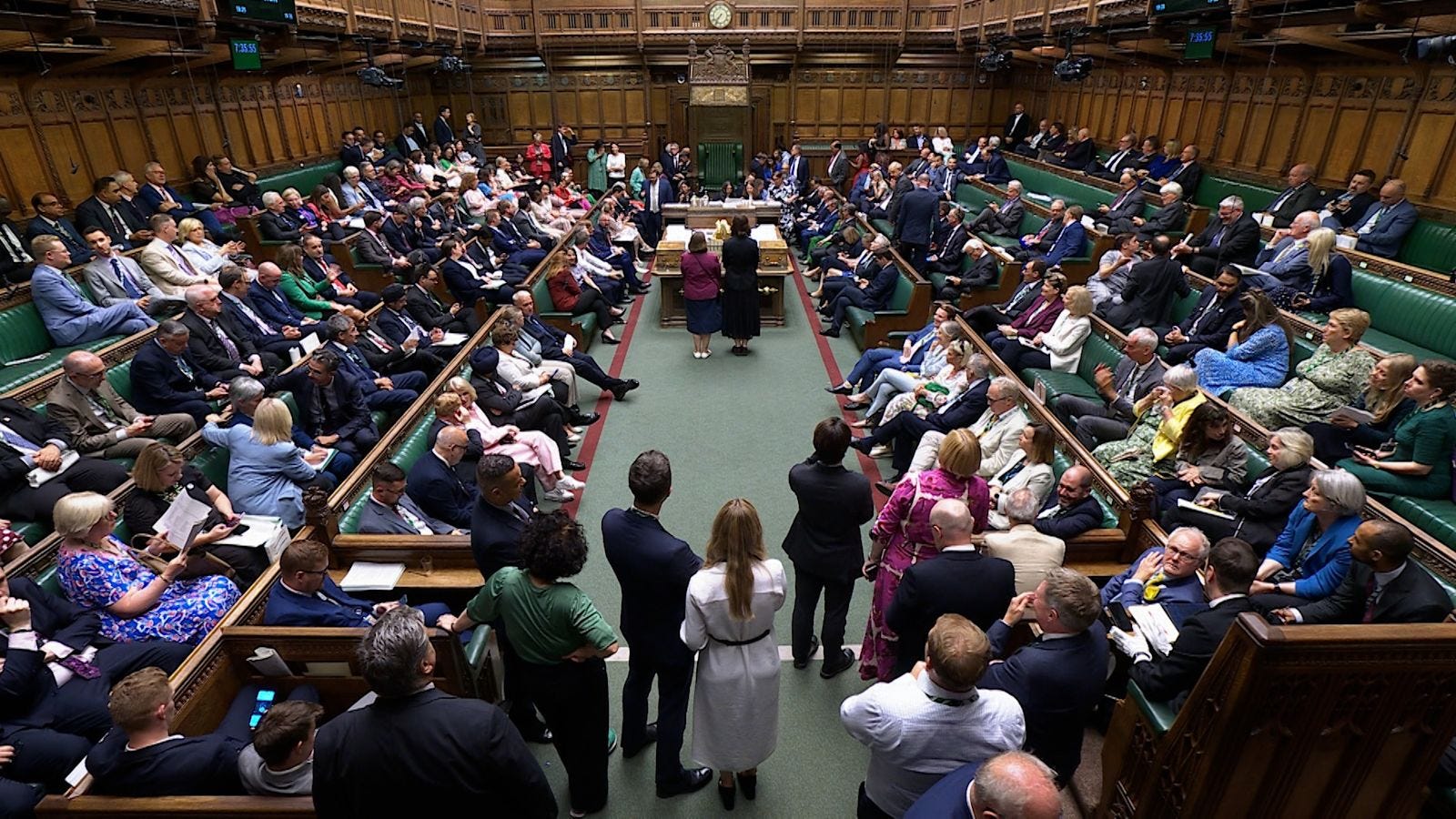
MPs voting on the Universal Credit bill in July 2025. There were more rebellions over this bill than any other during the Parliamentary session
I’ve been producing regular updates on the state of backbench rebellions for almost 30 years. It turns out, rather neatly, that this one on the first session of the 2024 parliament has ended up coinciding almost completely with the Starmer premiership. So, this is both a look back at what has caused Keir Starmer’s whips to have sleepless nights, but also an indication of what Andy Burnham is likely to inherit.
The data below cover the entire first session, which was a whopper, running from July 2024 until April 2026. Between the first vote on 22 July 2024 and the last on 28 April 2026, there were a total of 515 divisions.1 Of those 515 votes, there were 45 occasions where one or more Labour MPs voted against their whip. That’s a Labour rebellion in around 9% of all votes.
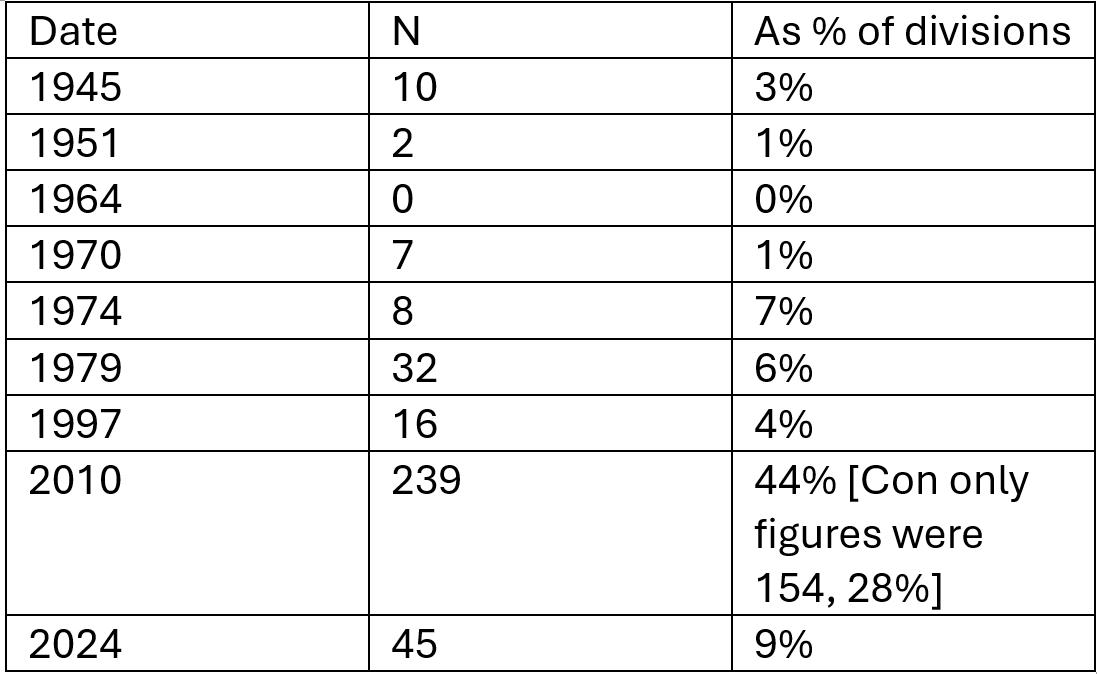
In absolute terms, this rate is clearly low; nine out of every ten votes saw no Labour MP vote against their party. But the 2024 session was the first session to take place after a change in government. Such sessions normally do not see widespread backbench revolt: the government is fresh, carrying out its manifesto mandate, there are usually lots of new MPs; and so on.2 If we compare like-with-like, as in Table 1, then the 2024 session looks less pliant. The 9% figure for 2024 is the second highest in the table, beaten only by the remarkable 2010-12 session, when the whips struggled with all the issues of a coalition. The same applies for the raw number of rebellions; 45 is way behind the 239 in 2010-12 but tops all the other listed sessions. Or put another way: the rebellion rate by government MPs in the 2024 session was the highest for the first session of any newly elected government, consisting only of one party, since 1945.
1. First session rebellion figures, for all first sessions featuring a change in government since 1945
There were rebellions over a dozen government bills, as well as on other issues. The largest single rebellion comprised the 49 Labour MPs who voted against their whip on the Second Reading of the Universal Credit and Personal Independent Payment Bill, the government’s flagship piece of welfare reform legislation. Most of the media attention focussed on the two earliest rebellions on this bill (the 49 at second reading, preceded by 44 on a reasoned amendment), but there were a further six revolts over the bill, ranging from seven MPs up to 47. Indeed, there were more separate rebellions over that bill than any other piece of legislation, including the six largest Labour backbench revolts of the session.3 In this, the government continued a long-standing Labour tradition of facing backbench rebellions over welfare, which dates back to 1924.
There was only one other rebellion consisting of more than 20 MPs: 26 Labour MPs voted against the Draft Public Order Act 2023 (Interference With Use or Operation of Key National Infrastructure) Regulations on a deferred division in January 2026. You probably won’t have heard of this; the rebellion went almost entirely unnoticed in the media. But it was a piece of secondary legislation which added the life sciences sector to the list of key national infrastructure, thus strengthening the police’s power against protestors – and it was the subject of a fairly considerable write-in campaign by some pressure groups.

Protesters dressed as ‘Zombie scientists’ at the University of Bristol campaigning against animal research in 2022. Secondary legislation adding the life sciences sector to key national infrastructure was subject to a large rebellion in January 2026
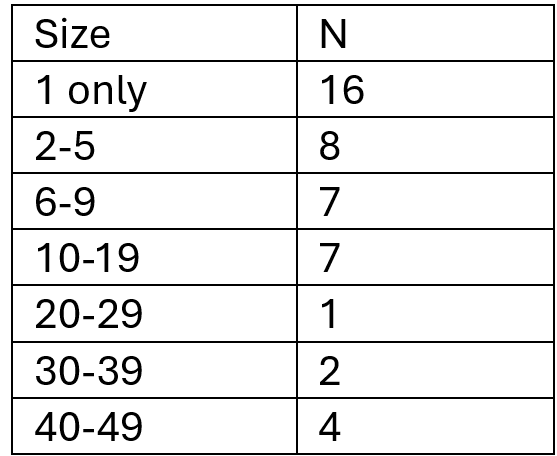
The size of the 45 rebellions is detailed in Table 2. The modal rebellion consisted of one MP; the median was 4; the mean was 10.5. If the rebellion rate was high relative to most comparable earlier sessions, that is less true of the size. The mean rebellion in 2024-26 sits somewhere mid-table, smaller than in the sessions of 1945 (15), 1951 (12), Feb 1974 (35) and 1997 (14), if larger than those of 1964 (0, obviously), 1979 (8), and 2010 (7).
2. Size of Labour backbench revolts, 2024-2026 session
A total of 73 Labour MPs cast votes against the party whip. The most rebellious – those who did so on ten or more occasions – are listed in Table 3, along with the number of votes they cast against the whip. Few of the names will be much of a surprise to anyone familiar with Westminster. There is an exact split between men and women, but only two of the massive 2024 intake in that list: Brian Leishman, the most rebellious of the 2024 intake, and Neil Duncan-Jordan.4 Yet this group are atypical in their behaviour. Even all of the 73 rebels constitute less than half Labour’s backbenchers, and even those Labour MPs who did rebel did so very infrequently. Fifteen MPs did so just once; another 10 did so twice. Indeed, even Burgon’s 24 votes only amount to a vote against the whip in less than 5% of divisions.
Most rebellious Labour backbenchers, 2024-2026 session
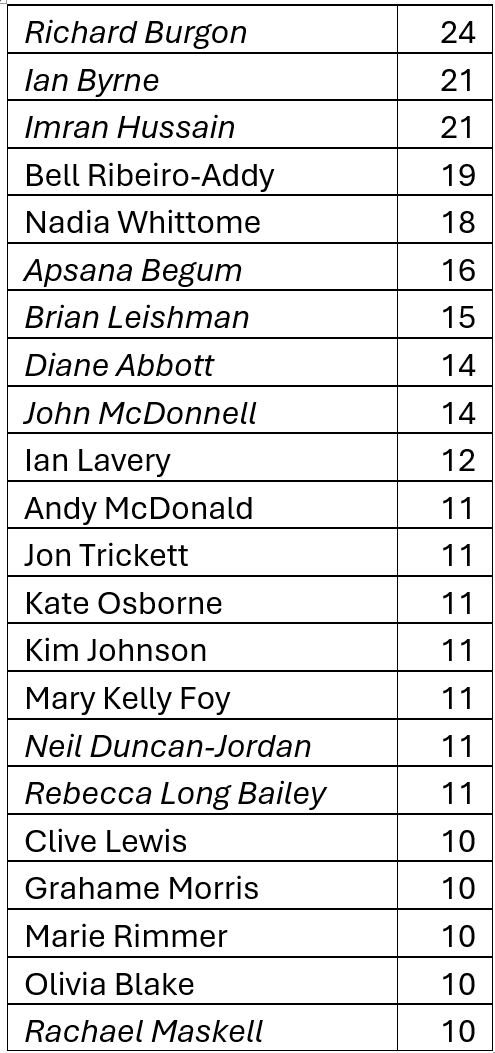
Note: Italics indicates a period spent without the whip
Overall, therefore, we therefore talking about very cohesive behaviour in the division lobbies. One way of measuring this is the Rice Index, a measure first published in 1925.5 To measure the cohesion of a parliamentary group, you take the absolute value of the percentage of ayes minus the percentage of noes. If a parliamentary party is united in one lobby, it will score 100. A party split right down the middle – half the MPs in one lobby, half in the other – scores 0. The mean average Rice score for Labour MPs for all 515 divisions was 97.3. It was a perfect 100 in almost 440 cases.
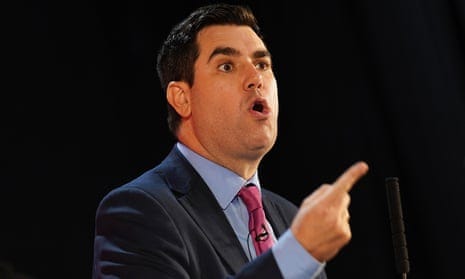
Richard Burgon was the most rebellious backbencher in the 2024-26 session. Buteven he rebelled in less than 5% of divisions.
Those, at least, are the raw figures. But there are some important caveats which need to be understood if they are to make sense. Some of these have always applied to the study of parliamentary voting, and are perhaps a bit nerdy (although if you’ve got this far I think I know my audience), but some are more substantive and especially important with this session – and for reasons that tell us a lot about what has been going on within the PLP and in parliament.
The first is that the 45 figure excludes ‘free votes’, those occasions on which the whips did not issue instructions to their MPs. This includes a series of House of Commons or procedural matters where the whips generally do not overtly interfere, but it also excludes votes on so-called ‘conscience issues’.6 This session included multiple votes on both assisted dying and abortion, both of which generated sizeable divisions within the PLP. Every vote on assisted dying saw the Rice score for Labour MPs fall below 30 and it hit 9.0 in one vote, with the PLP effectively split down the middle.
That figure of 9% therefore is not every occasion when a Labour MP voted against the rest of his or her party; it’s those occasions when Labour MPs defied the whip to do so. There are good reasons for treating these separately. There is a qualitative difference between voting against your party when the whip is on and doing so when it is not. Not differentiating whipped from unwhipped votes can lead to strange conclusions about an MP’s behaviour. But still, if we want to know what divided Labour MPs thus far this parliament we also need to look at the free votes.
The figures also excludes those occasions when MPs vote twice. The procedures of the House of Commons give MPs just two formal options: to vote aye or no on whatever question is before them. Sometimes MPs vote twice to register an abstention. MPs also sometimes vote in both lobbies as a way of correcting an initial vote cast in error, rushing back through the other lobby once they realise their mistake. And there are also those occasions when Hansard simply mis-records an MP’s vote. With the help of the MPs concerned, I have been able to identify most such mis-recorded votes and have excluded them from the data.7
More importantly, however, we are also not able to record the occasions when MPs defy their whips by abstaining, rather than voting against. Because the House of Commons does not allow MPs to register abstentions – other than, as mentioned above, by voting twice – it is not possible to read anything into absences. The whips may have formally sanctioned an absence from a vote; it may be accidental; or it may be deliberate. There is no information on the record that allows us to establish, at least not systematically, the causes of absences. There were multiple votes in the session where significant numbers of Labour MPs abstained in non-trivial numbers. Again, therefore, the true level of division is larger than that revealed by the dissenting votes cast.
The final caveat is more recent in origin. It is now much more common to see MPs have the whip removed – temporarily or permanently – than it used to be. In ten years, the Blair government did not remove the whip from a single MP because of their voting; by contrast, seven Labour MPs had the whip removed after just the third vote of the 2024 parliament, following a rebellion over the King’s Speech; another group of four lost it in July 2025. Yet others lost it because of other votes and/or other behaviour. Most regained it eventually, but for periods of the session they were sitting as independents.
The political consequence of this hard line was that it sent – as it was meant to – a message about the consequences of rebellion, and there is little doubt that, at least in the short term, this damped down rebellions. It took until April 2025 until there was a rebellion consisting of more than ten Labour MPs voting against their whips. The methodological consequence is that it makes comparison with earlier periods tricky. While independent, an MP who votes against the Labour government is not technically rebelling – because there is nothing for them to rebel against. It does not make much sense just to add their votes to the raw figures – because we don’t know if they would have behaved the same had they been in receipt of the whip – yet equally it seems strange just to ignore them.8 Almost half of those listed in Table 3 were without their whip at some point during the session. Take John McDonnell, for example. While he was without the whip (and even if we just examine the occasions when there were rebellions by those in receipt of the whip), McDonnell voted against the Labour position 15 further times in addition to the 14 in the table above. The equivalent figure for Rosie Duffield, who resigned the whip in September 2024, is 19. It is best therefore to treat almost all of the figures above as minima. Inclusion of rebellions by whipless MPs would not change any of them massively, but it would certainly nudge them up.
***
None of the whipped votes saw a government defeat. But they came close. The most obvious example came over the Universal Credit bill, where the government faced possible defeat at Second Reading, something which would have been unprecedented for a government in its position. Since 1900, only one government bill had been lost at Second Reading by a government with a working majority. That was the Shops Bill, in 1986. That happened seven years into Mrs Thatcher’s premiership, deep into her second term, and on a relatively minor piece of legislation. A defeat over the Universal Credit Bill would have been less than a year in, on a major piece of legislation, and to a government with an even larger majority. Instead, fearing defeat, and just hours before Second Reading, the government announced it was junking the proposed changes to Personal Independence Payments, a key component of the bill, subject to a review.
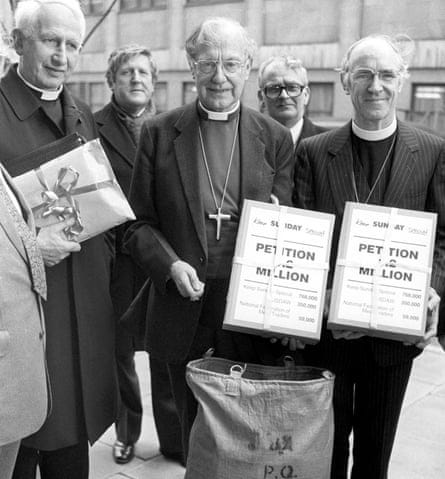
Senior church figures arriving at Downing Street with a petition to “Keep Sunday Special” in 1986. The Shops Bill deregulating Sunday trading is the only bill since 1900 where a government with a working majority has lost at Second Reading.
That bill demonstrates the most significant issue with all such data. Behold, as it says in Psalms 133, how good and how pleasant it is for brethren to dwell together in unity – but this can be unity of eventual behaviour, not attitudes or intention. This was the cohesion after the government had backed down. High scores don’t necessarily indicate togetherness. Plus, Universal Credit was only the highest profile of the measures on which the government backed down. The 2024 session was a good reminder that rebellions and influence are not always the same.
A new Prime Minister should not necessarily expect a honeymoon with their backbenchers. When Gordon Brown replaced Tony Blair in 2007, the first backbench rebellion took place 45 minutes after Brown had left Buckingham Palace. Recent Conservative changes in PM have not led to outbreaks of harmony. Over a parliament, rebellion tends just to get worse as backbench disgruntlement builds – akin to the hardening of the arteries. It seems doubtful that many of those listed in table 3 will massively change their behaviour; to their ranks will be added disgruntled ex-ministers, who know where the bodies are buried, and can often be effective leaders of rebellions. Andy Burnham has previously been critical of the process of whipping at Westminster, arguing that government should listen more to the PLP, and that the whipping system should be looser. We shall see.
Philip Cowley is Professor of Politics at Queen Mary, University of London. His latest book is “The Smallest Room in the House” and it is really very good. Once upon a time he wrote a book about rebellions in an earlier Labour government “The Rebels: How Blair Mislaid His Majority” which is also very good, although the late Roy Hattersley did not like it much.
Before this, Phil was co-author of three “Nuffield” election studies covering the British General Elections from 2010 to 2017, and co-edited three volumes of short essays with Rob, which featured Margaret Thatcher’s cat and Andy Burnham’s T-Shirt.
In raw terms, this is the second highest total for the entire post-war period, beaten only by the 544 in the 2010-12 session. But these were both extended sessions lasting a full two years; there were some 500 divisions in the 1979 session, which ran from May 1979 until November 1980.
If you want to see a foolishly naïve view of this, try this idiot’s writings.
Of all the dissenting votes cast by Labour MPs during the session (~460) that one bill accounted for 59% of them. And that, remember, is after the government gave way on key parts of the bill, as discussed below.
Just off the table, however, are Chris Hinchliff (9), Simon Opher (8), Cat Eccles (7), Lee Barron, Lorraine Beavers and Margaret Mullane (6).
S A Rice, The Behavior of Legislative Groups: A Method of Measurement, Political Science Quarterly (1925). The Rice index takes no account of absences, which can be a problem when there is mass deliberate abstention. Take, for example, Kirsty Blackman’s ten minute rule motion in September 2025 on the two child welfare limit: the government abstained, allowing a free vote for backbenchers; seven Labour MPs voted aye, none voted no. That’s a Rice score of 100. But is that really a totally united party? It’s also not great with smaller parties, where idiosyncratic behaviour by one MP can have a disproportionate effect. Other indices are available, as they say. But they haven’t lasted 100 years.
It is sometimes difficult to distinguish definitively between whipped and genuinely free votes and there is a tricky middle ground, where the vote may not be officially whipped but where it is quite clear what the party hierarchy want their MPs to do. There are, as a whip once put it, ‘free votes and free votes’. But based both on contacts with MPs and with whips, I believe that I have identified all those occasions when Labour MPs defied the official instructions of their whips.
A brief aside: I have been writing to MPs with such queries for about 30 years. Most MPs reply quickly, keen to have their votes recorded accurately, even when the vote might reflect badly on them. This session, for the first time ever, I found it impossible to get responses from a handful of MPs’ offices, despite multiple attempts. I make no complaint about this: as a non-constituent they owe me nothing. But I wonder why? Is it that they are now so swamped with correspondence? Or is it that they are more worried about the mischief that could be done with, say, identification of a mistaken vote? The result is that there are a couple of smaller votes where I am still unsure whether the MP deliberately rebelled or not.
It’s worth noting that this cuts both ways. While outside the party they are, of course, completely free to vote as they like, but most wanted the whip back. It’s perfectly possible that some of them were more likely to follow the Labour line while without the whip than if they had had it.