
Gorton and Denton Postmortem
The biggest ever shake up to the party system may be on the way in May

Its less than two weeks since the Greens made history with their first ever by-election victory in Gorton & Denton, yet the result already feels like ancient history. War has returned to the Middle East, and the shockwaves from this new conflict look set to roil the world, with huge spikes in energy prices and analysts talking grimly of worse to come. But the Gorton outcome still matters, not just as another stage in the ongoing disintegration of Britain’s traditional party system, but also because the result gives us some strong hints about how the political response to new economic shocks may manifest in the May local and devolved elections and beyond. With that in mind, here are some thoughts on the implications of this seismic by-election win for the bumper set of local and devolved elections due less than two months from now in early May.
The Greens: London calling
Superlatives are over-used in politics, but sometimes they are justified. This truly was a stunning victory for the Greens, smashing all previous records, and rightly drawing comparison with some of the most famous by-election breakthroughs in history. Though she is not the first Green MP, Hannah Spencer will take her place alongside the SNP’s Winnie Ewing and Plaid Cymru’s Gwnfor Evans as a candidate whose by-election breakthrough made history for her party.1
Spencer gained Gorton and Denton with nearly 41% of the vote, four times the highest vote share ever achieved by any previous Green candidate, and enough to deliver a 4,402 vote majority over the second placed Reform, with Labour pushed into third. The biggest question hanging over this contest was whether one of the two left parties would find a way to win the argument over who was best place to “stop Reform.” The Greens, perhaps helped by late polling showing them best placed to consolidate support, won that argument decisively, winning 5,600 more votes than Labour. In the end though, the point was moot: the anti-Reform vote in Gorton and Denton was so large that even an exactly even split between the Greens and Labour would have put both parties 1,500 votes ahead of Reform’s Matthew Goodwin.
Top 10 Green by-election performances
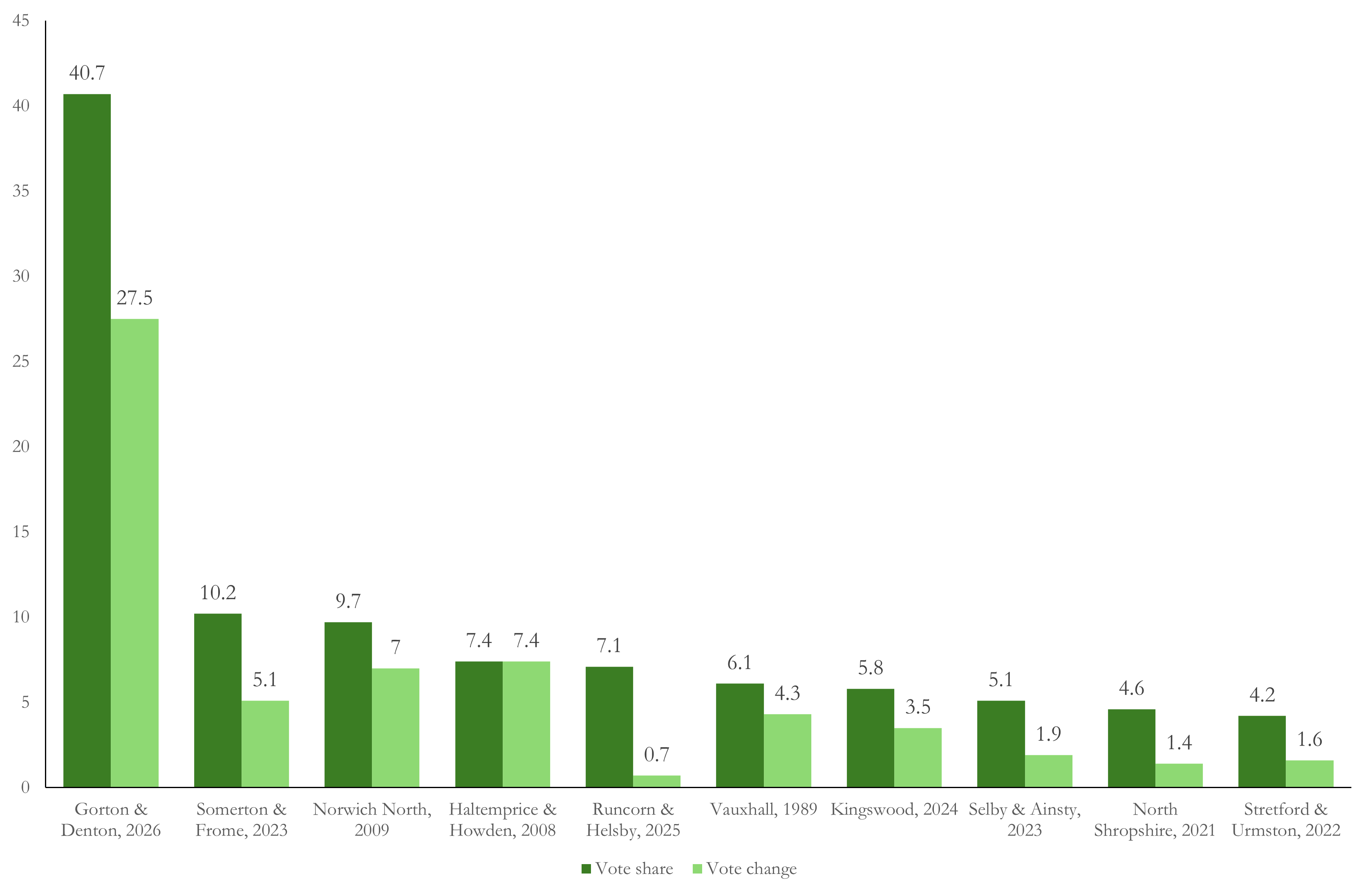
The aftershocks from this electoral earthquake will not be long in coming. The Greens were already likely to do well in May’s English local elections - the party has made substantial gains in every set of English local elections since 2019, a sustained advance which has largely flown below the radar of national media attention but given the Greens a substantial and steadily growing base in local government.
But this time the Greens go into the contests in their best ever national polling position - ahead of Labour with some pollsters - and by happy coincidence these elections take place on much of the most favourable terrain for the Greens in England. The Greens therefore have a golden opportunity to replicate the Liberal Democrats’ past electoral model - mobilising midterm hostility to the incumbent government to sweep into power in local government, then using the profile, credibility and organisation that local government brings as a platform for Westminster breakthroughs.
The Greens’ Wetsminster target list is already fairly clear: there were 39 Westminster constituencies where the party came second to Labour in 2024. Nearly all are in big English cities, including three Manchester constituencies bordering Gorton and Denton and four Bristol seats near to the 2024 Green gain of Bristol Central. There are also single or multiple Green second places in Sheffield, Liverpool, Leeds, Norwich, Cardiff, Oxford, Huddersfield, and bordering Brighton (Hove & Portslade). But by far the biggest prize for the Greens, with 18 of the 39 seats where the party starts second, is London.
While most local councils are elected in “thirds”, meaning the Greens have to play a long game, winning successive local elections to build up their local presence, one big English region does things differently, electing all of its councillors together once every four years. And it just so happens to be the region where the Greens’ natural supporters also gather in largest numbers: London. Every seat on London’s 32 borough councils is up for grabs this May. Even better for the Greens, their strongest Westminster results in London came in a set of constituencies clustered together in adjoining inner London councils. If the Greens achieve the kind of smashing breakthrough polling and demographics suggest we may soon need a new name for this area: the Inner London Green Belt? The Green Wall? Green Hedge? The Great Green Glob?
From Lambeth to Redbridge: soon to be London’s Great Green Glob?
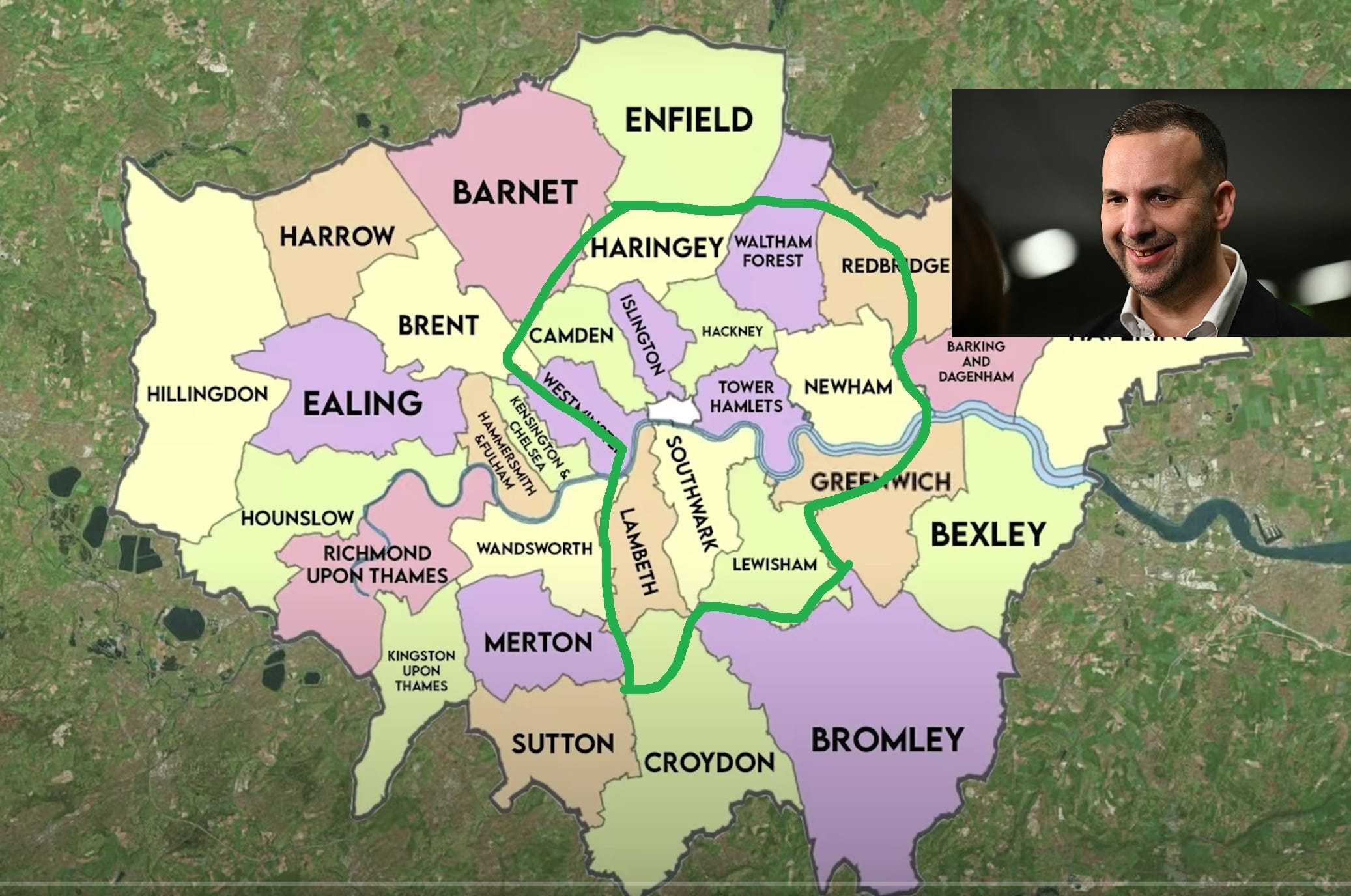
Whatever we end up calling it, the clustering of strong 2024 Green finishes in adjoining London boroughs all short tube rides from each other greatly simplifies the Greens’ electoral strategy for May and beyond. All the places in London the party will most want to target are close together and easily reachable for the party’s many London based activists. Meanwhile, a number of the Greens’ other natural strongholds, including Bristol, Brighton & Hove and Liverpool/Wirral, have no local elections this year, freeing up resources to focus on the battle for the capital.
London constituencies where Greens start second to Labour
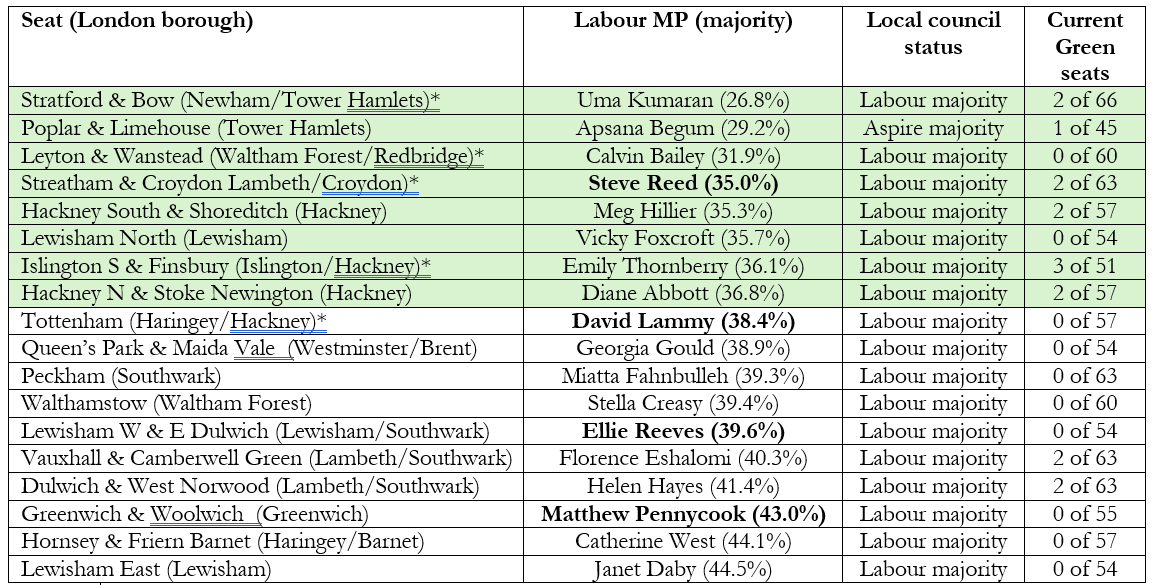
*Seats which cross borough boundaries - council figures refer to largest borough. Seats shaded in Green require a smaller swing than Gorton and Denton for Greens to gain. Names in bold are Labour frontbenchers
The Green win in Gorton & Denton could not be more timely, as it has shown Green activists and undecided London voters that the Greens can indeed surge to victory from a standing start. By showing what is possible, this by-election breakthrough has now made Green advance across the inner London boroughs a great deal more likely. A lot of London’s Labour MPs, including some very senior ones, represent areas which might be about to see Green breakthroughs. Senior Labour figures including Solicitor General Ellie Reeves, Housing, Communities and Local Government Secretary Steve Reed, and Deputy Prime Minister David Lammy could soon find themselves find themselves working with new Green councillors - or indeed new Green council leaders - in their constituencies very soon.
Reform: A stumble soon to be forgotten?
Reform finished second in Gorton and Denton, well behind the Greens, on 28.7%. As readers of the Swingometer will know, this result was hardly a surprise in a seat whose demographics tilted heavily against the party. Indeed, a share of nearly 29% on a high turnout - at or above Reform’s current national polling is an impressive outcome given this is a seat where we would expect Reform to underperform.
Rather than highlight his creditable performance in a tough seat, Goodwin has chosen to fulminate about alleged electoral irregularities, seek to undermine the legitimacy of the result and launch rather lurid attacks on the residents of the area he claimed he wanted to champion, complaining to the Spectator about “angry cat ladies” and “Muslim lads staring at me”, while ‘joking’ about Green voters as “crack addicts” from the “Islamo-woke Green alliance” and claiming (falsely) that the victorious Green candidate blamed him for the MEN arena bombing. Goodwin seems taken aback that he and his campaign are seen as divisive. It really is quite the mystery.
Leaving aside the troubling attacks on the legitimacy of a decisive election result by the defeated Reform candidate and his party leader, this latest strong showing on opposition territory suggests Reform are on course for another major wave of gains in May, when much more favourable council areas will be up for election. To secure 29% of the vote in this seat, Reform must have really run up the score in the more favourable Denton wards, most likely securing dominant wins in all of them.
Farage’s happy hunting grounds: Local councils holding elections in May where more than 65% of voters backed Leave in 2016
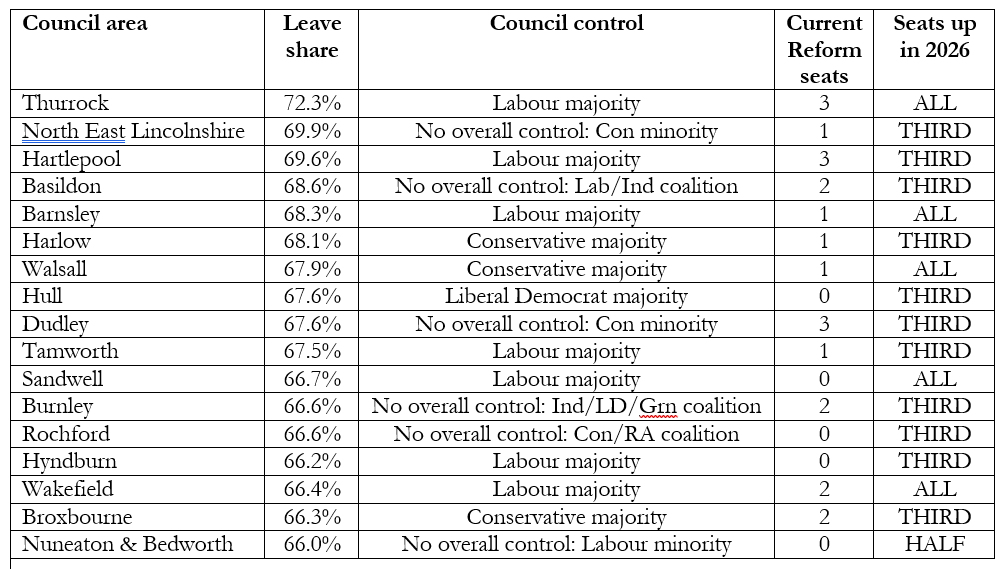
There are many places even more favourable still up for election in a few weeks, with plenty of seats up in local authorities with older, whiter and more heavily Leave voting electorates than Gorton and Denton. As the table above illustrates, there are many seats up for grabs on councils where two thirds or more of the local electorate voted Leave in 2016. These are the kinds of places that have experienced massive Reform surges in 2024 and 2025. Reform stood few candidates when these councils were last up for election in May 2024 or earlier, and has gained only a handful of seats through by-elections and defections since.
With Reform polling more strongly than a year ago, another huge wave of gains looks likely in such areas, but this time hitting Labour harder than the Conservatives, as Labour have twice as many seats up as the Tories, including hundreds of seats in Leave voting areas with currently Labour run councils. On top of this, Reform have also moved into a solid second place in Scottish Parliament polling, and are neck and neck with Plaid Cymru in polling for the Welsh Senedd. With the party poised to make historic gains in all three British nations in May, a breakthrough even bigger than last year, the setback in Gorton and Denton will most likely soon be forgotten.
The Conservatives, the Lib Dems and Advance UK: Local flops with broader implications?
Though as ‘major party’ representatives their candidates featured in both main hustings events, the Conservatives and Liberal Democrats were treated as largely irrelevant from the start. Yet the scale of their electoral failure is nonetheless remarkable and may have wider implications. These are the two parties who would traditionally have made hay when a very unpopular Labour government faced the voters. Instead, both were completely marginalised, and neither won more than 2% support. This is the first time since 1918 that two of the three Britain-wide “major” parties (Labour, the Conservatives and the Liberals/Liberal Democrats) have fallen so low in the same by-election. And it is the lowest by-election vote share the Conservatives have ever received since the introduction of the mass franchise.
Collapse on such a scale raises troubling questions for both parties going into the May local elections. For the Conservatives, the Gorton defeat further underlines the existential crisis currently facing the party. In every previous Parliament since World War 2, trouble for the government has meant recovery for the main opposition party. Not this time. The Conservatives continue to plummet in polls and election contests alike, and the Gorton and Denton result suggests the Tory vote may dry up entirely in its weakest areas, as Reform become the only right wing game in town. That is a troubling precedent for the national Conservatives given there are nearly 200 seats where the party finished third (121) of fourth (65) in the 2024 general election. The further the Conservatives fall this May in both strongholds they are defending and weaker areas where they are fighting for relevance, the longer the odds and the narrower the path to recovery at the next general election. A second local election pummelling for the main opposition party would be an outcome without precedent in modern political history2, adding to growing concerns that the Conservatives’ decline may become terminal.
The Liberal Democrats, too, must worry about their displacement in Gorton and Denton by the Greens as the vehicel for progressive protest. The previous Labour government’s fall from grace in the early 2000s saw the Lib Dems rise to new heights as the main vehicle for progressive discontent in Labour strongholds- including in many of the wards of this seat, which elected Lib Dem councillors in that period. Those times look long gone now - indeed this is the seventh Westminster by-election since 2021 to feature a Lib Dem share below 2%, all of them seats where a more viable centre left party was available. While the Lib Dems remain buoyant in the ‘blue wall’ areas where hey are running as amain alternative to the Conservatives, their capacity to compete beyond these areas was already eroding, and Gorton and Denton suggests the Greens may soon fully occupy that terrain. A big Green surge this May could see the Lib Dems further restricted and marginalised, functioning as a powerful anti-Tory force in the South of England, but with little reach beyond this.
Gorton and Denton also provided a first electoral test for the splinter movements - Advance UK and Restore Britain - trying to outflank Reform UK on the right. Advance UK’s Nick Buckley was a strong candidate on paper - a lifelong resident and award winning local charitable worker with two previous Mayoral electoral campaigns under his belt, while Reform put up a London media personality with tenuous links to the constituency. But Buckley and Advance flopped completely, finishing behind Sir Oink A Lot of the Monster Raving Looney Party. This suggests that, for all the noise that disaffected former Reformers Rupert Lowe and Ben Habib make on social media, Nigel Farage’s dominance of the radical right political landscape remains almost total. It will be interesting to see how many far right candidates from these two parties put themselves forward in May, and how they perform. My suspicion is “not many” and “not well”.
Labour: Into the Valley of Death
No one comes away from Gorton and Denton, or goes into the May local elections, with more to worry about than Labour. The best that can be said about this by-election result is it wasn’t the worst ever. But on any metric it was dire indeed, particularly for a government so recently installed with a landslide majority. This was the seventh largest Labour majority overturned in a by-election, and one of the top twenty drops in the party’s support ever recorded. Tony Blair experienced two swings of seventeen points or more against his party over the whole of his first six years in office, and neither resulted in defeat. Keir Starmer has already lost two seats, on mammoth swings, to different parties, less than two years in to his term in office. And much worse looks set to come in May.
Scottish Labour’s brief and remarkable resurgence in 2024 now looks like ancient history, with most polling suggesting the party will finish third (at best) in both constituency and regional polling behind the SNP and Reform. And all the polling suggests Welsh Labour will collapse into third place behind both Plaid Cymru and Reform, with some polls suggesting the party may struggle to break double digits or be certain of any representation at all. This is catastrophic in Wales, a country where Labour has not lost a nationwide domestic election in over a century.3 And now in England Labour will face a pincer movement from Reform and the Greens, with Farage’s party set to sweep the leave voting towns and urban regions of the North and Midlands which Labour had only just wrested back from the Conservatives, while the Greens look set to march through the town halls of the capital, the governing party’s last great redoubt.
The root cause of all of this has been visible for a while. Labour have spent much of the past two years trying to convince socially conservative, older Leave voters that the party understands and is responding to their priorities. This strategy already flopped in the general election, where a relentless focus on “hero voters” delivered meager (if strategically important) returns, while Labour suffered an ominous slump among liberal-left voters and in its safest seats. Since then the Reform whispering strategy has been an unmitigated disaster - nothing Labour has said and done has made the slightest impression on Reform voters, who loathe Keir Starmer with the heat of a thousand suns, while the repeated and clumsy deployment of polarising language on immigration in particular has alienated the younger, more socially liberal, ethnically diverse and university educated voters who have made up Labour’s core support for the last two decades.
Labour prepare their May campaign
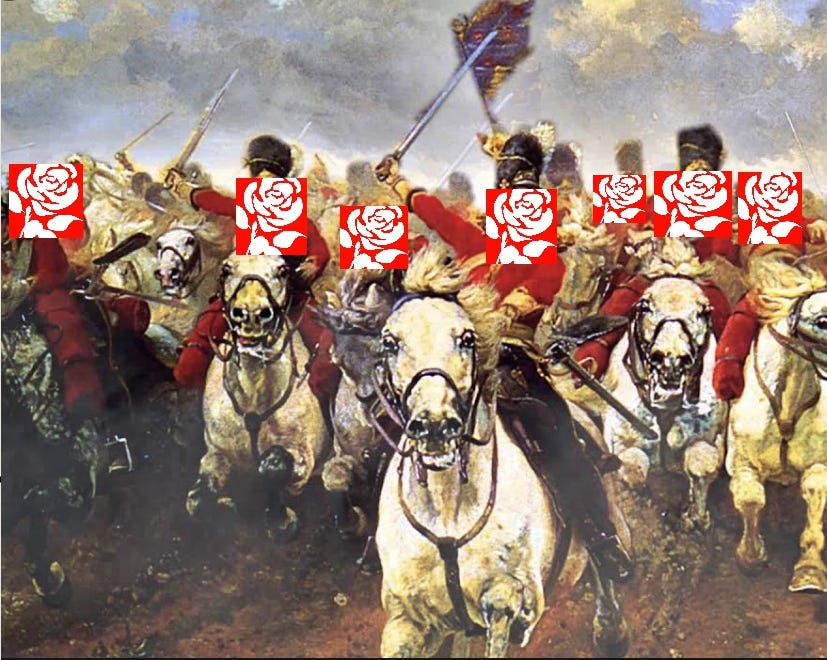
“Forward, the Light Brigade!” Was there a man dismayed? Not though the soldier knew Someone had blundered.
Reviled on the right, loathed on the left, Labour are charging into the Valley of Electoral Death. In almost every region of Britain there is now aonther party most voters prefer to Labour incumbents - Labour lose to Plaid in Wales, to the SNP in Scotland, to the Lib Dems in the ‘blue wall’, to Reform in the ‘red wall’ and now to the Greens in London and other big cities. The party which, just two years ago, managed to be acceptable anywhere looks destined to become unacceptable everywhere. Being no one’s first choice is disastrous in an electoral system which is called first past the post for a reason.
In an effort to bail out their fast sinking ship, Labour strategists have tried to mobilise the force which buoyed them up so effectively just two years ago: negative tactical voting. Three times in the last year, voters have been told ad nauseam “only Labour can stop Reform”. And three times this message has failed. It failed in Runcorn and Helsby, where Reform won anyway, in part because the Greens rejected the arid calculus of “you may not like us but we’re all you’ve got.” Then it failed in Caerphilly, where voters who had backed Labour for a hundred years unbroken simply ignored the warnings and decamped en masse to Plaid Cymru whose national message and local candidate they found more congenial. And it failed in Gorton and Denton where a large local left leaning electorate faced with a murky electoral picture decided they might as well vote their hearts, whatever the risk.
Labour go into these local elections with far more seats up than anyone else and at present little cause for hope. Wooing Reform voters has failed. Using Reform to recover progressive voters has failed. Now they are trying to paint the Greens as unacceptably extreme. That looks almost certain to fail too. Attack lines about the Greens being the party of legalised drugs and exit from NATO may have bite when the general election approaches and voters scrutinise Zack Polanski’s party more closely, but right now they look certain to fall flat. Voters are hopping mad with the incumbent government and very happy to seize on a newly effective vehicle for expressing their anger.
This is a bleak electoral landscape, but paradoxically a total collapse for Labour now may sow the seeds for at least some future recovery. Polling consistently shows Reform are the most divisive party in the system, the party most voters would vote against if they could vote negatively, and the party voters across our fragmenting system are most motivated to stop. The underlying premise of “Stop Reform” campaigning is not wrong - voters do want to stop Reform. They either don’t see the threat or don’t believe Labour is the best counter to it. A series of smashing Reform wins across Labour held territory will make it easier to persuade voters about the clear and present local danger of Reform. And while in a by-election a party like the Greens can throw everything at displacing Labour, in a general election the smaller parties will have to target ruthlessly, and there will be hundreds of seats where Labour’s claim to be the best or only anti-Reform option will be stronger and less contested.
It may be cold comfort for defeated councillors and legislators, but crushing defeat this May could sow the seeds for a future recovery by encouraging voters in many areas to start thinking of the competition as Labour vs Reform. This May will be bloody for the government. But the darkest hour comes before the dawn.
Gwnfor Evans delivered Plaid Cymru’s first ever Westminster seat by winning the 1966 Carmarthen by-election, Winnie Ewing did the same for the SNP in the 1967 Hamilton by-election. Both parties’ historic victories came within two years of Harold Wilson’s landslide Labour victory in the 1966 general election.
While Labour lost seats in opposition in every year except 2018 between 2016 and 2021, the seat losses and decline in vote share were far smaller than the Conservatives experienced last year and are likely to experience again this year.
Labour came second behind the Conservatives in the 2009 European Parliament vote from Wales, and fell third behind both the Brexit Party and Plaid Cymru in the final 2019 European Parliament vote, which now looks like a harbinger of the changes coming in the 2026 Senedd contest (my thanks to Keelan Carr for pointing out my error in overlooking the European Parliament in an earlier version). Labour topped the poll in every Senedd contest since the institution’s creating as the Welsh Assembly in 1999 and has topped the poll in every Westminster election since at least 1945. I have not located detailed voting statistics for earlier in the 20th century, but Labour returned substantially more Welsh MPs than any other party in every election from 1922 onwards, suggesting 1918 (108 years ago) was most likely the last domestic contest where a party other than Labour came top in votes.
How long until Labour finally decide to push the big red nuclear button labelled “Proportional Representation”? They are running out of time to do so.
A very good read as usual, thank you.
A teeny point...the cavalry picture is of the Scots Greys at Waterloo, not the Light Brigade in Crimea. :-)
If it helps, that charge also ended disastrously with the British cavalry being described as the worse led in Europe.