
The Makerfield by-election: High risk, high return
Can the Manchester Mayor turn back the teal tide in Wigan?

Here we go again. Less than four months after Gorton & Denton, Greater Manchester voters are off to the polls in another by-election. The Gorton & Denton contest was defined by the man who wasn’t there: Greater Manchester Mayor Andy Burnham. And Makerfield is also all about Burnham, now on the ballot in a surreal by-election where voters are being asked to elect a Labour MP in order to depose a Labour PM. There has never been a by-election with stakes quite like this, and so for the next four weeks the eyes of the whole political class will fall on Makerfield, the seat on the outer edges of Burnham’s Greater Manchester fiefdom which will now decide his fate, and that of his party.
Makerfield is a place inbetween: a cluster of commuter towns out on the far western edge of the Greater Manchester city-region. Though in Greater Manchester, is not really Manchester - this is Lancashire to the locals, but also within easy reach of Liverpool, and is as much in Merseyside’s cultural orbit as Manchester’s. Makerfield is part of Wigan Borough Council but it is not fully Wigan either - Makerfield’s towns are separate communities on the edge of Wigan borough, and as we shall see voters here have a sometimes oppositional relationship with Wigan council in local elections. And though the seat is called Makerfield, there is no place here by that name. The constituency’s name comes from a suffix applied to two towns - Ashton-in-Makerfield and Ince-in-Makerfield - neither of which call themselves “Makerfield” and one of which (Ince) is no longer in the seat. This is a seat which isn’t what it appears.
Makerfield constituency map
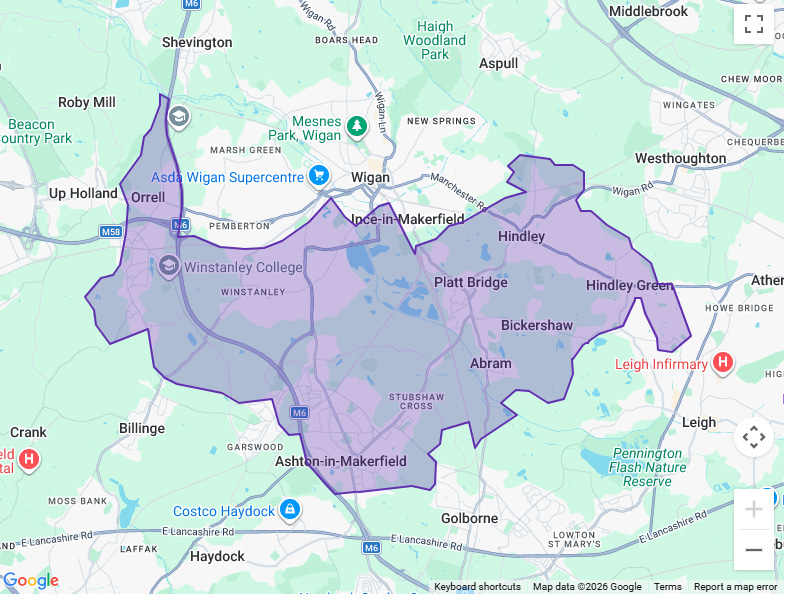
Makerfield takes in eight wards wrapping themselves aroudn the south and west of Wigan town centre. It is bordered to the north east by the outlying Bolton suburb of Westhoughton1, in the seat of Bolton West; to the East and South East by the towns of Atherton, Leigh and Lowton in the seat of Leigh and Atherton; to the South and South West by Haydock (home of Haydock Park racecourse) and Newton Le-Willows in St Helens North consistutuency; to the West and North West by Skelmersdale in the sprawling West Lancashire seat; and to the North by Wigan town centre and Ince-in-Makerfield, both in Wigan constituency.
There is a lot of green on the Makerfield seat map. Though located in a metropolitan borough and a big city combined authority, Makerfield is an archipeligo of separate and often poorly connected towns. This geography is a legacy of the mining industry around which these communities first sprang up, each town built around pits and related industries. There are five big clusters of settlement going from East to West - Hindley and Hindley Green on the edge of Leigh; Platt Bridge, Bickershaw and Abram between Leigh and Ashton; Ashton-in-Makerfield, the seat’s largest town, abutting Merseyside on the Southern edge of the seat; the suburbs of Winstanley and Orrell wrap themselves aroud Wigan in the Western corner of the seat. The towns in the north-east - Hindley, Platt Bridge and Abram - are more economically deprived while the towns hugging the M6 in the west - Orrell, Winstanley and Ashton-in-Makerfield itself - are rather better off.
Map of the Wigan area collieries in 1925 - Makerfield constituency takes in much of the southern third of this map
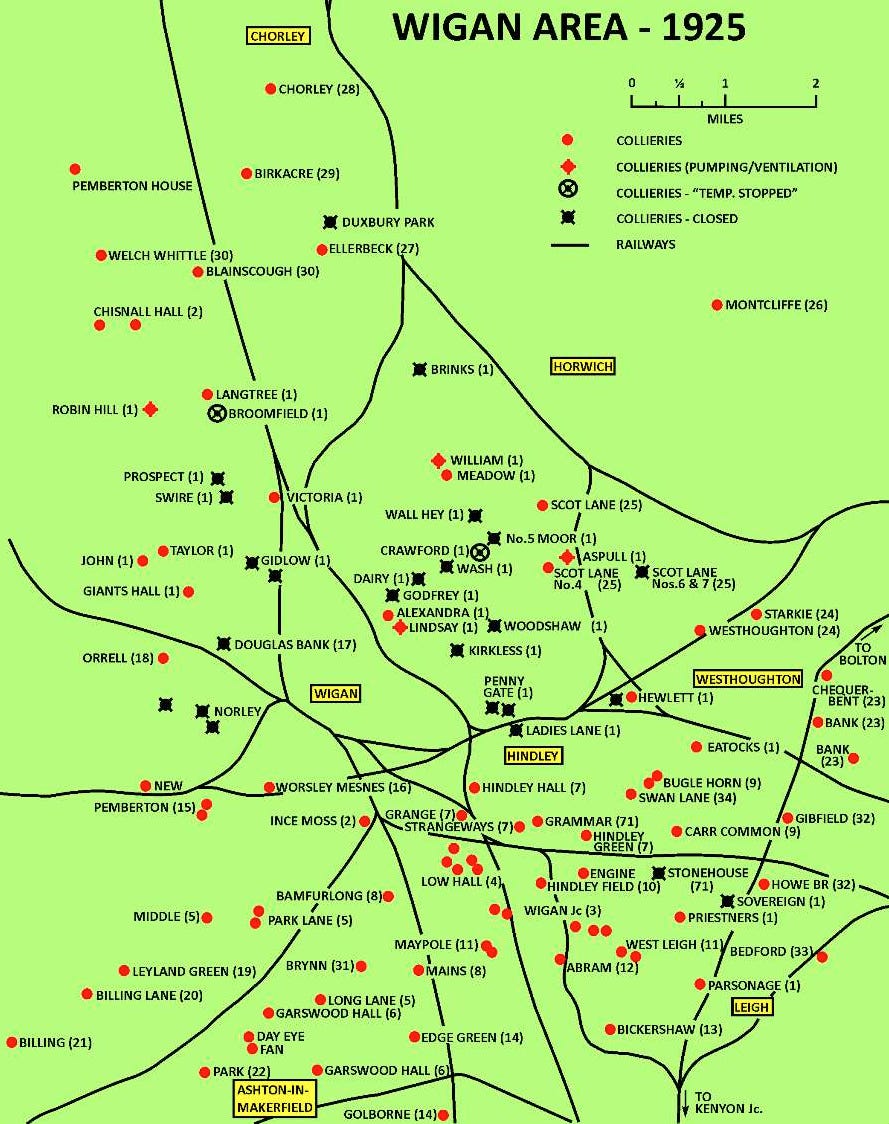
Source: Northern Mine Research Society
None of the towns in Makerfield have tram links to Manchester and it is much quicker to get to Liverpool’s city centre than Manchester’s from most of the seat’s train stations. It is also no wonder Andy Burnham’s “Bee Network” buses are so well known here - buses are often the best or only option for non car owners in an area where the only other public transport is usually the catastrophically dyfunctional Northern Rail network.
But most Makerfield residents avoid public transport entirely. This is car commuting territory, though wherever you are in Makerfield constituency it is usually easier to drive out than across - no major roads run link all of the seat’s main settlements directly, though each town has a major road taking people out of the seat. The A577 running through Hindley and Hindley Green carries people west into Wigan and east into the Manchester ring road system, the M6 running along the western edge of the seat carries people north and south, while the M58 branching off the M6 in Orrell ward takes motorists into Merseyside.
While Makerfield has endured often wrenching economic changes after the mining industry collapsed, and remains held back by geographical fragmentation and unreliable transport, this is an area which defies simplistic stereotypes of rusting red wall towns. Home ownership is high, unemployment is low, and economic activity matches the national average. Makerfield has many attractive neighbourhoods with good cheap housing and impressive local schools. It is commutable to both of the North West’s economic engines - Manchester and Liverpool - and on the doorstep of Wigan, where large regeneration projects are underway.
Demographic profile: cars and commuters
One of the great stories of social change across England in general, and Manchester in particular - immigration and rising ethnic diversity - has passed Makerfield by completely. This seat is 97% white and 96% British born, with 97% offering only British forms of national identity.
This is also a seat of settled home owning commuters: 94% of the accommodation in the seat is housing rather than flats, 73% of residents own their house outright or with a mortgage, and nearly 70% of those houses have three bedrooms or more - all figures well above the national average. The share of Makerfield residents who rent from the council or private landlords is well below the national average.
Makerfield is also distinctive in its attachment to the car: two thirds of residents report getting to work by car, either as driver or passenger, well above the national average (49%), while the share who report working mainly from home is well below the (COVID inflated) national average in the 2021 census.2
Makerfield compared with England and Wales averages on various 2021 census measures
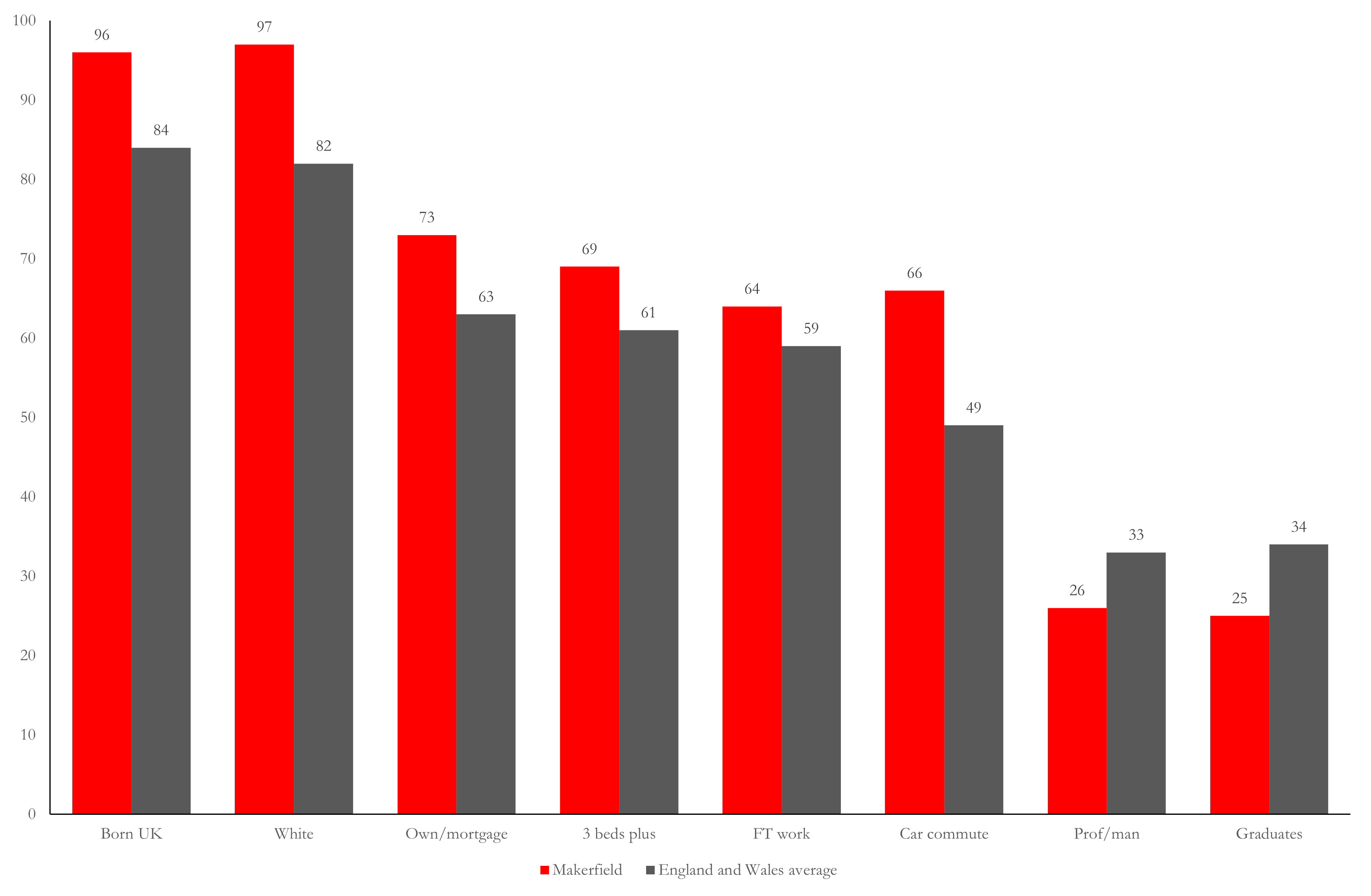
A seat of white, British born, home owning commuters working everyday jobs full time
And there are a lot of commuters. Claimant count unemployment is below the national average, and overall economic activity is bang on the average for England and Wales as a whole. This is a seat with plenty of skilled workers and lower middle class strivers, with above average shares working in admin, skilled trades, and caring/leisure services as well as a share of routine manual workers which sits well above the national average. Conversely, there are relatively few residents from Labour’s newer core vote of professional middle class graduates - the share classified in the upper reaches of the middle class is well below average, as is the share who hold a university degree.
Makerfield as a whole is not an economically deprived , but the constituency average masks substantial variation. There are eight council wards entirely within Makerfield constituency - four have deprivation levels above the England and Wales average, four below. Prosperous and deprived communities are often right next door to each other - for example Platt Bridge (the deprived community at the centre of Abram ward) is a ten minute drive from the centre of Ashton-in-Makerfield, the seat’s relatively well to do largest settlement. The two most prosperous wards - Orrell and Winstanley - are however somewhat set apart from the rest, sitting on the northwesternmost edge of the seat and with better links to Wigan centre going east and Merseyside going west than to the other towns of the constituency.
Share of households deprive on at least one dimension, Makerfield wards and England and Wales average
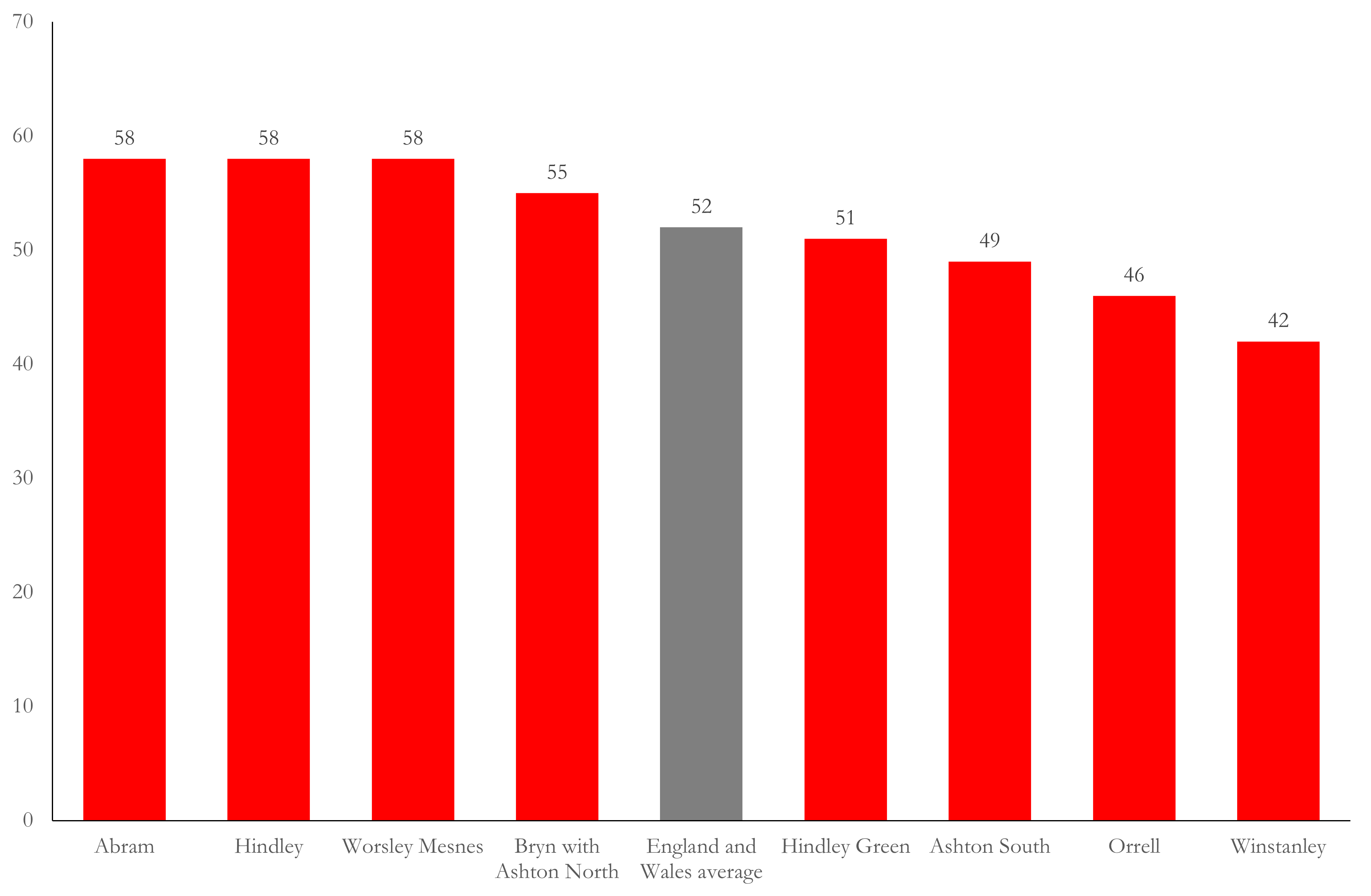
Source: 2021 Census
In many respects, Makerfield fits the profile of a swing seat - a diverse collection of distinct commuter towns encompassing the secure and the struggling, the well connected and the isolated, with higher than average home ownership but also higher than average shares in mid-ranking and working class occupations. A seat like this in Essex or the East Midlands would most likely be a battleground, change hands on a regular basis between Labour and the Tories. But Makerfield has (so far) never swung with the winds in Westminster. And to understand why, we need to dive intothe area’s political history.
Political history: the rise and fall of mines and miners
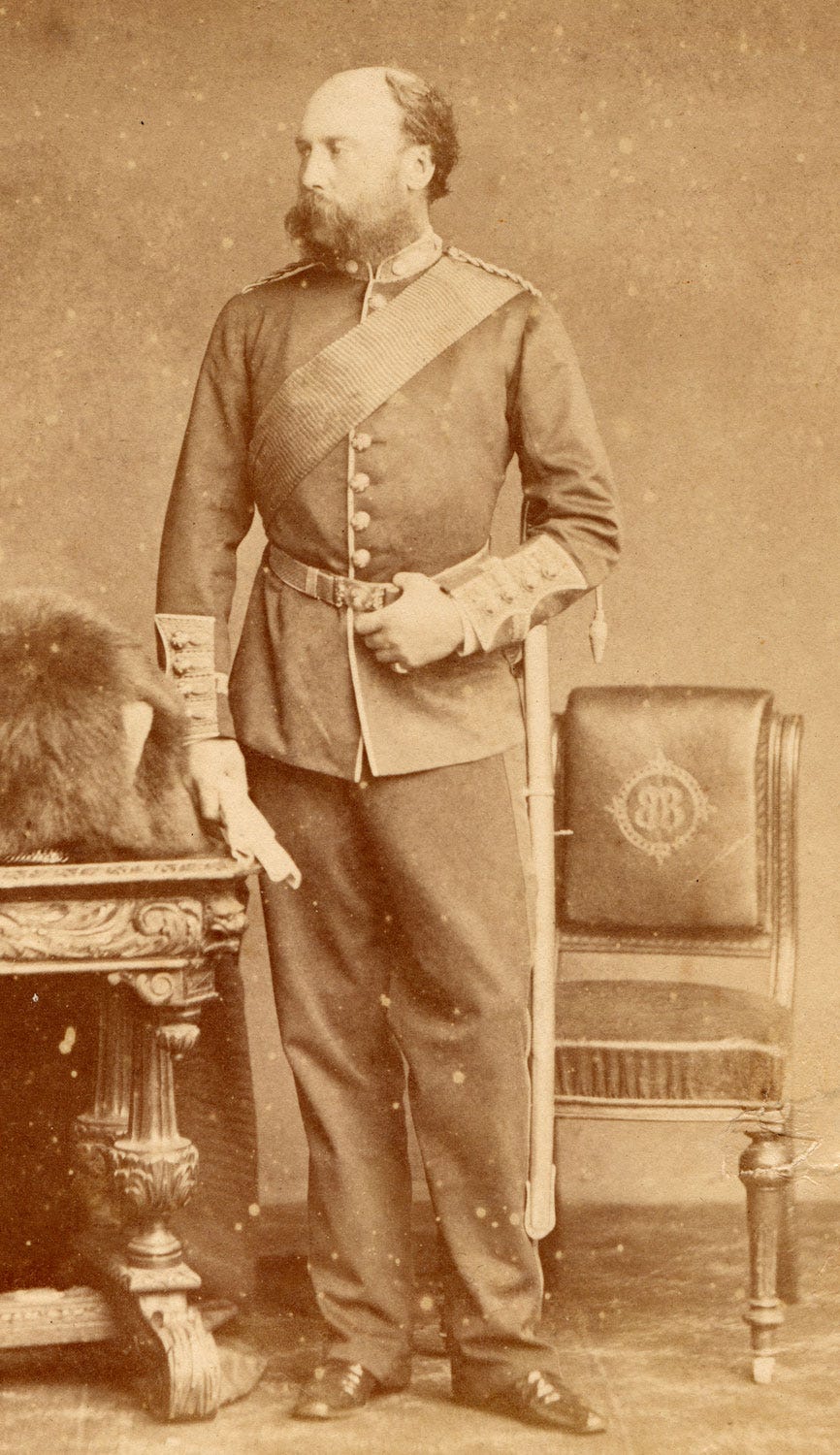
Out with the old…Henry Blundell-Hollinsead-Blundell, Makerfield’s last Victorian MP
The Westminster electoral history of Makerfield, and its predecessor seat Ince, is in one respect simple: Labour, Labour, Labour. But while the name on the rosette remains the same, the succession of MPs representing the area also traces the shift of the Labour party, nationally and locally, away from unionised heavy industrial and towards university graduates and the public sector.
Stephen Walsh (1906-29) was elected as member for Ince in 1906, before most workers had the vote and before there was even a Labour Party for them to support.3 Walsh, an orphan who had left school at 13 to work in an Ashton-in-Makerfield coalmine, defeated the area’s long serving Conservative incumbent Henry Blundell-Hollinsead-Blundell CB DL, Captain of the Boats and veteran of the Wall Game at Eton; Classics graduate (Christ Church, Oxford)); veteran of the Nile Expedition to rescue Captain Gordon; married to a Maid of Honour of Queen Victoria. Blundell-Hollinsead-Blundell could at least claim a local link: his family owned much of the Lancashire Coalfield. Ince’s first Labour MP was the miner was defeated the mine owner.
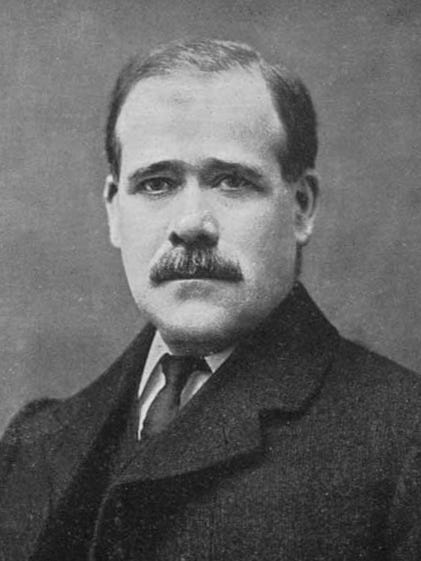
…in with the new: Stephen Walsh: Kirkdale orphan, Ashton-in-Makerfield miner, Labour Party Deputy Leader
Walsh served as Member for Ince for 23 years until his death in 1929, rising to the top ranks of the Labour party as it emerged as a party of government, serving in front bench roles in Lloyd George’s wartime coalition during World War I, serving for two years as Deputy Leader of the Labour party in 1921-22, then entering the Cabinet as Secretary of State for War in Ramsay Macdonald’s short first government of 1924, suceeding the Earl of Derby. Walsh never won less than 57% in six contests, and in 1918, the first universal male franchise election, he won an astonishing 87% of the local vote.4
The three MPs who followed Stephen Walsh were all cut from the same cloth: local miners sent from the pits to Parliament by the mining unions. First was Gordon Macdonald (1929-1942), a Welsh born native Welsh speaker who moved to Lancashire as a small child, joined his father working in an Ashton-in-Makerfield pit at 13, and rose to serve as the last governor of Newfoundland before it was returned to Canada, and was given a peerage by Attlee, who made Baron Macdonald of Gwaenysgor his Paymaster-General.5
After Gordon Macdonald came Leigh born Tom Brown (1942-1964), a miner since the age of 12 and Vice President of the Cheshire Miners’ Federation, who became known as the “miner’s champion” through his tireless advocacy on behalf of miners, pressing for better pensions and compensation for those suffering for industrial diseases. In five contested elections from 1945 to 1959, Brown never won less than 70% of the vote.
The last of Ince/Makerfield’s mining MPs was the most controversial. Michael McGuire (Ince 1964-1983, Makerfield 1983-7) migrated from county Mayo as a young child and started working in a St Helens pit at the age of 13. He rose fast through the National Union of Mineworkers (NUM), who were instrumental both in his arrival and departure from Parliament. As with his predecessor, union support secured him the Ince safe seat in 1964, but in the Miner’s Strike of 1984-5 McGuire’s refusal to condemn Lancashire mine workers (including many of his own constituents) who voted to continue working put him at odds with the NUM of Arthur Scargill. It was a politically fatal choice - he was deselected by Labour ahead of the 1987 election.
After 81 years being represented by men who had toiled in the local pits, in 1987 Ian McCartney (1987-2010) became the first Labour MP not to have grown up locally or worked in the local mines. But McCartney had a traditional working class Labour biography in other respects - he left school at 15 with no qualifications and worked a number of manual jobs before making a name for himself as a local councillor in the seat.
After McCartney, another political high flyer who held front bench roles including Chair of the Labour Party during the Blair years stood down there came a bigger change. Yvonne Forague (2010-24) was a break from the norm in a seat which had only elected working class men who left school at the earliest opportunity for over a century: a univeristy graduate, a public sector professional (20 years as chief executive of St Helens Citizens Advice Bureau), and a woman.
Fovargue was a break with Makerfield’s long tradition of local working class MPs, but she could at least claim strong links to, and service in, the area. The same could not be said of Josh Simons (2024-26), the MP controversially selected for Makerfield by a Labour National Executive Committee panel in 2024 following Fovargue’s late announcement that she would stand down. Though born in the North West, Simons, 31 at the time of his selection, went to school in Cambridge, then went on to secure degrees from Cambridge and Harvard (PhD) before working on AI for Meta, creators of Facebook. For the two years prior to his selection he had served as Director of Labour Together, the Starmer loyalist think tank closely associated with Keir Starmer’s electoral impresario Morgan McSweeney.
If Stephen Walsh and Gordon Macdonald, working class kids whose rise from the local pit to the pinnacles of power epitomises the romantic tale Labour likes to tell about its idealised past, Simons, a transatlantic intellectual with credentials from the world’s leading universities and close links to the Labour leadership, parachuted into a struggling community he had no connection to, personified the story critics tell of Labour’s troubled present. Local reaction to the well connected, London based Simons was frosty, at best, and Reform sought to capitalise on the controversy by selecting Robery Kenyon, an army veteran and local plumber, to run against Simons. Reform managed a strong second place, with over 30% of the vote, but Makerfield, though grumpy, stayed red.
Makerfield electoral history: Labour, but with reservations
Staying red is what Makerfield does. No one but Labour has won a Westminster contest here in 120 years. That sets Makerfield apart from other constituencies with similar local histories and political cultures, white working class former coalfield seats such as Ashfield, Blyth Valley, Bolsover and Makerfield’s neighbouring constituency of Leigh. All voted heavily for Leave in 2016, and all were swayed by Boris Johnson’s promise to “get Brexit done” in 2019. But not Makerfield - Labour won here by nearly 5,000 votes in 2019, and the Conservative vote barely grew. Makerfield - a white, working class, 66% Leave voting Labour seat - looks like an achetypal ‘Red Wall’ battleground, but even Boris Johnson could not break through here.6
But something changed here this year. Reform swept across Wigan borough, winning all but one of the seats, including every ward in Makerfield.
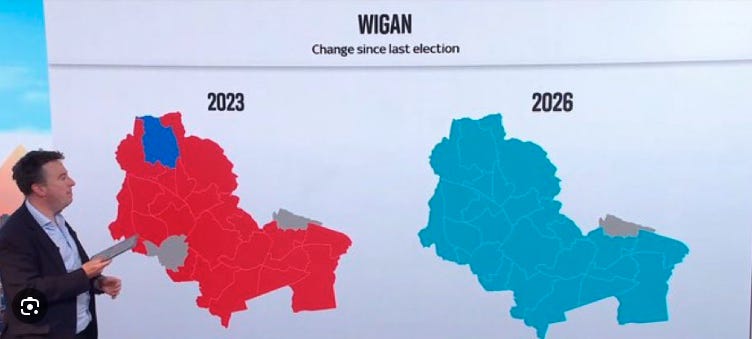
It is indeed a dramatic shift
Before and after maps of Wigan local election results, with Labour swept aside by a great teal wave, will be widely shared in coming weeks. But such maps are doubly misleading. Firstly, the red landscapes of 2023 and 2024 overstate Labour strength in Makerfield, where Labour is generally strong enough to win but not dominant. Secondly, the great Reform wave of 2026 is inflated by the near-disappearance of the independent candidates who had hitherto provided the main local opposition. The vanishing of independents helped Reform amplify their advance and sweep the seat by uniting local and national discontents under a single banner.
Most Makerfield wards vote Labour most of the time, but most also have also bucked the party at some point in recent electoral history. In the mid 2000s, Community Action, a minor party combining economic populism (free public transport), NIMBYism (moratorium on green belt building) and authoritarianism (zero tolerance on crime) became the official opposition on Wigan council by winning most of the seats available in the Makerfield wards. After the disintegration of Community Action, the seat lacked a unified voice of opposition, but local voters continued to find outlets to express discontent with Labour in most of the seat’s wards.
Labour vote and largest non-Labour vote in Makerfield wards, 2024
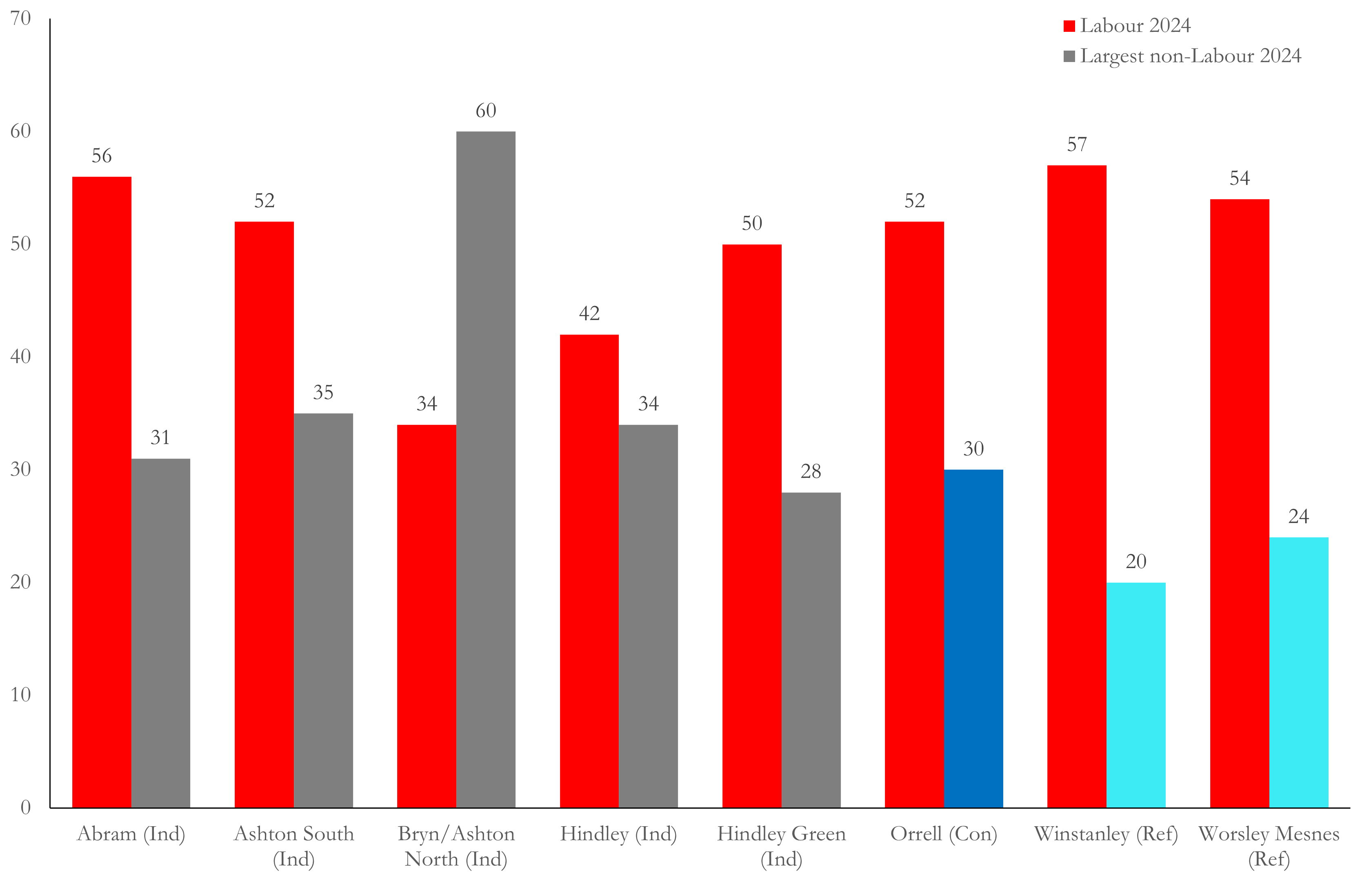
Voters in the towns of the South and East of the seat - Ashton, Bryn, Hindley and Hindley Green - have consistently backed independent candidates in large numbers - the independent vote in each of these wards has averaged over 30% since 2015. Bryn, in particular, seems determined to plough its own furrow in local contests: independents have won the ward in seven of the last ten elections. Labour has generally prevailed in the other three, but by narrow margins.
UKIP and, earlier, the BNP have posted substantial vote shares in Abram and Worsley Mesnes - the two most deprived wards in the seat - but neither the far right nor the radical right ever won either seat before 2026.7 In the more prosperous commuter suburb of Orrell at the Western edge of the seat, the Conservatives were until recently strong enough to compete and sometimes win (their last success was in 2021). The opposition is fragmented, but Makerfield has never been a Labour monoculture - most Labour councillors face serious electoral competition in their wards.
Yet while Makerfield voters have a clear independent or anti-Labour streak in local elections, before 2026 this was never a happy hunting ground for the radical right. UKIP, and earlier the BNP, achieved substantial vote shares in some Makerfield wards but neither ever won a seat. Given the demographics of the area - overwhelmingly white, with few graduates, students or migrants, and many working class car commuters - this is surprising. Areas with profiles like this often returned large groups of UKIP councillors during the peak UKIP years running up to Brexit. UKIP’s failure to break through may reflect the area’s political culture - Makerfield sits in Greater Manchester, where the local Labour party is unuusally strong, but is also within the commuting zone and cultural orbit of Merseyside, a city-region where voters have been exceptionally loyal to Labour and hostile to both the traditional and radical right in recent decades regardless of local demographics.
Labour and Reform vote changes 2024-26, local elections in Makerfield wards
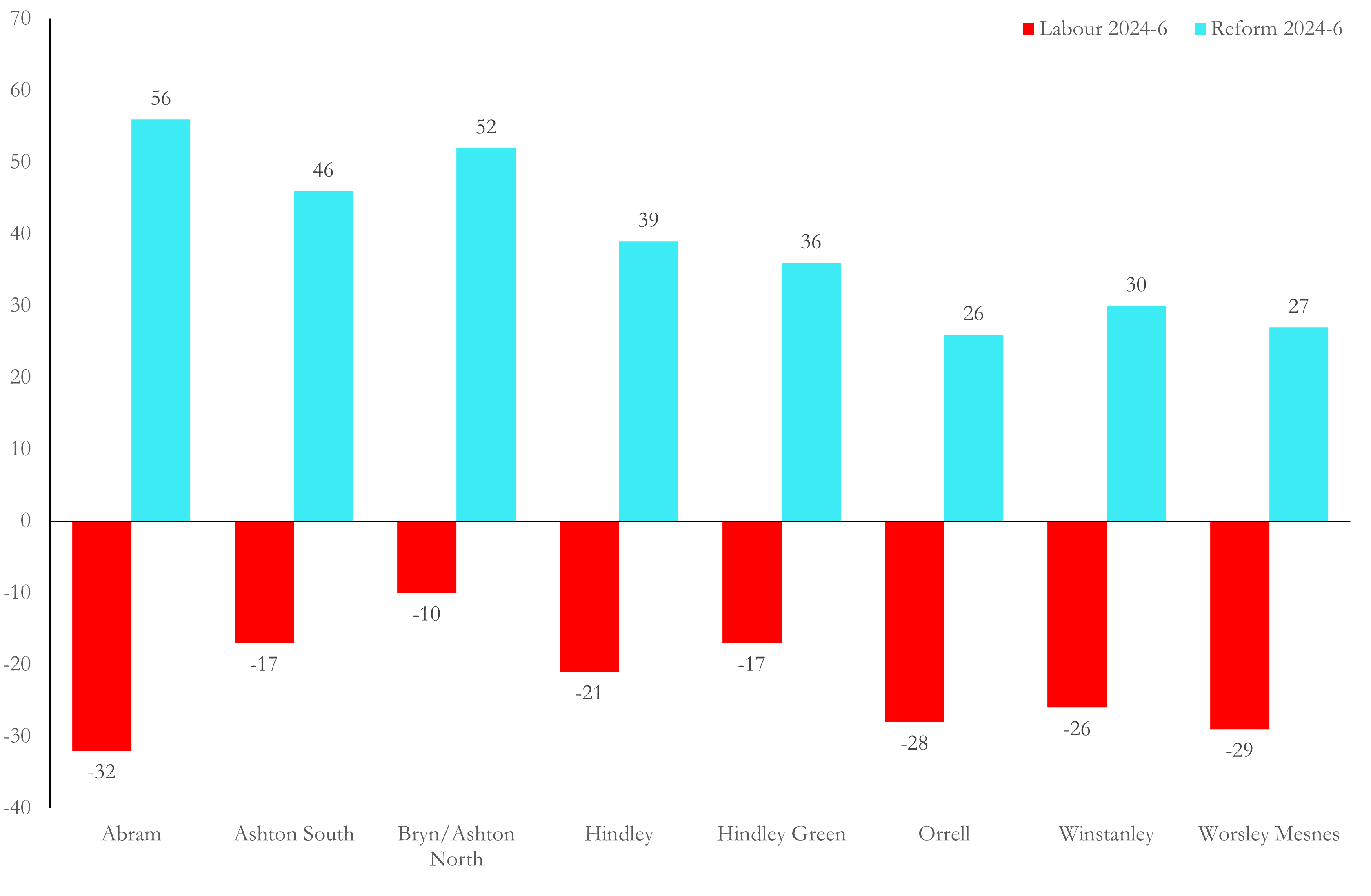
Whatever the reasons for Farage’s past struggles here, the local picture changed utterly in 2026, when Reform won ever ward in Makerfield as part of their sweep of Wigan council, where they won all but one of the seats up for election. As we can see above, Reform’s advance was very impressive indeed, with gains on 2024 ranging from +26 to +56 in Makerfield’s wards. But in most cases the Reform advance was much larger than Labour’s decline, reflecting the abrupt disappearance of the independent candidates who had been the focal point of pre-Reform local opposition. We should not downplay Reform’s achievement here - a clean sweep of an area like this is quite remarkable. But it is a reflection both of gains from Labour and a consolidation of the substantial existing anti-Labour vote. This is the trick Reform will need to repeat if they are to defeat Labour’s most popular politician next month.
State of the race: advantage Andy?
Local prospects in Makerfield look very different depending on whether we focus on 2026 or 2024. Focus on this month’s local elections and it looks like a straightforward Reform gain - the party has just swept the board in an area with Reform friendly local demographics. And the party achieved a big swing here in 2024, capitalising on local discontent with a parachuted candidate to more than double their vote, displace the Conservatives as the local opposition and turn the seat into a clear Labour-Reform marginal. Reform start in a far stronger position here than they did in Gorton and Denton, where they pushed Labour into third, or in Runcorn and Helsby, the seat they gained last year. The political climate right now is harsh for incumbents - no party has successfully defended a Westminster seat since the Conservatives narrowly held Uxbridge and South Ruislip in July 2023 - a run of eleven successive defeats over three years which is without precedent in modern electoral history.
2024 and 2019 notional vote shares in Makerfield
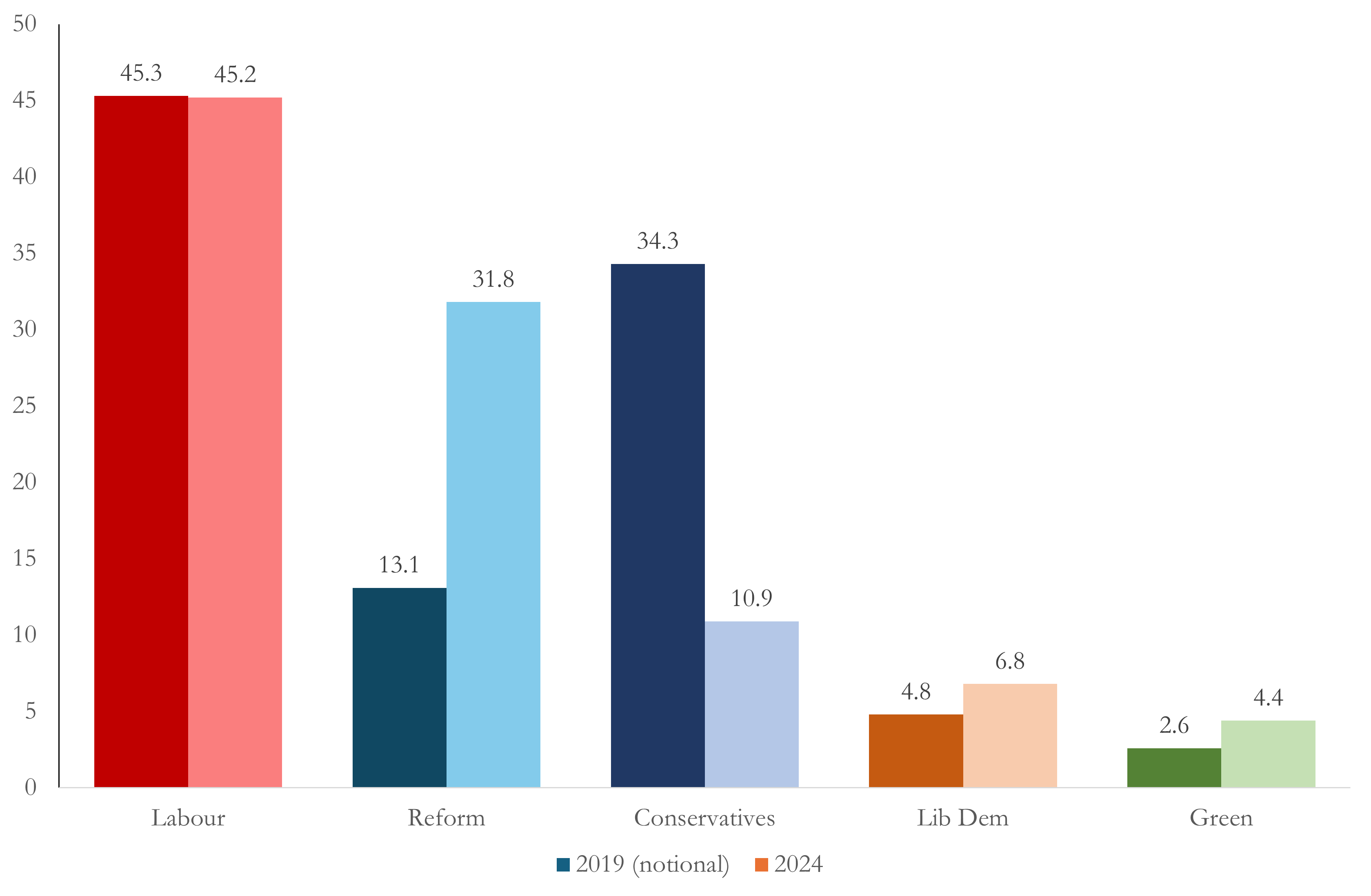
But look a bit further back and Makerfield looks like a much tougher contest for the insurgents. The seat has rebuffed Farage’s past advances, and despite being heavily Leave, voters were not persuaded by Boris Johnson’s “Get Brexit Done” campaign in 2019. Reform’s surge in the 2024 election looks to have come at the Tories’ expense - Labour’s vote barely dropped here despite the party’s candidate controversy.
And the contest looks different still if we focus on Mayoral elections where Andy Burnham is on the ballot - Burnham has massively outperformed Labour across Wigan borough in all three of his Mayoral contests, winning the borough every time by stunning margins, with two thirds or even three quarters of the local vote. Few politicians anywhere can boast of an electoral record as dominant as Andy Burnham’s in Greater Manchester.
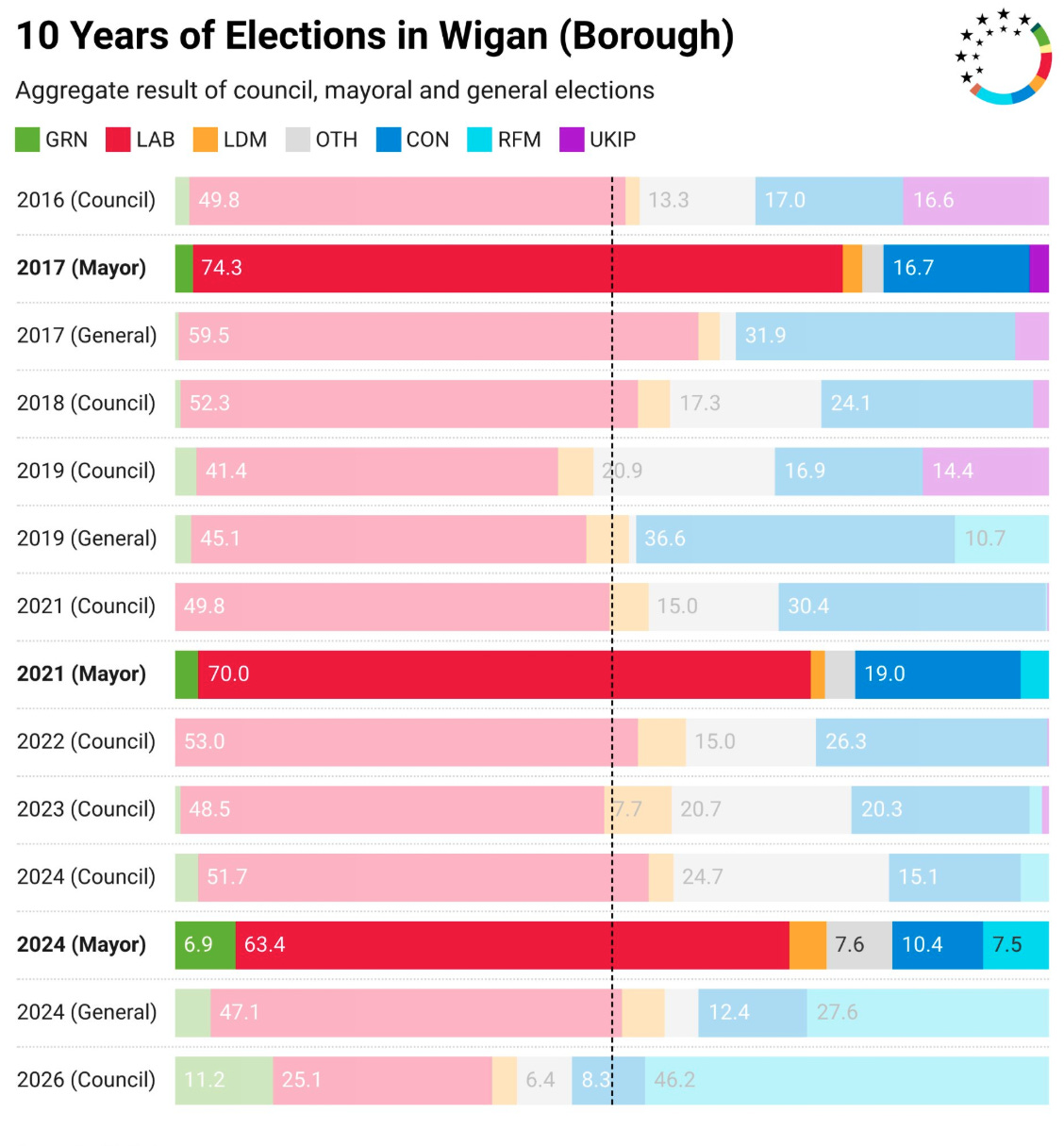
Source: Josh Housden/Nowcast.uk
But for all Burnham’s undoubted strength, Reform have a clear shot at victory in Makerfield. They swept the seat just a few weeks ago, and these local election gains show us the path to a Reform victory - consolidate the fragmented, anti-Labour and anti-establishment vote behind a single banner and then recruit enough disaffected Labour voters to tip the balance.
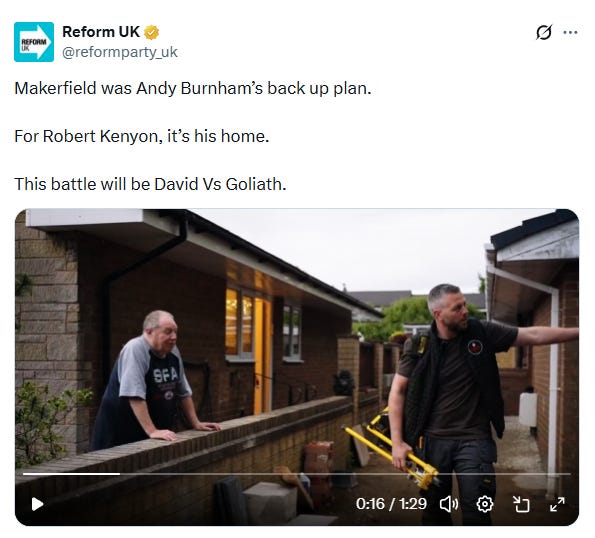
Robert Kenyon, local lad and local plumber doing local plumbing for locals in Makerfield. Watch the full video here
Reform have started well on this front, picking a local plumber, Robert Kenyon, who is already a veteran of four Makerfield election campaigns, having run in the last three local elections (each time in a different ward) as well as being the Reform Westminster candidate in the 2024 general election.8 Kenyon is an effective communicator, and his slick launch video draws a strong contrast between his status as a local plumber (plumbers are having a good run in Manchester politics) and:
“Labour, and most of the other parties, who have got career politicians, they go to private school and university, they get a job at a think tank…and then before you know it they’re parachuted into a seat.”
This is a pretty accurate summary of outgoing MP Josh Simons’ CV, though it works less well as a critique of Andy Burnham, and not at all as a summary of earlier Ince/Makerfield Labour MPs, as we have seen. But that local history will not be known by most, while memories of the Simons parachute controversy are fresh, so this is an obvious bruise for Reform to punch, particularly when fielding a candidate who provides an obvious counterpoint.
The selection of Kenyon, and the highly professional campaign material produced so far, suggest Reform will fight this seat tooth and nail. As well they might: the seat is a one way bet for Farage’s party. Defeat to Labour’s most popular politician can be easily explained as a one-off, but for the same reason victory would be a haymaker sending the Labour party to the canvas, knocking out the heir apparent and most likely triggering chaos and panic in the governing party.
No pressure, then, for the man whose ambitions to turn around the Labour government’s political fortunes have triggered this contest. Andy Burnham has made no secret of his local credentials, with his campaign launch video reminding Makerfield residents that he “got battered” in school rugby league matches in the seat, and sends his own children to a local school nearby.
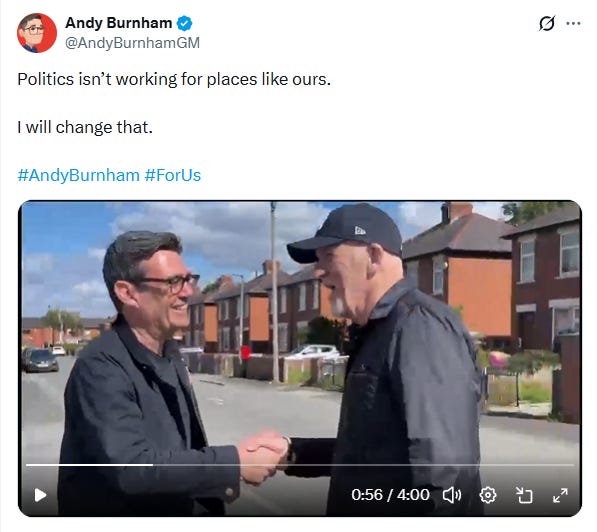
Andy Burnham, local lad and local leader, meeting locals locally in Makerfield. Watch the full video here
While the first half of the video burnishes Burnham’s local credentials, the second half reminds Makerfield voters of his political achievements “fighting for ordinary people” - compensation for miners, justice for Hillsborough (important in an area with many Liverpool and Everton fans), and of course his success and popularity as Greater Manchester mayor. A procession of grinning locals march up to him to shake hands and take selfies, with one telling the camera “If he can do for the country what he’s done for Manchester, we’ll be in a better place, for sure.”
The outcome of this contest will likely turn on whether the people of Makerfield buy into that argument. The many commuters in the seat will be well aware of Manchester’s revival, though equally aware that their area hasn’t seen much of the benefit. But they clearly like Andy Burnham. And if he can turn that goodwill into votes next month, then he will arrive in Westminster looking like the man with the magic touch, and the path to Downing Street will clear.
Like all magic tricks, this one involves suspending disbelief - retaining a seat Labour has never lost in 120 years ought not to be an achievement. But such seats have been falling like ninepins lately and Burnham’s party are desparate for someone, anyone, who can turn around their fortunes. And therein lies Reform’s great opportunity: if Farage can defeat Labour’s great champion in his own backyard, all hell will break loose. The fates of two parties, and the trajectory of the rest of this Parliament, now rests in the hands of Makerfield voters. This is truly a by-election like no other.
Boltonians refer to Westhoughton residents as “keaw yeds” or “cow heads”, referencing a local legend concerning a Westhoughton farmer who discovered a cow with his head stuck in a new and expensive gate. Deciding the gate was worth more than the animal, the farmer resolved the issue by beheading the cow.
Makerfield’s attachment to the car may be one factor in Reform’s strength here in 2026 - Southampton political scientist Lawrence McKay has found car commuting to be one of the strongest predictors of Reform performance in this May’s local elections. The prevalence of car commuters also means this is likely to be a seat where Greater Manchester’s “Clean Air Zone” pollution charging scheme, now mothballed, was particularly unpopular.
Walsh stood for the Labour Representation Committee; the Labour Party’s first nationa conference came the next year).
Even more astonishing, the other 13% of the vote went to the communist newspaper editor and Socialist Labour candidate William Paul, presumably on the basis that Walsh was not left wing enough.
Macdonald returned to his Welsh roots at the end of his career, serving as National Governer for Wales of the BBC. and as Chairman of the Broadcasting Council for Wales.
Though it meets the popular stereotype of the ‘red wall’ - white working class Leave voting Labour seats in the North and Midlands - Makerfield was not one of the seats included in the original “red wall” classification by James Kanagasooriam, the analyst who coined the term. See: Kanagasooriam, J and Simon, E (2021) “Red Wall: The Definitive Description”. My thanks to Isla Glaister for flagging this point.
Platt Bridge, the main town in Abram ward, is known locally as “Platt Wazz.” The origins of this are obscure, but one theory is that the local train drivers regularly stopped here to use the facilities.
Kenyon ran in Winstanley in 2023, coming last with 18% of the vote, then ran in Orrell in 2024, coming third with 14%, then switched to Bryn with Ashton-in-Makerfield North in 2026, where he won with 52%. The last move was astute, as Bryn is the Makerfield ward most open to electing non-Labour councillors.
Brilliant breakdown. The point about Reform consolidating the legacy independent/Community Action vote is crucial, but the ultimate wildcard here could end up being fragmentation on the left.
In a seat where the baseline Survation model gives Burnham a razor-thin lead over Reform, voters voting on grassroots conviction matters immensely. If even 3% of the left-wing vote goes Green, Burnham’s cushion will completely vanish and could essentially hand the seat to Reform.
‘Makerfield is part of Wigan Borough Council but it is not really Wigan either - residents of Makerfield’s identify primarily with their towns, and regard Wigan itself as a local rival.’
This sounds like a description of Leigh (or perhaps Atherton or Tyldesley.)
The wards within Makerfield (aside from one small section) are very much within the town of Wigan as well as the borough of Wigan (yes I realise this is incredibly confusing!)