
Gorton & Denton Final Update: All To Play For
Anyone can win it, and each will have a tale to tell if they do

State of the race: Intriguingly poised
Welcome to my final update on the Gorton and Denton by-election, now just a few days away. The big news since my last post is the publication of two constituency polls from reputable pollsters. I had not expected seat polling here, given the difficult demographics of the area, and while there are some caveats attached to both polls, the polls provide us with our first rigorous and independent intelligence on a hard fought and much spun contest, and they tell a consistent story.
And that story is: the race is a dead heat, a statistical three way tie going into the final days. Omnisis, who published over the weekend, have the Greens narrowly ahead on 33%, Reform on 29% and Labour on 26%, but they also have a huge number of undecided voters, outnumbering committed supporters for any party. Opinium, who published on Tuesday evening, have the race Greens 28% Labour 28% Reform 27%, though among voters who are most likely to vote the Greens hold a narrow two point lead (30-28-28). All of these differences are well within the margins of error in a constituency poll, which are noisier and harder to get right. The race is, in short, a near-perfect three way tie. Like a classic cricket test match, this contest goes into the final session intriguingly poised, with all results still possible.
Gorton and Denton seat polls - it doesn’t get closer than this
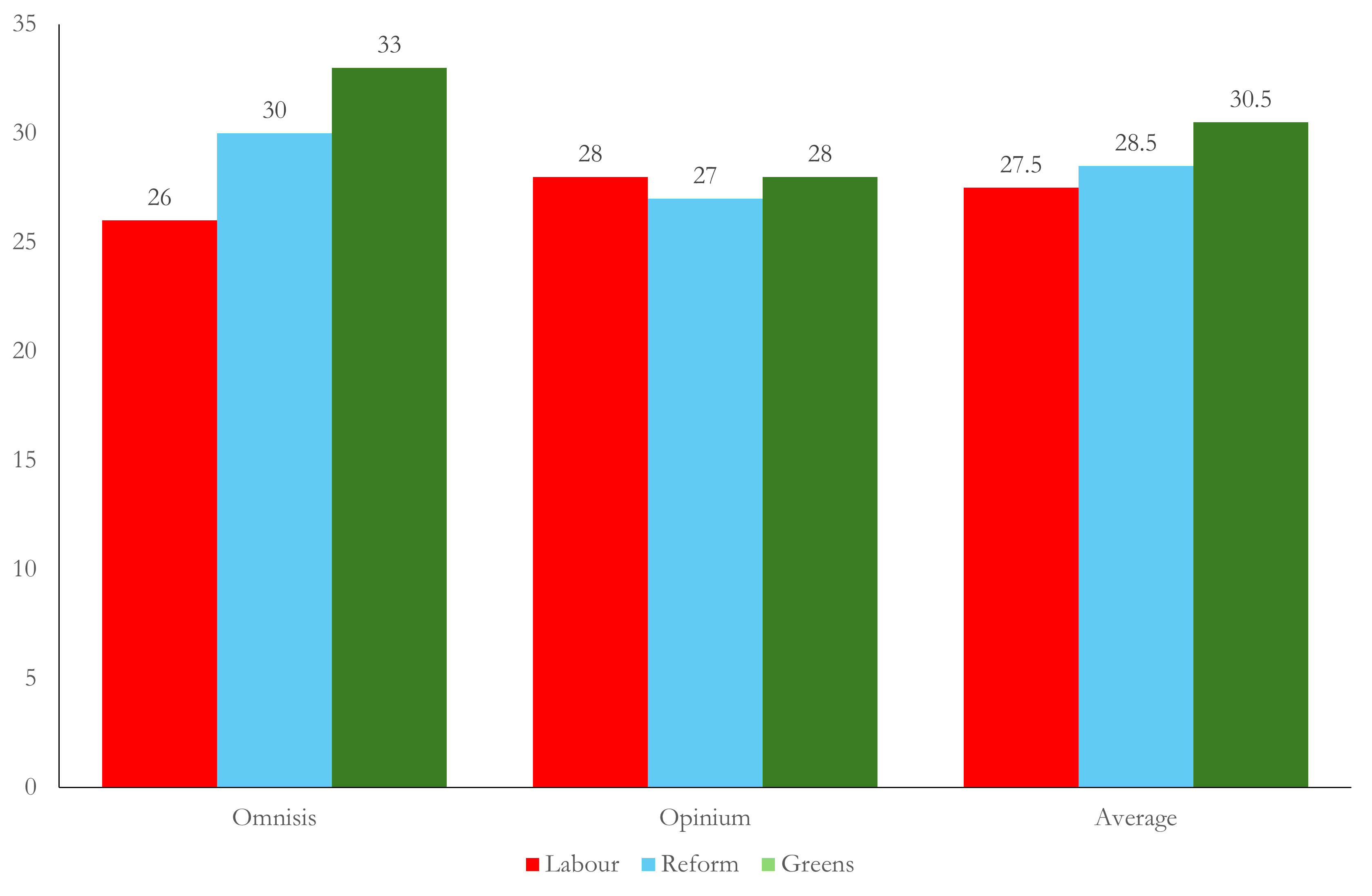
Every party will take encouragement from these polls. Reform look to have fully mobilised their potential support in a seat where they are at a substantial demographic disadvantage - 30% support is above a uniform swing from national polling, in a seat where based on demographics we would expect Reform to underperform their national polling. Matthew Goodwin’s polarising and often controversial campaign has succeeded in its core aim - the Reform vote looks energised and mobilised, and Reform are still in the running with days to go.
The Greens will also be greatly cheered by two polls that put them either narrowly ahead or tied for the lead in a seat where they started with no presence in local government, little organisation and finished a distant third place in the general election less than two years ago. Whether they win or not, the Greens look certain to smash their previous record in a by-election - 10.2% in Somerton and Frome in 2023 - and will emerge with much enhanced credentials as a challenger to Labour in the governing party’s traditional urban heartlands. Even a narrow defeat will set the Greens up well for local elections due in Greater Manchester in less than three months, and for the general election contests to come in this seat and others like it.
Labour, too, will take heart from polling that shows them battered yet unbowed, and still in contention to hold on to the seat despite a dire national polling environment, scandals embroiling the government, and intense anti-incumbent campaigns attacking them from the left and the right simultaneously. A successful by-election defence in this harshest of climates will boost national and local morale, making the possibility of government survival and electoral recovery that bit more credible.
Could tactical voting break the deadlock?
Yet a three way tie also represents a failure of tactical coordination. As I anticipated in my first post on Gorton and Denton, the combined left vote remains much larger than the right vote, meaning that while Reform have performed well in a tough seat, they are only still in the running thanks to a near-perfect split in the Labour and Green vote. If anything tips the balance towards one or the other of the two left parties in the final days, that may prove decisive. And there are two scraps of information both favouring the same contender.
Firstly, both pollsters sought to quantify tatical voting by asking respondents how they would vote if they believed different pairs of parties were the the only viable options in the constituency. In the Omnisis poll, both Labour voters and undecided voters expressed a considerably greater willingness to cast a tactical vote for the Greens than vice versa, meaning a Greens vs Reform race came out as Greens 39 Reform 25, while a Labour vs Reform race came out Labour 33 Reform 28. In the Opinium poll 66% of Labour and Lib Dem supporters said they would be willing to back the Green candidate is she was “best placed to beat Reform in your constituency”, while 41% of Green and Lib Dem supporters said they would be willing to back the Labour candidate is she was strongest locally.
By sending two clear signals - that the Greens can win and that they are better placed to benefit from late tactical voting - these polls may end up helping to break the very deadlock they have revealed, if such information helps persuade some waveering voters eager to keep Reform out to coalesce behind the Greens. The seat polls have already persuaded two potentially influential actors, the tactical voting websites tactical.vote and StopReformUK.vote, who have both endorsed the Greens as the stronger anti-Reform option, citing these polling numbers, in particular the tactical voting cross-breaks as major factors in this choice. However, neither site claims the polling alone is decisive, and they point to other factors including the dire national polling for Labour, the general anti-incumbent dynamic found in by-elections, and the withdrawal of the Workers Party, whose supporters seem most likely to go Green. It is hard to know how many voters will use such sites, or even be aware of them, but there is no doubt that both the recommendations and the polls themselves provide a filip to Green campaigners, and a further obstacle for Labour campaigners, as we enter the frantic final hours of the race.
And frantic this race has certainly been. Both the Reform and Green candidates have poured fourth a great torrent of social media output, each with a similar “walking down the street talking to camera” video format, and in each case with multiple monologues which focusing on demonising their populist opponent as well as bashing Labour. Followers of Matthew Goodwin’s social media accounts have been told the Greens are a “trojan horse” for sectarianism, extremism, open borders legalising all drugs and sexualising children in a campaign which certainly isn’t going to be criticised for excessive subtlety. Goodwin hasn’t yet said that a Green victory would be a sign the apocalypse is nigh, but there are still 48 hours to go. The Greens’ Hannah Spencer has been almost as hyper-active on social media channels, but with a rather more upbeat message promoting her story as a local plumber who left school at 16, taking pot shots at Labour and attacking Reform’s politics of fear. The Labour candidate, Angeliki Stogia, seems to be a bit of a throwback to an earlier era of campaigning, largely shunning social media and seeking to persuade small groups of voters face to face (helped by her spurned colleague Andy Burnham).
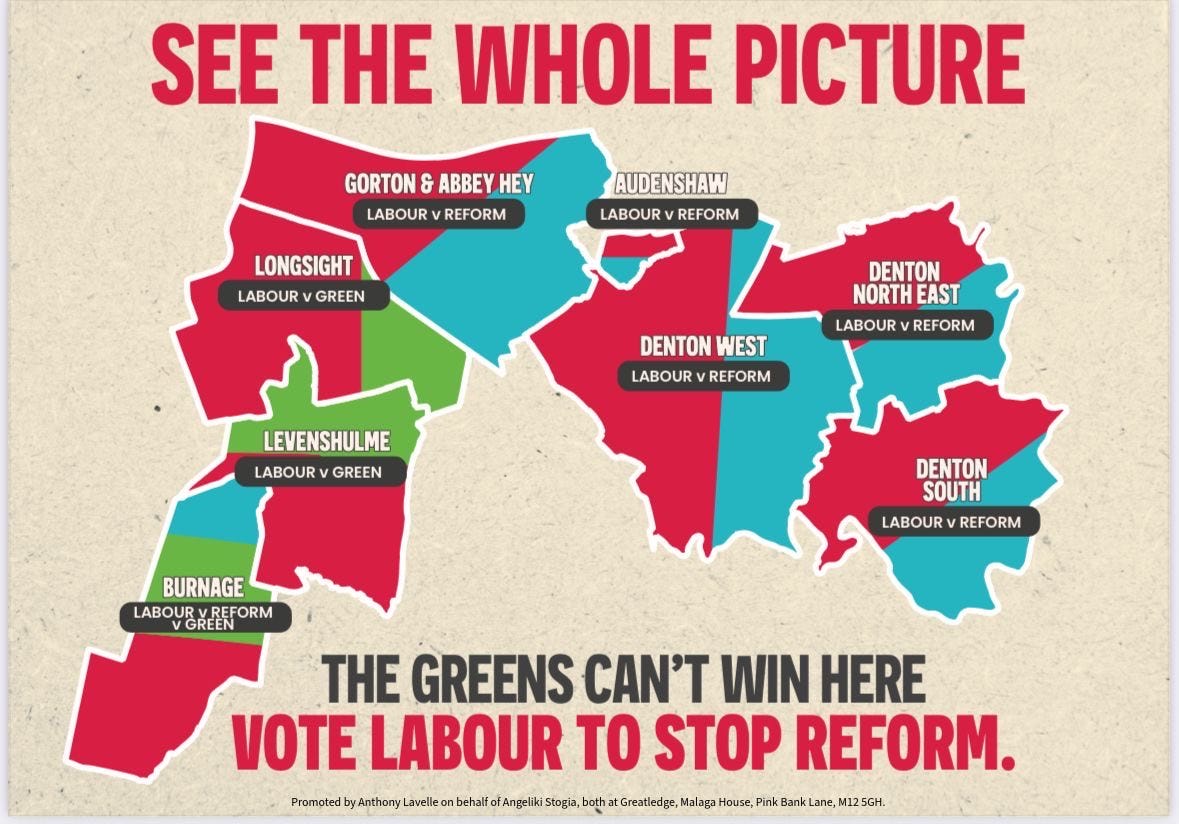
And as the campaign builds to its furious finale, the relentless leaflet wars have continued. The Greens now have new weapons to deploy, as one of the two recent polls (one allegedly sponsored by a former Green donor) shows them with a clear lead, while Labour still have to fall back on the highly dubious and now rather out of date FindOutNow poll, and statistical models of national polling, for their “winning here” bar charts. The paucity of pro-Labour data also seems to have driven a campaigning innovation, in the form of a psychadelic technicolour DreamMap which has appeared on leaflets and social media posts, under the title “See the Whole Picture”:
All clear?
I’m really not sure what a voter is supposed to do with this dayglo patchwork quilt. Are we supposed to conclude that Labour are in the running in every ward, because every ward has a red patch? How do all these patches relate to actual voting numbers, and how were these numbers gathered anyway, and by who? We aren’t told, and with absolutely no information about the underlying data driving the map, this is little more than an exercise in colouring in, or perhaps the starting point for a debate about the role of abstract art in modern election campaigning:
But is it art?
Both constituency polls should be treated with a large pinch of salt - seat polling is hard, and doubly so in a seat with large numbers of residents from hard to poll groups such as Muslims and students. But both polls are painting the same picture of the race - a tight three way race with the Greens, crucially, more attractive to tactical anti-Reform voters. Voters eager to back the strongest anti-Reform candidate have therefore been sent a clear signal that the Green candidate is better placed now, and more likely to pick up further support.
While both polls show a statistical tie with more than enough undecided voters to swing the contest to any of the three front runners, and both polls could prove to be wrong due to poor samples or random error, this consistent late signal - reinforced by tactical voting websites - could yet provide decisive in a seat which from the start has looked likely to turn on whether one of the left leaning parties could persuade the larger left bloc of voters to coalesce behind their candidate. These polls have provided the Greens with a valuable late campaigning tool, made life even harder for a Labour party running against the national tide, and may make the even three way split they have revealed a little less likely to manifest on Friday morning.
Three Friday morning stories
In his excellent book '“Everything is Obvious (Once You Know the Answer), Duncan Watts tells us the story of a cunning trick that the early social scientist Paul Lazarsfeld played on the bureaucrats who had funded his pioneering study of the US army.1 He gave them a list of six key findings from the study - for example “men from rural backgrounds were usually in better spirits during their Army life than those from urban backgrounds.” Those he presented to immediately came up with plenty of reasons why this was obvious - rural men would be more used to outdoors life and manual labour, so obviously they would adapt to army life better. Each of the findings was summarily declared to be common sense - “why are we paying all this money when the answers are so simple?”
But then came the kicker: Lazarsfeld revealed that the true findings for the study were in fact the opposite to those he had just presented - city men, for example, adapted more easily to army life. And, when this was pointed out, his audience would immediately come up with simple common sense narratives to explain these new findings - city men were used to working in large organisations, to chains of command, strictly defined roles and so on. Two sets of results producing two mutually exclusive sets of “common sense” explanation. Hence Watts’ title - everything looks “obvious” to us once we know the answer, but before we do, several different “common sense” explanations hover in the wings, waiting for their curtain call.
This by-election is a bit like that famous early experiment - once we know the result on Frday morning, the likely explanations will come straight into view, and the equally plausible alternative narratives for alternative results will be swiftly forgotten. But we should remember what Lazarsfeld’s cautionary tale hints at - if one of the parties prevails by a few percentage points, that doesn’t make their tale of triumph the whole and obvious truth. A tight three way split in the vote means each of the three parties has achieved something. While only one will win, and hence frame the official narrative of Friday’s, the electoral achievements of each party will still matter, and may change the story in elections to come.
Here are three different tales of by-election victory that could unfold on Friday morning, each drawing on parallels from recent electoral history.
Labour’s Tale: Red Eastleigh
Eastleigh looked like a very tough seat to defend for the Liberal Democrats in 2013. The party’s national polling had collapsed, as the third party many had backed as an anti-Conservative option bore the brunt of voter anger at the Coalition government. With national polling in free fall and a deeply unpopular leader, the last thing the party needed was a by-election triggered by local scandal in a traditional stronghold. When Liberal Democrat Chris Huhne resigned in 2013, after pleading guilty of lying to police to avoid a speeding ticket, many thought the Lib Dems would be certain to lose his Eastleigh seat, which looked likely to provide the rising UK Independence Party with its first ever MP.
But the Lib Dems, having first gained the seat in a famous by-election upset twenty years ago, had built a powerful local stronghold in the area. Their dominance of the local council, with 40 of 44 seats, had been undented by Coalition, and they were confident that they had by far the strongest local organisation and intelligence. And so it proved - though the UKIP vote surged, the Conservative vote refused to be squeezed and the Lib Dems were able to hold on in a fragmented contest despite a large fall in their local vote, winning the seat with just 32% of the vote.
Eastleigh results 2010 general election and 2013 by-election
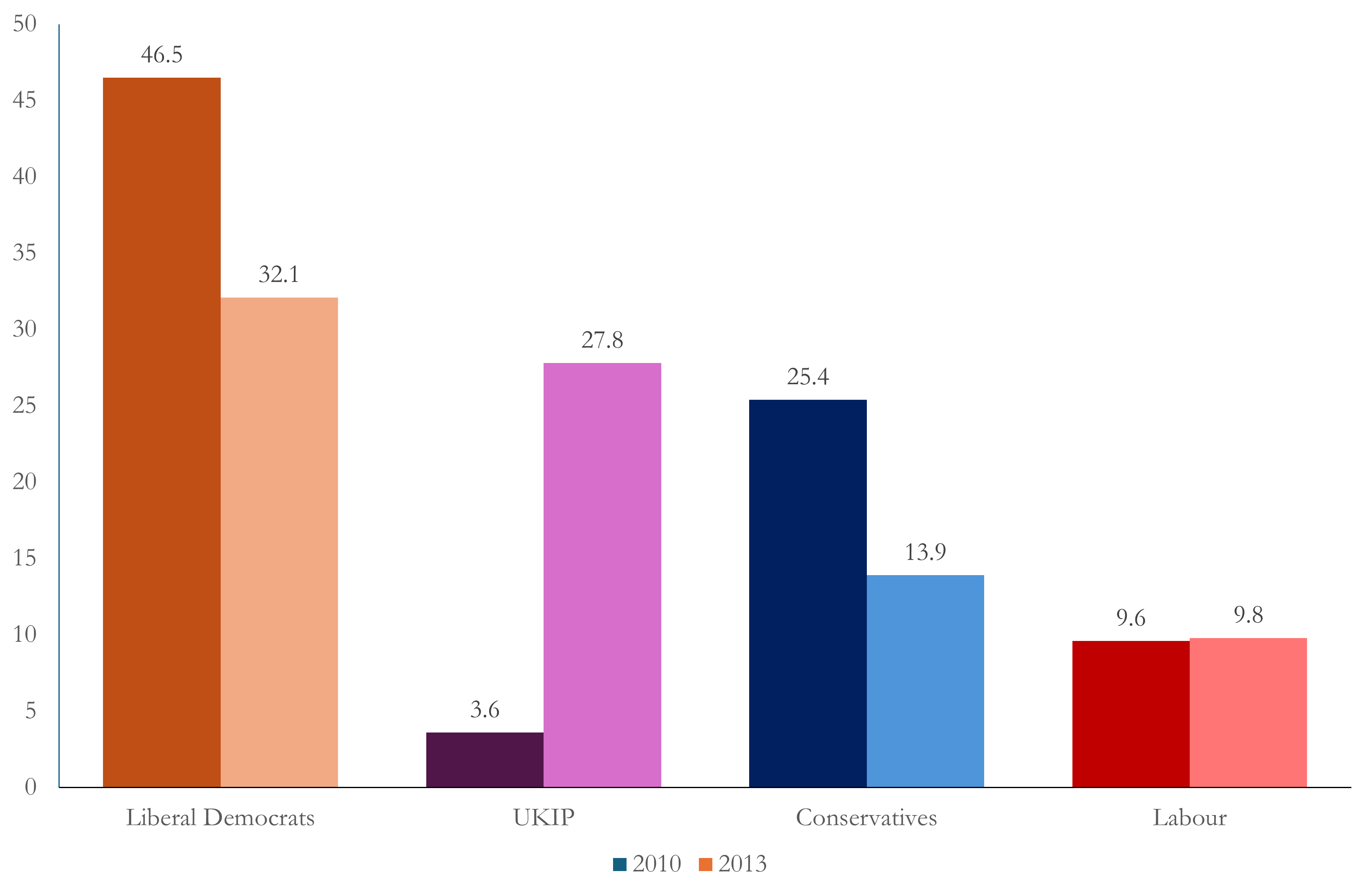
Gorton and Denton also features an embattled incumbent from an unpopular governing party, looking to rely on deep reserves of local strength, and divided local opposition, to hold off a voter backlash and a surging radical right. If Labour hold on this week the result will likely look like Eastleigh a decade ago - a big drop in the local vote, to the low 30s or below, but with the resilience of the local brand and local party organisation proving sufficient to narrowly prevail against divided and disorganised opponents. In Gorton and Denton, as in Eastleigh, the threat of a radical right victory may help to rally support for beleagured incumbent if voters unhappy with Labour’s national record decide a Reform MP would be even worse.
But if Labour emerge triumphant from the count on Friday morning, they should remember the sting in the Eastleigh tail - a split opposition and the spectre of a UKIP win were enough to hold on in 2013, but defeat came soon after in the general election two years later, as local voters decided that UKIP were no longer a threat and decamped en masse to the Conservatives. The Liberal Democrats would not recover Eastleigh until 2024, despite continuing to dominate every local council election in the seat.
The Greens’ Tale: Caerphilly Revisited
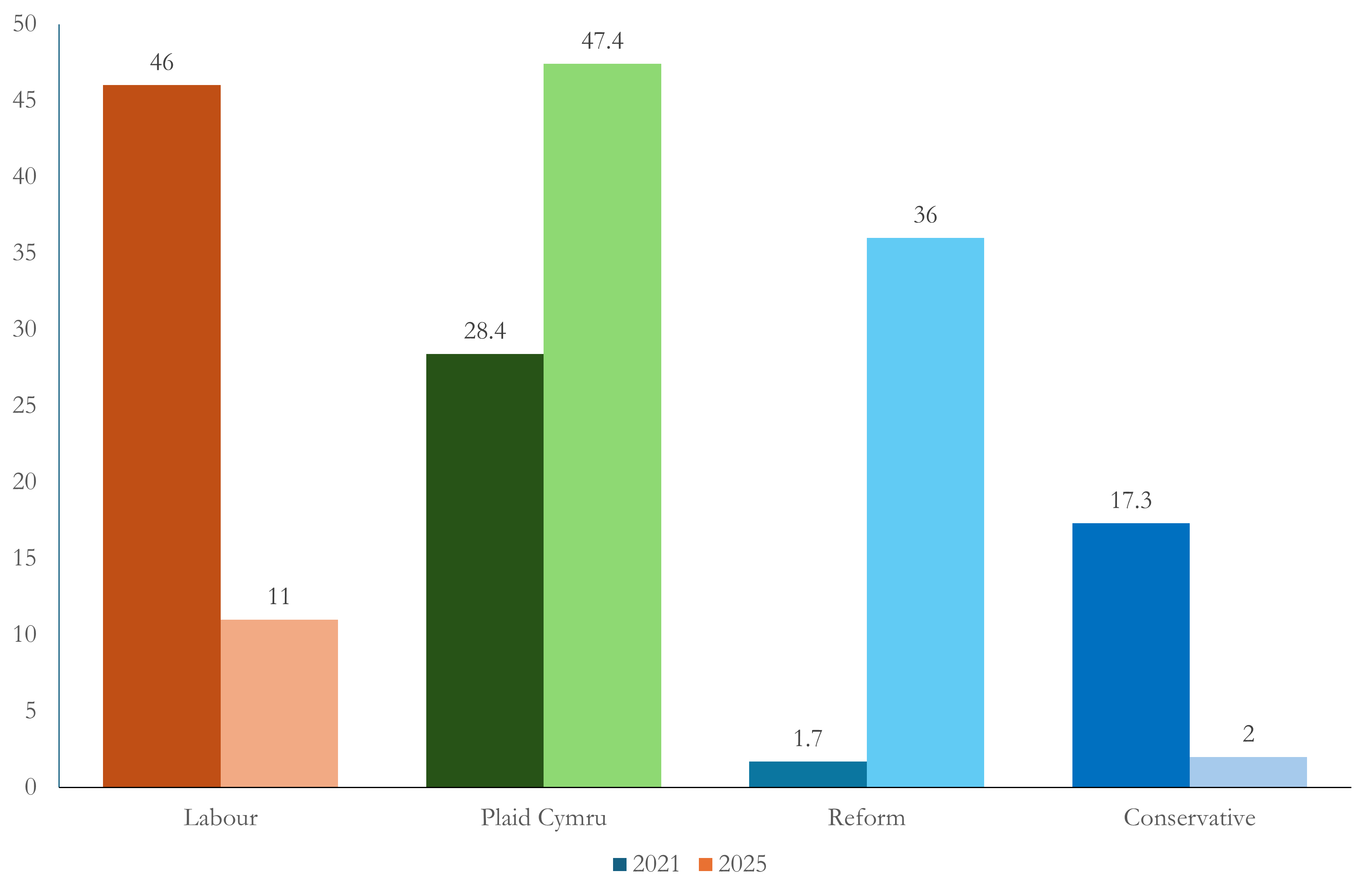
The Greens’ tale of victory will likely draw inspiration from a much more recent result. Last autumn, Plaid Cymru ended over a century of Labour dominance in Caerphilly by narrowly beating Reform, with the incumbent falling to third place. Labour had worked aggressively to frame a vote for Plaid as risking a Reform win, telling Caerphilly votes endlessly “Only Labour Can Beat Reform”. Yet while many local voters did want to prevent a Reform victory, this message fell on deaf ears, as votes decided that Plaid were in fact the more credible local option, as well as the best vehicle for registering progressive discontent with Welsh and Westminster Labour administrations. The anti-Reform vote did indeed coalesce, but tactical voting, along with negative messaging, proved Labour’s undoing.
Caerphilly results 2021 Senedd election and 2025 by-election
If the Greens win on Friday, this is the tale they will tell: “When Labour tell you they are the only party who can stop Reform, don’t believe a word of it. Labour tried that in Wales, and lost. They tried that in Manchester, and lost. They are finished. The Greens are now the true voice of the left and the best anti-Reform choice.” This is a message which will resonate in many wards and constituencies in the big cities of England - from Manchester, Birmingham, Bristol, London and many others - where Green friendly demographic groups cluster together, and the Greens often have more local organisation and electoral presence than they did in Gorton and Denton. The Greens will look to use this win as a springboard to even greater success in May’s local and devolved elections, and to cement their credentials as a genuine national competitor to Labour on the left.
But there is a sting in the tail here too. The Greens’ vote does indeed cluster heavily, which makes them a credible threat in a minority of mostly safe Labour areas. But that clustering in turn means that in most seats, most of the time, the Greens are not in all likelihood the most viable anti-Reform option. If their supporters decide Gorton and Denton sends a signal that they no longer need to compromise or vote tactically, then that in turn could enable Reform candidates to win elsewhere on divided left votes, just as Labour claim. In last year’s Runcorn and Helsby by-election for example, the Greens won over 7% of the vote, up substantially on the general election, in a seat Reform won by 6 votes. If even a small fraction of those voters had backed Labour, Reform would have been defeated. A Gorton win may bring more Green victories in deeply red Labour territory, but it also risks more Runcorns, with a split vote letting Reform through, in more socially mixed areas where the Greens lack critical mass.
Reform’s Tale: Peterborough (Reversed)
If Reform emerge triumphant this Friday morning it will almost certainly be thanks to an even split in the much larger local anti-Reform vote. Farage and some of his veteran advisors may remember when a similar scenario played out in reverse in the dog days of the Theresa May government in 2019, when the conviction of Peterborough Labour MP Fiona Onasanya for perverting the course of justice triggered a recall petition and a by-election in the 62% Leave voting marginal seat, just a few months after Farage had launched his new outfit The Brexit Party.
The by-election was slated for 6th June, just a fortnight after the final and largely pointless European Parliament elections, which Britain was obliged to hold after efforts to secure a Brexit deal had once again been delayed, and which Farage’s brand new party won handily. The Brexit party was running in a Brexit seat in a Brexit crisis after winning a Brexit election - this, surely, would be an easy further win for Farage, and one that would prove his new party was a clear and credible threat in Westminster elections.
Peterborough results 2017 general election and 2019 by-election
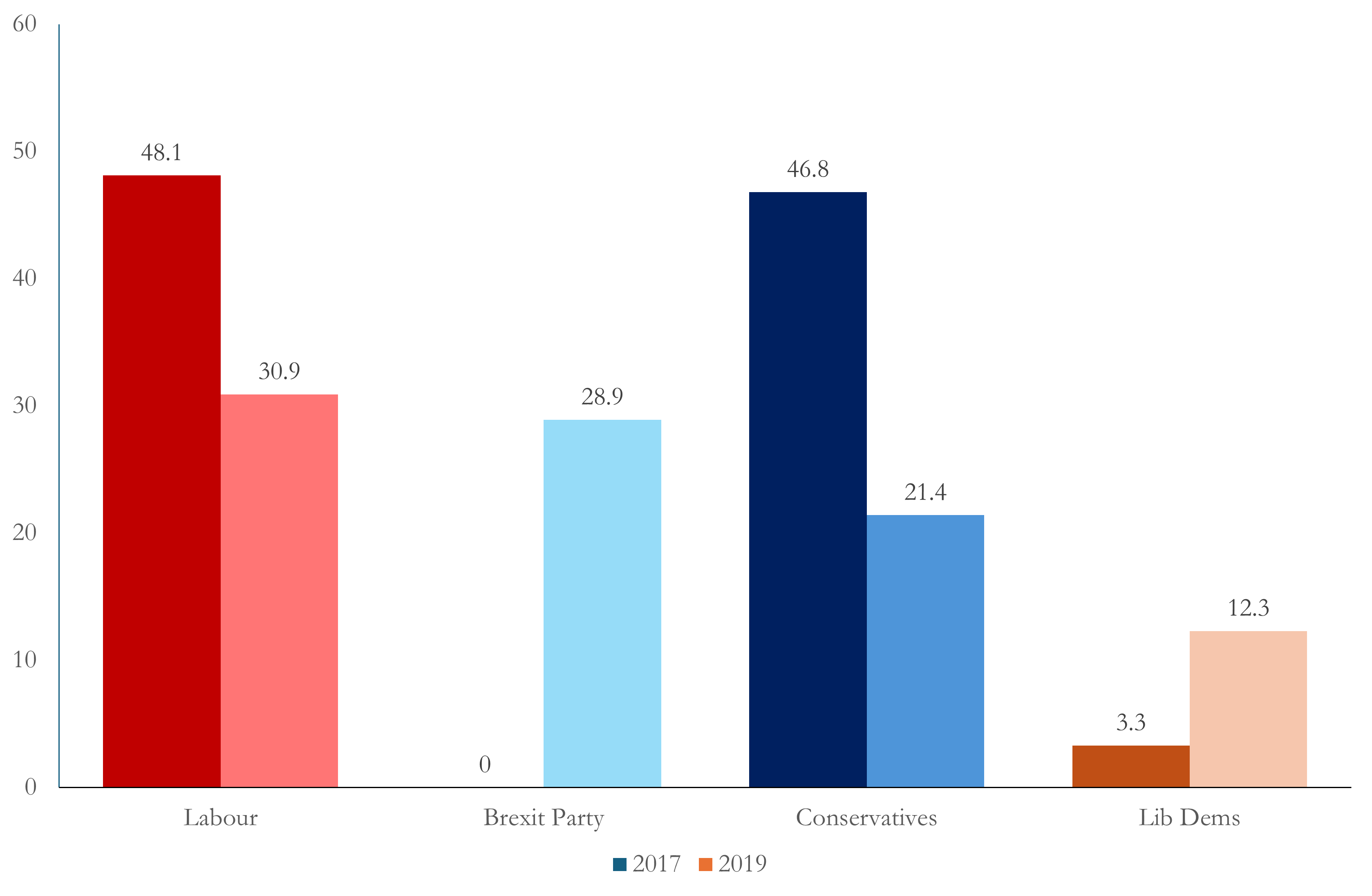
But it was not to be. Though the Brexit Party won 29% from a standing start2, and the Conservative vote slumped by 25 points, the radical new insurgent couldn’t squeeze the establishment right quite enough to win. So Corbyn’s Labour held on, with just 31% of the vote, even as more than half of local voters backed one of two strongly pro-Brexit parties.3 The reprive didn’t last though - when Peterborough voted again six months later, the now Johnson led “Get Brexit Done” Conservatives won the seat back with 47%, with the Brexit Party polling just 4%.
A Reform win in Gorton and Denton may, like Peterborough’s Labour win, prove the fleeting consequence of a freakish divide in the opposition vote. But Reform won’t mind that one bit, and with good reason. A Reform win this Friday would be a remarkable achievement, regardless of the circumstances that bring it about. This is a seat where Reform have no business even being in contention, and where none of Farage’s predecessor parties have ever been in the running. Returning an MP for such an area would be the strongest signal yet that his latest organisation is a serious and credible contender for a Westminster majority.
Slide Away?
Whoever wins on Friday, the result is likely to confirm a number of trends. Labour are sinking, populist parties are rising on the right and on the left, and as those parties are becoming viable and competitive in ever more seats, elections are becoming even more unpredictable. Prospects have never looked bleaker for the mainstream parties who have dominated British politics for so long - both may soon fall out of the top two in national polling, both face annihilation in the May local and devolved elections, and as the tide of revolt rises everywhere there are no safe seats left for either party’s MPs or local councillors.
The simultaneous collapse of both mainstream parties and the reshaping of our political landscape is unprecedented in living memory but it was not impossible to forsee. In 2020, Maria Sobolewska and I set out three scenarios for how politics might develop in the 2020s in our book “Brexitland”.4 Here is how we described the ‘replacement’ scenario:
“The final scenario, replacement, would kick in if the traditional governing parties prove unable to accommodate or resolve identity conflicts. If they fail, one or both could die off as voters shift en masse to parties better able to reflect their concerns. While the disappearance of established parties is a rare event in mature democracies, it is by no means unknown, and collapse can be swift when it comes…
The sudden disappearance of a governing party could be enabled by the peculiar incentives of the British ‘winner takes all’ electoral system. Voters are reluctant to back upstart parties even when they prefer them, because they fear such parties cannot win locally…In normal political circumstances, this tendency promotes political stability, protecting the traditional parties and suppressing support for newcomers. But if an upstart party manages to overtake one of the established parties in polls or election contest, this can set off a feeback loop as voters start to believe the insurgent is now a viable alternative and they no longer have to accept second best.
We can think of this as an electoral ‘Tinkerbell effect’ - if people believe new parties can win, that belief can become self-fulfilling. If people cease to believe the old parties are unbeatable, this can make them beatable.”
Whichever party emerges victorious on Friday, we may come to see this as the day Labour’s electoral Tinkerbell dies. And if voters’ beliefs about who can and cannot win are changed by this weeks events, then the pace of change may be about to accelerate once again. Hold on to your hats.
And finally…
I wanted to given the last word to Burnage’s most famous sons. At the MEN hustings several of the candidates scandalously could not name their favourite Oasis song, or gave obviously bad answers.5 Your own correspondent has no such hesitation6 in recommending this all time banger: enjoy!
There are many places that I wish to go…But everything’s depending on the way the wind may blow
I once played in a cricket team with Watts while a PhD student, when he was using a visiting fellowship at my college to write a book about “why common sense is wrong”. Being an Australian he was insanely competitive on the pitch and incredibly nice off the pitch. He’s a brilliant researcher who built a mathematical theory of the popular “six degrees of separation” notion, and his book is really excellent - full of counter-intuitive ideas and fascinating stories.
This remains the second best by-election vote share by the Brexit Party or Reform to date, after their win. UKIP did better three times - Clacton 2014 (59.7%, won), Rochester & Strood 2014 (42.1%, won), Heywood & Middleton 2014 (38.7%, second to Labour).
Labour’s 30.9% winning share was the lowest in a by-election since 1946, and the second lowest in a universal franchise election behind 30.0% in the Combined Universities election of that year. Both of those records could fall this week.
Two of them said Definitely Maybe, which is their best album but it isn’t a song, and the Green candidate said she preferred the Stone Roses (a Man United band FFS!). In a rare moment of Red-Teal unity both the Labour and Reform candidates said “Supersonic”, which is a decent track but wouldn’t make my top five.
Not entirely true - I was between this and Slide Away, which is also an all time banger.
Only tangentially relevant, but: the Eastleigh by-election was one of those interesting turning points of political history. As I recall, Nick Clegg later said that if the Lib Dems had lost the seat, he would have resigned as leader. Similarly, Keir Starmer considered his position after Labour actually did lose the 2021 Hartlepool by-election. In both cases, one wonders what would have happened next if they had gone…
I'm not sure I'd call Caerphilly a "narrow win". Plaid got 47% of the vote, versus 36% for Reform and ended up with a 3,800 majority.
As a LibDem who was involved in the Eastleigh byelection ("We like Mike!"), we were concerned that UKIP might win. From my door knocking there I'd say that Chris Huhne's very good reputation as a hard working constituency MP also helped.