
Gorton & Denton update 2: Leaflet wars
I'm sorry but I just don't know, I know you said I told you so

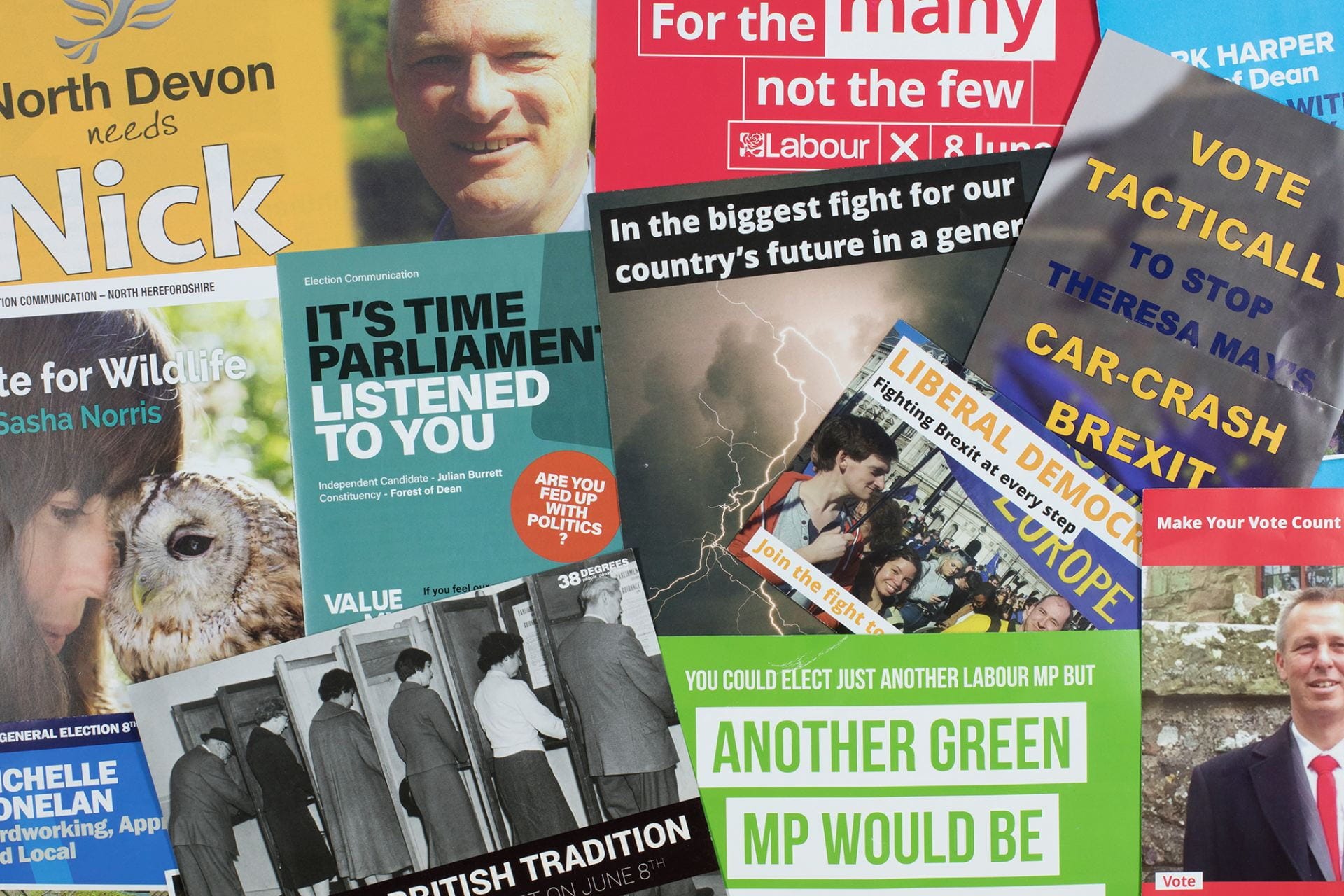
Consider the leaflet. A5 fragments of political ephemera, all following the same basic form, yet each with subtle variations making it unique. Electoral snowflakes. And, like snowflakes, predictable changes in the local climate stimulate their arrival in great blizzards. The leaflet is far and away the most popular medium for local election campaigning. This is logical - pushing leaflets through doors (or sending them via post) is a much quicker and cheaper way to reach a voter than trying to contact them by any other means. Every party therefore embraces the leaflet with great enthusiasm, and, as the table below confirms, far more voters report receiving party leaflets than ever get a phone call, an email or a chance to offer a “great reaction on the doorstep” to a party canvasser.
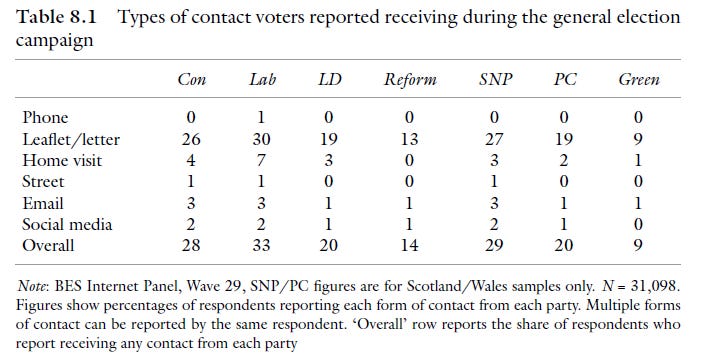
Source: “The British General Election of 2024”, chapter 8
The leaflet is the footsoldier of any election campaign - a cheap and expendable resource all parties fling at every contest, in the hope of achieving some advantage through sheer weight of numbers. A brief glance at a glossy scrap of paper fished from a pile of pizza menus before it is dumped in the recycling bin is, for many citizens their first, last, and only point of contact with the political parties campaigning for their vote. While few leaflets are read, and fewer still change minds, this is a numbers game: even if one leaflet in a thousand strikes a chord, the campaign has done its job.
The leaflets from any campaign tell us a lot about how the parties seek to present themselves and make their case, in a medium which we know reaches more voters than most. One of the most fascinating data gathering exercises in British politics research is therefore the OpenElections project, a collaboration between academics at the Univeristy of Nottingham and the organisation Democracy Club which has already compiled an archive of tens of thousands of election leaflets. If you have received a leaflet want to add to this wonderful electoral history resource, you can upload it here.

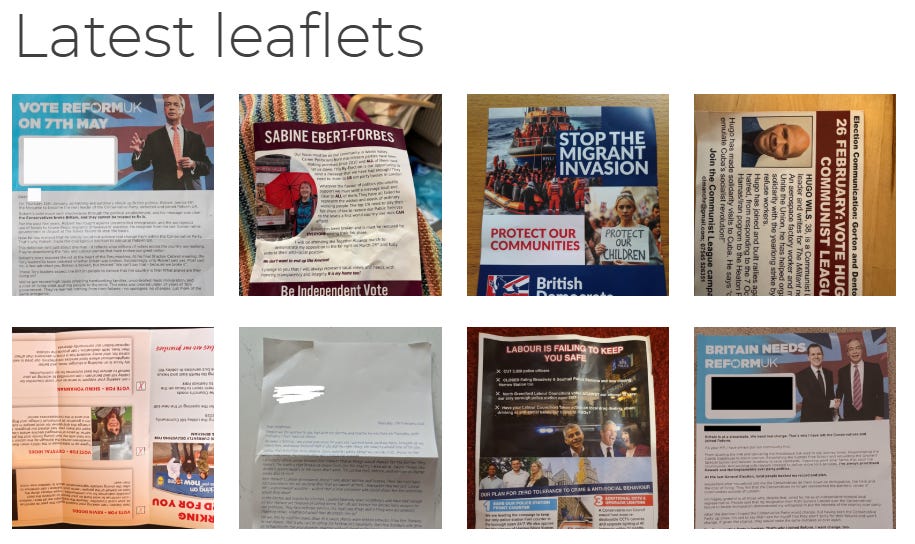
With three parties in the running in Gorton and Denton and the result very much in doubt, a furious leaflet war is now in full swing. With everything to play for, each of the three front runners been pushing the envelope (literally and metaphorically) with letterbox material of dubious veracity (and in one case dubious legality). All par for the course in a tight race where voters often have little to go on.
Leaflets can, and should, inform voters and invigorate local democratic competition. But they need to abide by the legal rules of the game and, ideally, also by the “spirit of cricket” - sticking to the intended goals of the rule makers, not just the letter of the law. We are barely halfway through this by-election contest and already one main contender has broken the letter of the law, while another has violated the spirit of the rules, in a leaflet which quotes from this very Substack. I expected casualties in the leaflet wars. I didn’t expect one of them to be me.
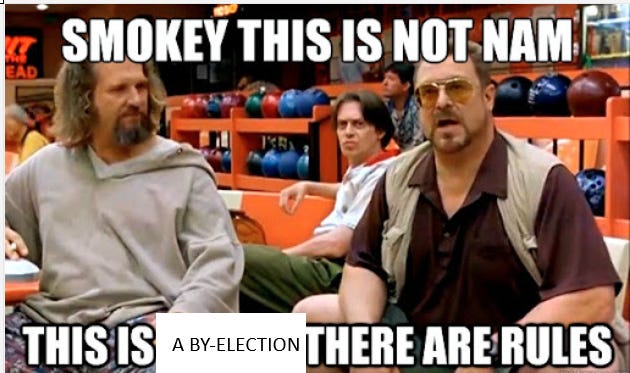
This leaflet aggression will not stand, man.
Leaflet Wars Episode I: The Phantom Menace
Reform kicked off the first leaflet controversy, when residents of Denton what appeared to be a hand written note from a concerned local pensioner, Patricia Clegg, setting out why she once voted Labour but was now considering Reform, based on arguments which suggested detailed knowledge of both parties’ recent policy choices, and which bore a remarkably close resemblance to Reform’s recent talking points (including the questionable claim that Matthew Goodwin, who studied in Salford but spent his childhood in St Albans, “grew up in Manchester”).
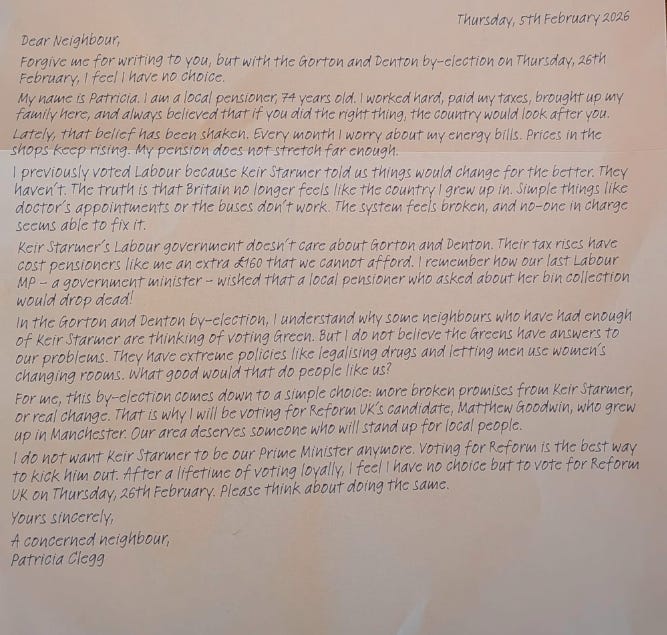
Patricia Clegg: Denton’s most politically well informed pensioner?
So far, so normal - apparently hand written neighbour notes like this are pretty common. I have received many from the local Liberal Democrats in council elections, for example. They are a symptom of our anti-political times. Voters don’t trust or engage with anything that looks like it has come from a political party, so the parties sometimes resort to a design which looks handwritten in the vain hope that voters, mistaking this for a genuine neighbourly communication, may at least scan it and pick up some information before chucking it in the bin. As always with leaflets, it is a numbers game - even a few seconds spent taking in some party messages before the deception becomes obvious can make the effort at camouflage worthwhile.
But eagle eyed Gorton and Denton voters familiar with electoral law noticed a problem with this Reform leaflet beyond its misleading formatting: there was literally no way for a voter reading it to know it was a political leaflet or that it had come from Reform UK. And that made Patricia’s ‘hand written note’ a big problem for Matthew Goodwin and his party. Under the Representation of the People Act 1983, “any material which can reasonably be regarded as intended to promote or procure the election of a candidate” must provide details of who printed the document, and details of the party and candidate involved. Patricia’s neighbourly note had none of these details, meaning that, as the Manchester Mill first reported, “Reform UK just broke electoral law in Gorton & Denton”.
You’re not wrong Walter
After a few hours of confused silence (and presumably some frantic backstage activity), Hardings, the printers responsible for the leaflet, announced the law breaking leaflet was due to an (unspecified) “error” for which they “took full responsibility”. But this raises more questions than it answers, suggesting this story may have some way to run yet.
Hardings are not novices when it comes to elections and leaflets - as the Manchester Mill reported this week they have producing leaflets for Reform since at least 2024, including a large amount of general election material, and very similar ‘handwritten notes’ from ‘Andrew Russell’ distributed to residents during the Caerphilly by-election campaign last autumn. Those leaflets, though, had the full legally required ‘imprint’ material at the bottom. It does seem a remarkable coincidence that a printer with long experience of producing legally compliant leaflets should choose to drop only the material required for legal compliance between approval and printing, in a campaign featuring a novice candidate with no experience of elections law.
If the materials sent by Reform UK to Hardings for printing, and the proofs they sent to Reform UK for approval before final print-off, were made public it would be straightforward to confirm when and where the error occurred, and who was ultimately responsible. I don’t know the details of electoral law - I’m a psephologist not a lawyer - but I would hope that those charged with enforcing it would see a public interest in establishing who failed in their legal obligations here and why, and would therefore use their powers to encourage (or compel) Reform UK and Hardings to publish these materials. If any lawyers reading the Swingometer happen to know what the rules are on all this, and what happens next, then do get in touch.
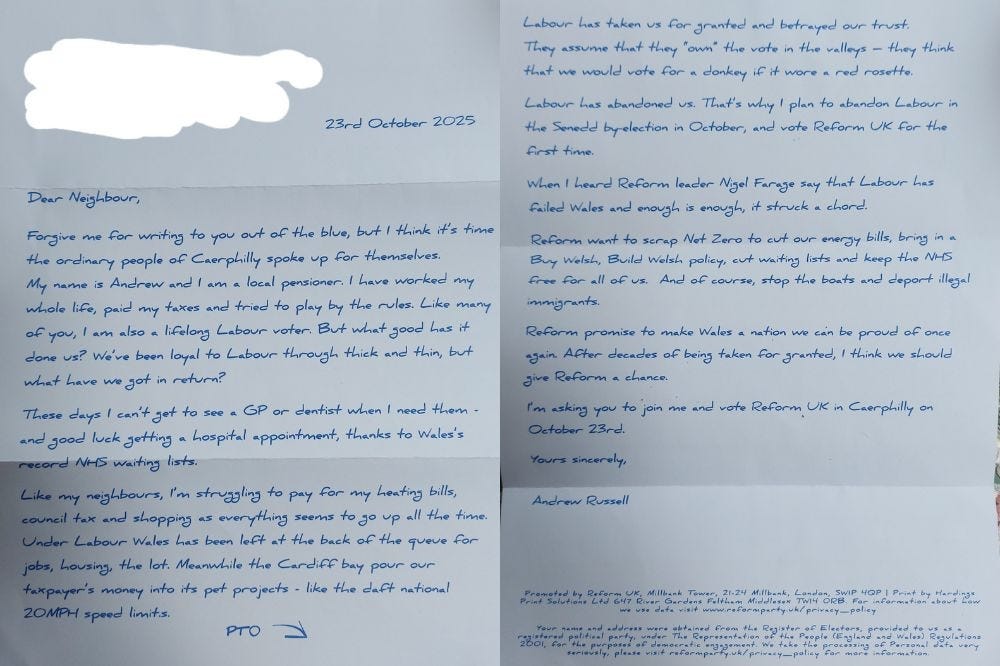
A ‘dear neighbour’ leaflet from ‘Andrew Russell’ delivered through Caerphilly letter boxes last October. But ‘Andrew Russell’ remembered his legal obligations (see the small print at the bottom of second page).
This story has one further amusing coda, also reported in the Mill. Patricia Clegg is, it turns out, a real 74 year old pensioner from the seat, and her son is not at all happy with Reform.1 Andrew Clegg, who describes himself as Mrs Clegg’s son, has been posting repeatedly on Reform candidate Matthew Goodwin’s facebook page saying his mum was being “hounded” following the distribution of a letter which she wrote but was “never signed off”. Reform’s treatment of his mother - “74 years old and shit on” has soured Andrew Clegg on the party - “I was a supporter and a fan…but now no more.” Perhaps the fake “dear neighbour” letter circulated on behalf of Mrs Clegg will be followed by a real “dear neighbour” letter from Mr Clegg?
Leaflet Wars 2: Attack of the Clones
As Swingometer readers will know, I love analysing elections. The demographic, political and social stories in play in every contest are so fascinating, and I enjoy helping others to understand the forces in play in a contest. What I didn’t expect, and have not enjoyed, is seeing that analysis ripped out of context and turned into a partisan weapon.
I am not a difficult person to find on or off social media, and I regularly talk to people from all the political parties as part of my work. So it came as quite a surprise when followers on BlueSky who live in Gorton and Denton started sending me pictures of Green leaflets they had received featuring my face and my words, under the headline “Everyone Agrees, Labour are Done”, and next to a deeply misleading graph I had already singled out for criticism on the Swingometer as a crime against data analysis. Have the Green campaign recruited me, and I am now endorsing their claims? Dear reader, they had not, and I do not.
No one from the local or national Green party contacted me about putting my face and words on their leaflets. That’s already a breach of the ‘spirit of cricket’ in my book even if it isn’t technically a breach of the rules. If you use someone’s face and words, and want to lean on their professional authority, its only right you contact them and clear it off with them. But that wasn’t the worst breach of trust for me. The Greens’ leaflet didn’t just use my words, it misrepresented my views. For starters, they labelled me as “the Experts” (sic) under the headline “Everyone agrees, Labour are done”. I’m glad they consider me an expert, but I certainly do not agree with that claim. The article I wrote - and they used - described Gorton and Denton as “a Labour leaning seat in a Labour leaning city in a Labour leaning region” and stated “we have a by-election where four different parties have a credible shot at victory.” One of those, as the article made abundently clear, was Labour.
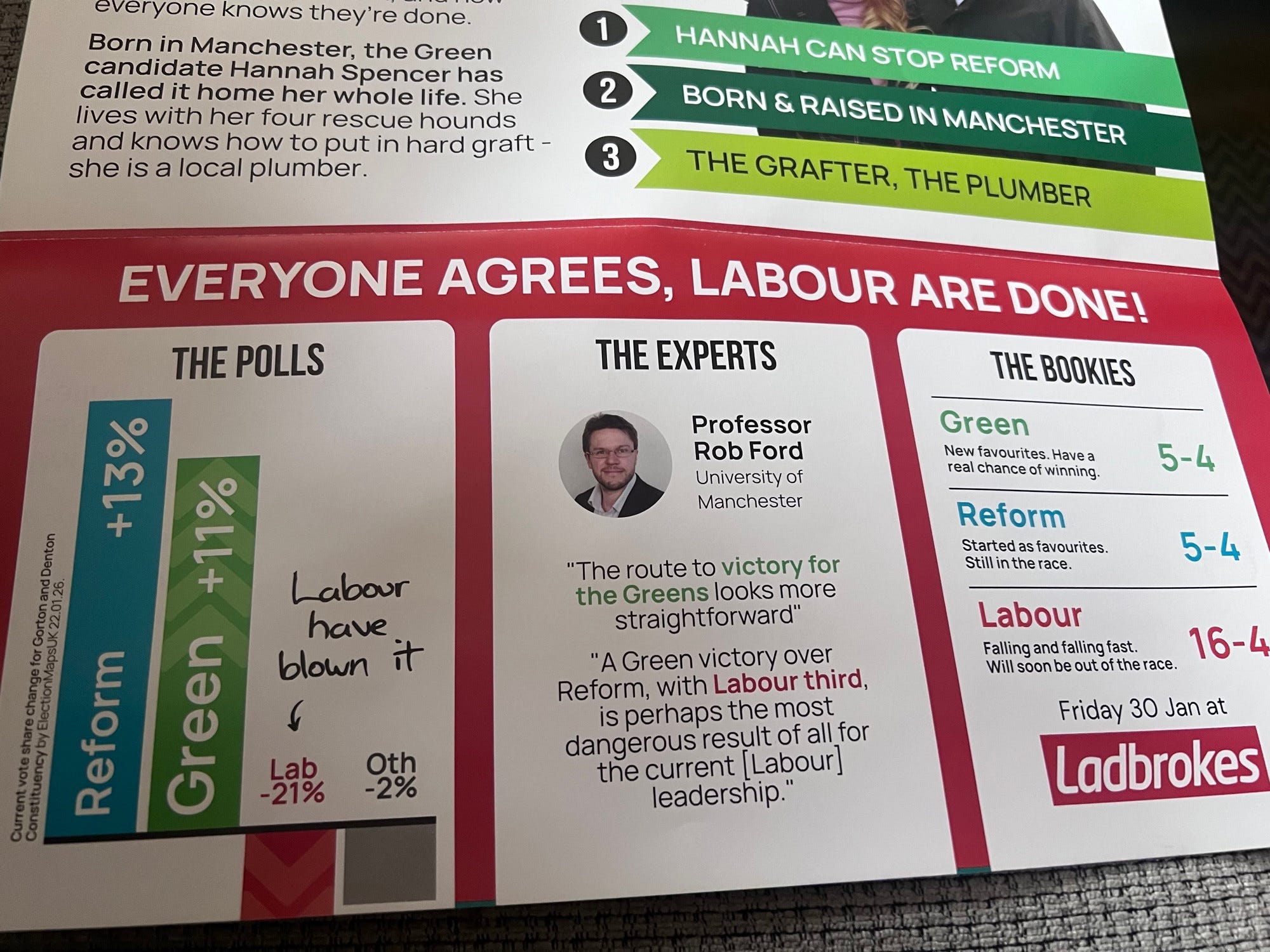
Professor Rob Ford does not, in fact, agree
But wait. It gets worse…The quote they used to justify the claim ‘Labour are Done!’ is as follows: “The route to victory for the Greens looks more straightforward”. Anyone reading this quote, under that heading, would assume I was saying the Green path to victory was more straightforward than Labour. But that’s not at all what I was saying, as becomes obvious is we restore the paragraph preceding that quote:
For the Workers Party the election seems to me a contest with little plausible upside. Of course, if they win it will be a huge story, but while Galloway’s outfits have delivered upsets before, the Muslim population does not look large or unified enough to make a win here plausible when another viable outlet for progressive discontent is available. The scenarios where they face criticism as spoilers look far more plausible than the scenarios where they win outright.
The route to victory for the Greens looks more straightforward - they are best placed to mobilise and unify the disparate voter groups unhappy with Labour in this seat, and if they can do so then a winning coalition is there for the taking. If the Greens achieved this it would simultaneously announce their arrival on the scene as a serious electoral force in Labour heartlands, and demonstrate that Labour’s Caerphilly collapse was not a one off.
I wasn’t saying a Green win was easier than a Labour win, as the leaflet suggests. I was saying a Green win was easier than a Workers Party win - something the latter party seemingly acknowledged days later when they withdrew from the race. Using my words without consulting me already violates the spirit of electoral cricket, but twisting my words like this is getting into Bodyline territory.
I was pretty miffed about all of this, and said so on social media, tagging in the national Greens accounts and the accounts of their local candidate. I also wrote to someone I knew in the national Green office who, to their credit, did respond quite quickly and promised that the local party had been told this was not on, and would not be using my face and name again. OK, I thought, I’m not delighted by what’s happened but at least that’s an end of it. So imagine my surprise a few day later to be sent an image of this…
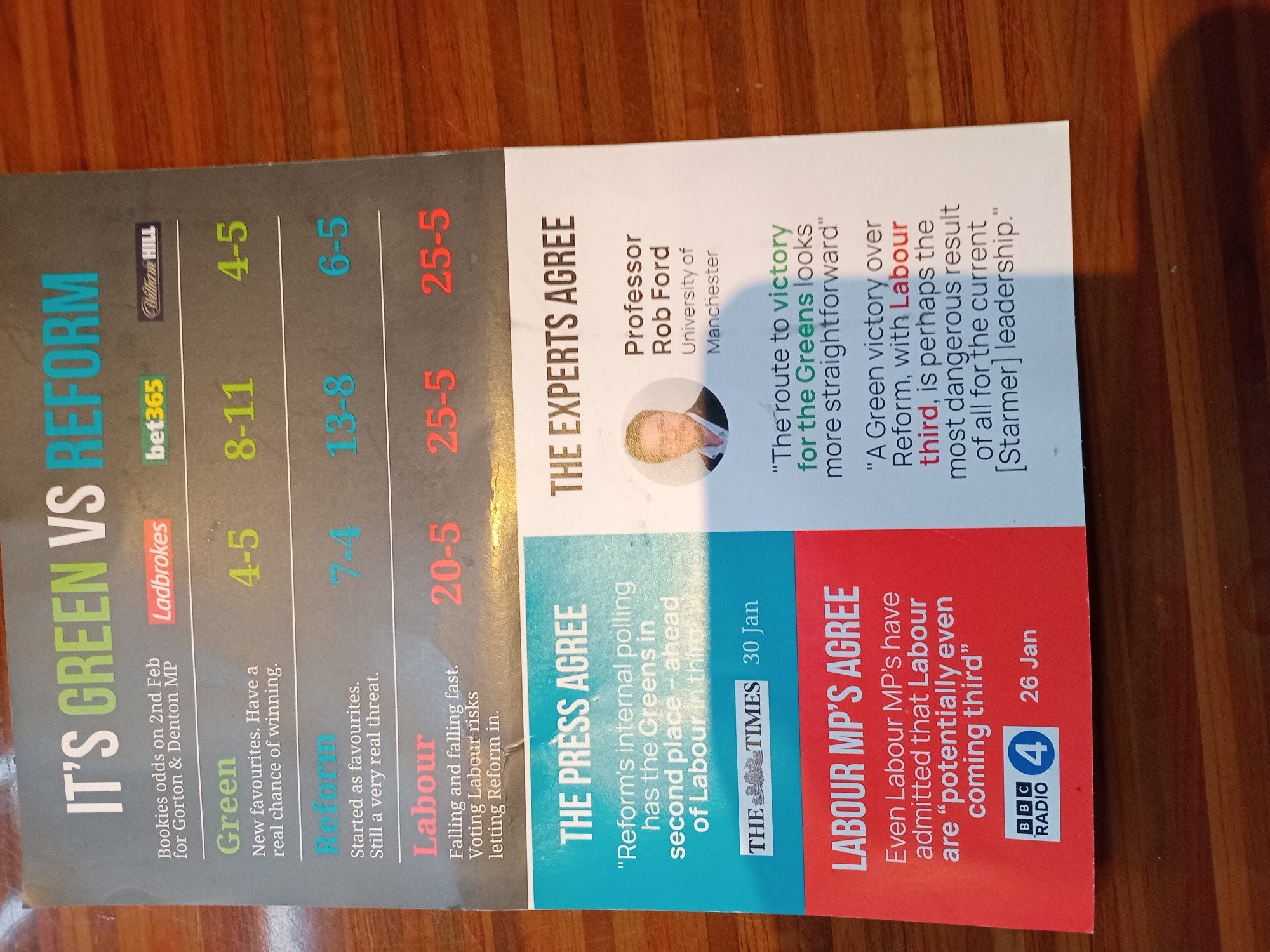
Somehow, the misleading quotes returned
Oh dear. My immediate reaction cannot be recorded on a family friendly Substack - but once I had taken a brisk walk around the block I reported the Greens to the Returning Officer for the election, who said that while they sympathised with my annoyance there’s nothing they could do. My correspondent at Green HQ was very apologetic, and said this second leaflet was part of the same print run, and must have been delivered by a rogue activist. Maybe that’s true, I have no way of knowing, but he and his party have not helped their case by failing to disclose the existence of a second leaflet when I first complained. The Greens talk a lot about wanting a more hopeful, less cynical politics. I’m all for that, but I don’t really think the way they have behaved over this is very consistent with that goal.2
That isn’t quite it for leaflets featuring your Swingometer correspondent though. Labour campaigners, having seen me fulminating about the Green leaflets on social media, then got in touch to ask whether they could use my posts on the whole affair in their leaflets. I wasn’t massively keen on this idea either - as a proudly objective and non-partisan analyst, I’d rather not be on anyone’s obviously partisan and not very analytical campaign material - but I felt it was reasonable of Labour to set the record straight given the Greens had apparently stuck their leaflet with my mug on it through thousands of letterboxes.
Thus it came to pass that my name appeared next to yet another dodgy graph - again one I’ve already critiqued on this Substack. I’m not sure this is quite within the spirit of cricket either, but Labour have at least presented my words in fair context, and they did ask me first, which is two points in their favour vs the Greens. But for the avoidance of doubt: that graph isn’t “The Truth” - it is total guff. It is not even a poll, it is from a statistical model. There are no reliable polls of the seat, and there aren’t likely to be.3 The statement “Every poll shows only Labour can beat Reform” is simply false. Lies in red are not, in my opinion, more informative or useful than lies in green.
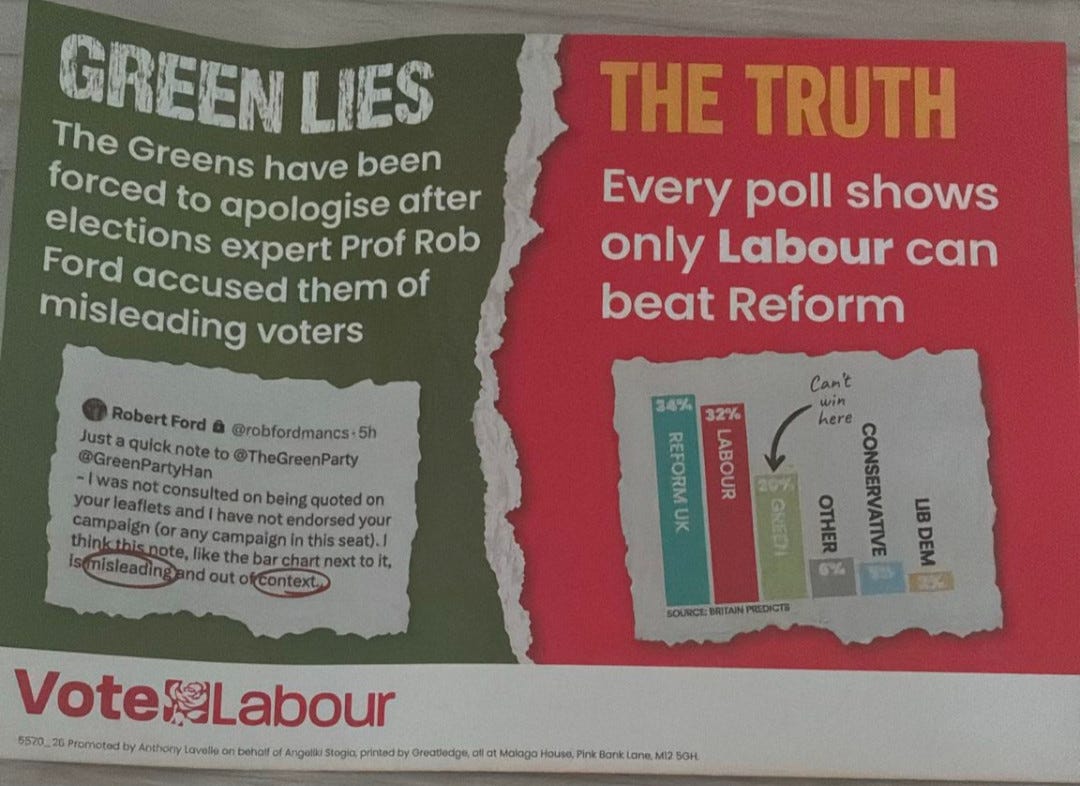
The Truth Is Out There (but that graph isn’t showing it)
What’s with all the Green-Labour leaflet beefing anyway?
The voters of Gorton and Denton may well be rather bemused about all the time and effort these two parties are spending (mis)informing them about the views of an obscure elections nerd from the neighbouring seat. Wouldn’t it be better for the parties to focus on what they have to offer, rather than torture data and commentary to make barely credible claims about the horse race?
I certainly sympathise with that view - and will be happy never to appear on anyone’s leaflets ever again - but I also understand how this odd state of affairs has come to pass. Both Labour leaning and Green leaning voters strongly prefer either party to Reform, and would very likely coalesce behind a left bloc front runner, if they knew for sure who that was. But they can’t, because there isn’t one. Both parties are therefore furiously posting leaflets into this information vacuum, but by doing so they only thicken the electoral fog of war that impedes their progress.
Labour claim that local electoral history, including the most recent local and general elections, make it obvious they are the strongest anti-Reform candidate. The Greens claim the Labour government’s national polling collapse, Keir Starmer’s toxicity, and the inherently Green friendly demographics of much of this seat, make it obvious that they are the strongest anti-Reform candidate. Both claims are plausible. They cannot both be true.
The risk for both parties, and the opportunity for the party they and their voters both oppose most, is that tactical co-ordination completely fails. Different voters believe each party, the larger left vote splits evenly, and Reform come through the middle. This, too, is a plausible scenario, but one that could only be averted if we had a genuinely authoritative source of information on who is ahead, or one of the two left contenders was willing to bow out to ensure Reform are defeated. We aren’t going to get authoritative information, because polling Muslims and highly mobile young people is expensive and very hard, and those groups are potentially decisive here. And I very much doubt we will see either Labour or the Greens back down in a seat both believe they can win, even though both claim preventing a Reform win is vitally important.
So I’m afraid the blizzard of dodgy claims will continue for another two weeks. My advice for neighbours in Gorton and Denton is don’t believe a word of it. Do your own research and back the candidate you believe is best for your values and your area. No one knows who’s going to win this seat. And that’s a beautiful thing for democracy in a long-safe seat where voters haven’t had a real and consequential choice to make for generations. The people decide: stick that on your leaflets!
Unlike ‘Andrew Russell’ the Labour voting pensioner from Caerphilly, who turned out not to be from Caerphilly and, judging by his photo, looks unlikely to be a pensioner either
I have still not had any contact at all from anyone in the local Green campaign.
Labour have also been heavily promoting the tiny sample size FindOutNow constituency poll with as evidence of their credentials - that isn’t reliable evidence either, as I and others recently told FullFact.org.
If you told someone in politics in 2016 that Rob Ford and Matt Goodwin would be play very prominent roles in a future by-election - they would correctly guess that Farage was doing well in the polls but would be surprised by the details!
Impact case study - done.